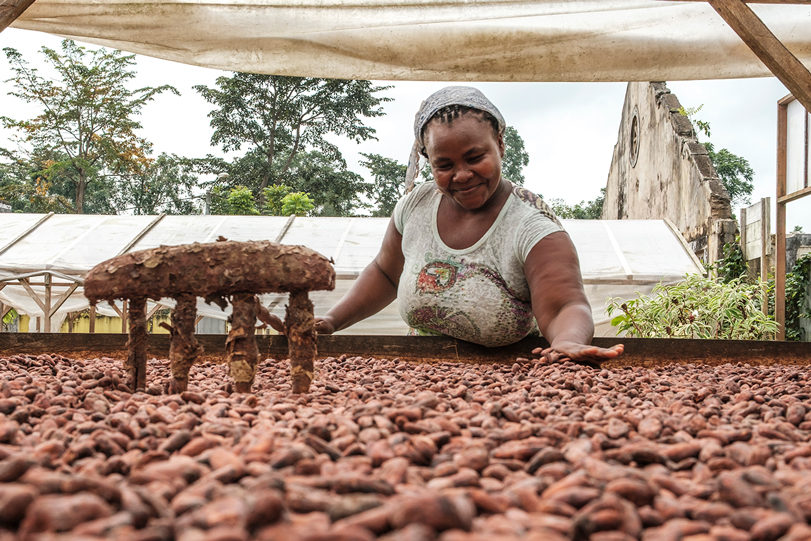
Lush with rainforests and cocoa plantations, the island country of Sao Tome and Principe is rich in biodiversity but faces increasing forest and land degradation due to agricultural expansion, changes in land use and the impacts of climate change. ©FAO/Eduardo Soteras
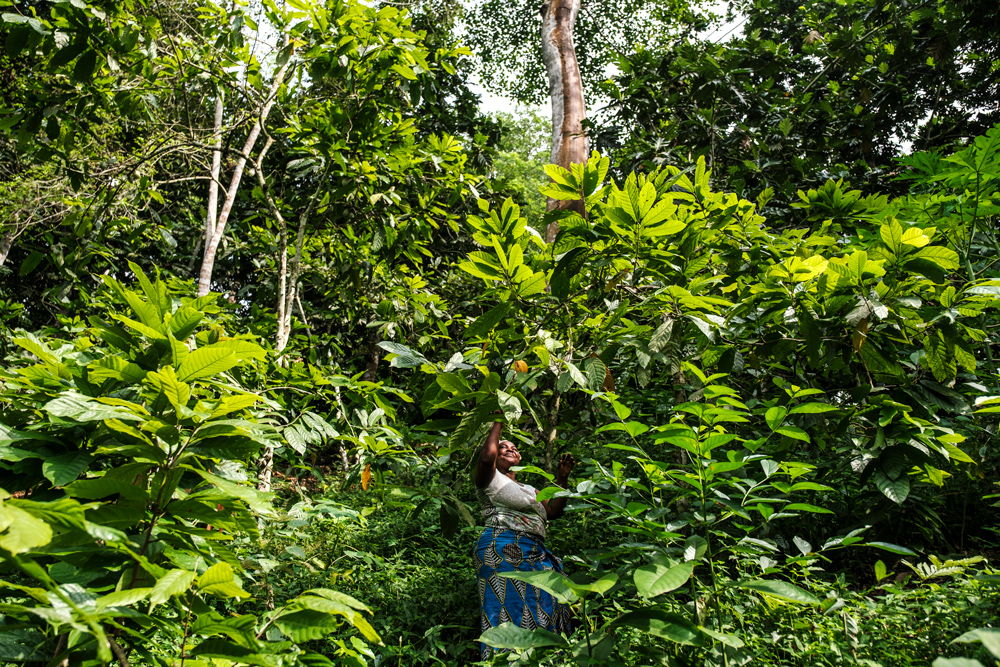
Sao Tome: The island of Sao Tome shimmers like a nugget of chocolate gold, its emerald rainforests and cocoa plantations glistening under the equatorial sun. Tucked off West Africa’s coast, this tiny nation hums with the rhythm of cocoa, its lifeblood and legacy. As dawn spills across Praia das Conchas Roça, children weave along sandy paths, their backpacks swaying as they head to school, hand in hand. Among them are the four children of Camila Varela De Carvalho, a 32-year-old cocoa farmer, and her four nephews, all raised under her steadfast care. As the children’s chatter fades, Camila’s day ignites. She grabs a bucket and her trusted harvesting tool—a wooden branch with a sharpened edge—and strides toward her cocoa farm, where the island’s golden promise takes root.
Among the cocoa trees, Camila moves with quiet precision, clearing branches and selecting a ripe pod, its vibrant shell a testament to the land’s bounty. With a small incision and a practised twist—a skill honed since she was eight—she splits it open, revealing white pulp-covered cocoa beans, the heart of her labour. These beans, destined to be dried, fermented, and transformed into chocolates, carry the weight of her family’s dreams and the community’s survival. “Cocoa makes a big difference in my life,” Camila says, her words grounded in purpose. “With the money from cocoa, I can buy fish and those things for the house we’re without.”
Life on this chocolate-gold island demands grit. Beyond her farm, Camila juggles three other jobs, while her husband takes on two. Her favourite is as a cocoa inspector at the Organic Cocoa Production and Export Cooperative (CECAB), where she weighs, selects, and stirs beans for drying, each task a thread in the island’s economic tapestry. Sao Tome and Principe, lush with biodiversity, faces mounting challenges—forest and land degradation from agricultural expansion, shifting land use, and climate change threaten its verdant heart. Yet, cocoa remains the island’s pulse, sustaining livelihoods and hope.
To safeguard this legacy, the Food and Agriculture Organization of the United Nations (FAO), alongside the International Union for Conservation of Nature, the United Nations Environment Programme, and the national government, launched The Restoration Initiative (TRI), funded by the Global Environment Facility (GEF). This project restores degraded forests while bolstering sustainable cocoa production, empowering farmers—especially women like Camila—with agroforestry techniques and organic and fair-trade certifications. “Before CECAB, we harvested cocoa, and tractors came to buy it,” Camila recalls. “When the tractor was full, they almost didn’t buy any cocoa. But now with CECAB, whenever you arrive, you can sell your cocoa.”
Since its founding in 2005, CECAB has grown into Sao Tome’s largest cooperative, uniting 37 producer groups and uplifting over 2,000 families. Camila’s cocoa earnings now cover her family’s essentials—food, education, and savings to last the year. Since 2019, TRI has restored over 8,000 hectares of agroforestry areas, with 3,500 farmers contributing, according to Faustino Oliveira, FAO’s national project coordinator. The goal is to restore 36,000 hectares—one-third of the country—by 2030. Nurseries across Sao Tome and Principe have produced over 240,980 seedlings of endemic fruit and tree species, planted in agroforestry plots, weaving sustainability into the island’s fabric.
In 2024, Sao Tome’s cocoa agroforestry system, centred on the unique Amelonado variety, was named a Globally Important Agricultural Heritage System (GIAHS), a nod to its cultural and ecological significance. For Camila, the island’s chocolate gold holds a sweeter ambition: crafting her own chocolates at CECAB’s factory, a pioneering venture ensuring farmers benefit across the cocoa value chain. “The transformation of their product into chocolate gives us enormous satisfaction,” says Antonia dos Lantos Neto, the factory’s manager. “It’s the first time the people of Sao Tome have their own factory.”
Camila has embraced CECAB’s entrepreneurship training, learning to use tablets for weighing and dispatching beans, undeterred by the male-dominated cocoa trade. Her message to fellow women farmers is fierce and clear: “Being a woman farmer means being a strong fighter. We must always continue to work to ensure there is never a shortage of products on the market. Not even at CECAB.” As the sun climbs higher over Sao Tome’s cocoa groves, Camila’s story unfolds—a testament to resilience, community, and the golden promise of an island where cocoa dreams take root.
Source: The FAO News and Media Office, Rome
– global bihari bureau