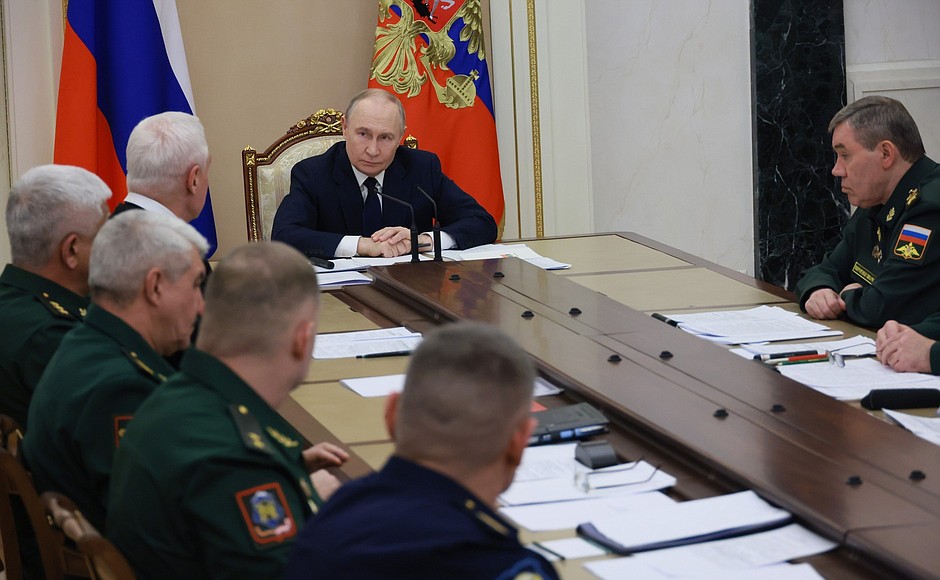
Russian President Vladimir Putin, chairs a meeting on the developments in the special military operation zone on December 29, 2025. Photo source: Kremlin
Drone Claim Fuels Tension, but Diplomacy Persists
Mar‑a‑Lago Peace Talks Continue as Tensions Flare in War
Moscow/Kyiv/Washington: Kyiv’s outright rejection of Russian claims that Ukrainian drones targeted the official residence of President Vladimir Putin has sharpened diplomatic tensions at a delicate moment in the peace process, with Moscow signalling a harder line even as talks brokered by the United States continue. The disputed incident, alleged by Russia to have occurred overnight between December 28 and 29, 2025, has emerged as a new fault line between the two sides, threatening to complicate efforts to build momentum towards ending the nearly four-year-old war.
Russia on December 30 doubled down on its accusation, with Foreign Minister Sergey Lavrov issuing a statement in Moscow describing the alleged drone barrage as a “terrorist attack” ordered by what he called the “Kiev regime.” Lavrov said the drones were aimed at the Russian President’s state residence in the Novgorod region and claimed that all were intercepted without casualties or damage. He thanked several foreign governments for condemning the alleged attack and framed it as further proof, in Moscow’s narrative, of Ukraine’s unwillingness to pursue peace. Lavrov’s statement, released on December 30, also broadened the charge into a wider political argument, questioning why NATO and European Union countries continued to press for security guarantees for Ukraine while, in Russia’s view, overlooking what it described as repeated attacks on civilian targets and political figures. The episode also recalls earlier unverified Russian claims, including a reported drone incident over the Kremlin in 2023, which similarly generated sharp diplomatic reactions without conclusive independent corroboration.
Ukraine has consistently denied the attack, with President Volodymyr Zelenskyy and Foreign Minister Andrii Sybiha characterising the claims as a “complete fabrication” intended to undermine the ongoing peace process. Multiple international open-source analysts and institutions, including the Institute for the Study of War and investigative media outlets, have found no evidence of the strike—no local reports of explosions, no debris, and no independent verification of drone activity over the presidential residence. The inconsistencies in Russian statements—Lavrov citing 91 drones while the Ministry of Defence offered lower figures—underscore the lack of verifiable facts and reinforce scepticism among external observers.
President Zelenskyy engaged in multiple phone calls on December 29 and 30 with global leaders, including US President Donald Trump, German Chancellor Friedrich Merz, Finnish President Alexander Stubb, and Latvian President Edgars Rinkēvičs. In these conversations, he categorically dismissed the alleged drone attack, emphasised Ukraine’s commitment to peace, and briefed the leaders on progress at the Mar-a-Lago talks. On December 28, Zelenskyy had met President Trump at Mar-a-Lago in Florida, where both sides discussed a 20-point framework for advancing peace. These discussions covered sequencing of security guarantees, monitoring arrangements, and working group follow-ups slated for early January. People familiar with the discussions said the framework under review includes provisions for phased demilitarised zones along active fronts, international monitoring arrangements potentially involving United Nations or European-led missions, sequencing of local elections in disputed areas under international supervision, and mechanisms linking sanctions relief to compliance benchmarks. The outline also touches on Ukraine’s longer-term integration with European institutions, while stopping short of any immediate NATO commitments. Officials cautioned that these elements remain conceptual and contingent, with no final language agreed and several politically sensitive points deliberately deferred to working-level negotiations.
President Trump’s reaction to the claims of a drone strike was one of outrage and disbelief during his December 29 call with President Putin. While characterising the allegation as “irrational” and “unimaginable,” he balanced condemnation with continued mediation, maintaining engagement to preserve momentum in the peace process. Diplomats say the immediate risk lies less in a collapse of talks than in retaliatory steps—rhetorical or military—that could harden positions before negotiations resume. Whether the current dispute leads to escalation or is absorbed into the diplomatic process may depend largely on Trump’s ability to maintain parallel pressure and engagement with both leaders in the weeks ahead.
Beyond the direct bilateral channels, Russian President Vladimir Putin spoke on December 30 with several regional leaders, including Masoud Pezeshkian, President of Iran, Kassym-Jomart Tokayev, President of Kazakhstan, and Shavkat Mirziyoyev, President of Uzbekistan. According to Kremlin readouts, the discussions included condemnation of the alleged attack, assurances of cooperation, and customary New Year greetings. Beyond these immediate regional partners, most major international actors have refrained from issuing formal condemnations of Ukraine. Governments in France, the United Kingdom, and key European Union institutions have limited their public responses to calls for restraint and verification, while NATO officials have avoided characterising the claim as fact. The absence of wider endorsement has underscored the degree of scepticism surrounding the allegation, even as diplomats privately acknowledge the risk that competing narratives could still influence negotiating positions.
On the battlefield, Russian commanders reported advances across multiple operational directions—North, West, Centre, South, East, and along the Dnepr front—claiming liberation of over 700 square kilometres and 32 settlements in December, with a cumulative 6,640 square kilometres gained in 2025. Ukrainian forces have largely remained defensive, conducting limited counterattacks to stabilise key sectors. These gains, however, are modest relative to the scale of the conflict—at a pace that analysts estimate averages roughly a dozen square kilometres a day, with Ukrainian and Western assessments putting Russian casualties at around 1,000 personnel killed or wounded daily. Expanded zones of control were noted in Sumy, Kharkiv, and Kursk, alongside continued operations in Seversk, Konstantinovka, and Zaporizhzhia, though Ukrainian forces have repeatedly contested territorial control claims. Observers emphasise that incremental gains remain vulnerable to counterstrikes and logistical constraints.
Diplomatic and military developments are being closely watched as the Jan 2026 working group sessions approach, which will test both sides’ commitment to dialogue and the resilience of the framework outlined at Mar-a-Lago. Analysts highlight that unresolved issues—territorial disputes, the status of the Zaporizhzhia nuclear facility, and the sequencing of security guarantees—remain central to any viable resolution. Discussions around sanctions relief, demilitarised zones, and international monitoring are expected to be refined, while Western governments maintain caution, stressing verification and adherence to agreed principles before any formal announcements. Russian motivations appear twofold: asserting leverage post-Mar-a-Lago and consolidating a narrative of Ukrainian obstruction, while Ukraine continues to project engagement, transparency, and willingness to implement measures agreed upon with the US.
The confluence of military, diplomatic, and informational dynamics highlights the fragility and complexity of the current peace process. While the Mar-a-Lago discussions and subsequent phone calls reflect substantive engagement, the contested drone allegation introduces a new source of tension, underscoring how unverified claims can reverberate across regional and global forums. The path forward will likely hinge on the careful calibration of messaging, operational decisions, and ongoing international mediation to prevent further escalation and preserve opportunities for negotiated resolution.
– global bihari bureau
In Florida, the President of Ukraine Held a Substantive and Constructive Meeting with the President of the United States