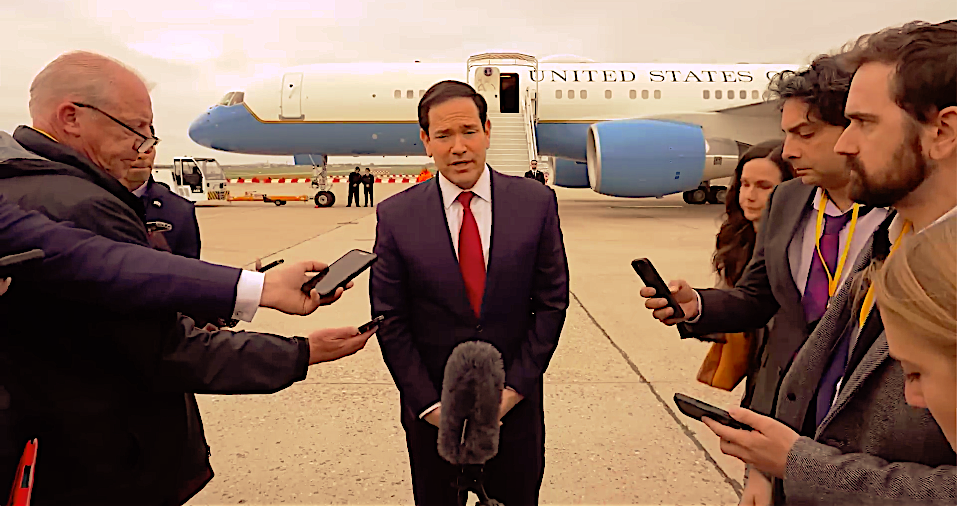
United States Secretary of State Marco Rubio briefing the media persons at Le Bourget Airport in Paris on March 27, 2026.
US Eyes Hormuz Risk as Iran Warns of Retaliation
Paris: The United States can achieve its military objectives against Iran “without any ground troops,” Secretary of State Marco Rubio said, addressing mounting speculation about escalation even as he acknowledged that ongoing deployments are intended to provide the President with “maximum optionality” to respond to contingencies.
Rubio was addressing the media at Le Bourget Airport after meetings with G7 counterparts today.
Pressed repeatedly on the purpose of the troop movements and whether they signalled preparation for a broader war, Rubio said such deployments are designed to prepare for “multiple contingencies,” declining to provide operational details and referring questions on tactics to the Defense Department. He maintained that the stated objectives of the campaign can be achieved without deploying U.S. forces on Iranian soil, while emphasising that military planning requires flexibility in the face of evolving conditions.
Those objectives, as he outlined them, are expansive in scope and focus on dismantling Iran’s core military capabilities. The United States, he said, is targeting Iran’s navy and air force, its missile and drone production infrastructure, and the launcher systems that underpin its ability to project force. According to Rubio, these actions are intended to prevent Iran from developing nuclear weapons and to limit its capacity to threaten regional and global security. He said the operation is progressing “on or ahead of schedule” and is expected to conclude “in a matter of weeks, not months,” underscoring what he described as a defined and time-bound campaign.
Rubio underscored that these objectives had been articulated “from the very first night” the President announced the operation, pushing back against what he described as reports suggesting a lack of clarity about U.S. goals. He said the mission was not open-ended but structured around specific degradations of Iran’s military capacity, particularly its ability to produce and deploy missiles and drones. In that context, he repeatedly emphasised that the United States was targeting not only existing weapons systems but also the industrial base that sustains them, including factories and infrastructure associated with missile and drone production.
He also framed the reduction of missile launchers as a critical component of the campaign, arguing that such systems enable Iran to conceal capabilities that could otherwise be used to advance toward a nuclear weapon. By “dramatically” reducing the number of these launchers, he said, the United States aims to deny Iran the ability to shield or rapidly deploy strategic assets. This focus on launchers, alongside production facilities and delivery systems, formed a central part of how Rubio described the operational logic of the campaign.
In describing how these objectives are being advanced, Rubio deferred repeatedly to the Defense Department on tactical execution but offered a broad characterisation of progress as continuous and cumulative. He said the campaign was proceeding in a way that steadily weakens Iran’s ability to “lash out” at its neighbours and threaten international targets, indicating that the strategy relies on sustained pressure rather than a single decisive strike. He credited what he referred to as the “Department of War” with carrying out that effort, describing its role as central to degrading Iran’s capabilities on a day-to-day basis.
Rubio also linked the defined objectives to a broader strategic endpoint, stating that once the current phase of operations is complete, Iran would be “weaker than they’ve been in recent history.” He framed this outcome not only in terms of immediate military degradation but also as a longer-term constraint on Iran’s capacity to reconstitute its capabilities. This forward-looking element connected the operational goals—targeting factories, launchers, and armed forces—to a wider objective of preventing Iran from re-emerging as a military threat in the near term.
The questions that followed reflected concern that such a campaign, despite its stated limits, could expand in duration or scale. Rubio rejected suggestions that the United States was moving toward a prolonged conflict, reiterating that the objectives had been clear from the outset and that Washington is not seeking to involve other countries in the ongoing military operation. At the same time, his reference to contingency planning signaled that the administration is preparing for a range of possible developments even as it projects confidence in the current trajectory.
Iran’s response pointed to the risk of those contingencies taking shape beyond the immediate battlefield. In a statement, Iranian President Masoud Pezeshkian said Iran does not initiate preemptive attacks but would respond to strikes on its infrastructure and economic centres with what he described as a “decisive and crushing response.” He also warned countries in the region not to allow their territories to be used by external powers, linking such actions to broader implications for regional security and development and suggesting that the geographic scope of the conflict could widen.
Rubio drew a distinction between the Iranian population and its leadership, describing the Iranian people as deserving of better conditions while characterising the ruling system as a “radical clerical regime.” He argued that Iran’s leadership has used national resources to fund militant groups and develop weapons systems rather than invest in domestic development, framing the current conflict as a response to long-standing patterns of behaviour. He also placed the confrontation within a broader historical context, describing Iran’s leadership as a persistent threat over several decades and accusing it of supporting attacks against Americans and others internationally, a framing he said underscored the urgency of degrading its military capabilities.
Rubio’s remarks came in the immediate context of consultations with partners in the Group of Seven, which he described as “really good meetings” focused in part on outlining the U.S. perspective on the Iran operation and preparing for its potential aftermath. He said allies were briefed on both the progress of the campaign and the challenges that could emerge once U.S. objectives are achieved, indicating that planning is already extending beyond the current phase of military action.
He repeatedly pointed to the possibility that Iran could seek to impose a tolling system in the Strait of Hormuz after the conflict, describing such a move as illegal and unacceptable. According to Rubio, there was broad recognition among G7 countries that such a scenario would require a coordinated response, with multiple governments signalling their understanding of the stakes and the need to be prepared to act.
Rubio stressed that while discussions with allies were advancing on potential maritime security arrangements, the United States is “not asking anybody to join the war,” drawing a clear distinction between the ongoing military operation and post-conflict planning. He said Washington is conducting the current phase independently and does not require external participation, even as it encourages partners to prepare for what could follow once U.S. objectives are achieved.
He also indicated that there was what he described as broad “buy-in” among G7 participants on the need to prepare for potential disruptions in the Strait of Hormuz, with multiple countries acknowledging both the risks and the necessity of coordinated action. This, he suggested, reflected a growing alignment on the need to ensure that international waterways remain open and are not subject to unilateral control.
While the United States would be willing to participate in such an effort, Rubio emphasised that it is not seeking to lead it, suggesting instead that countries most dependent on maritime trade through the strait should take a primary role. He noted that the United Kingdom has played a prominent role in advancing discussions and that other countries are actively engaged in shaping a framework for potential action.
He also indicated that allies appeared receptive to U.S. briefings on the campaign itself, saying there was appreciation for updates on the progress of operations and an understanding of what could unfold in the coming weeks. At the same time, his remarks suggested that while the United States is conducting the current military phase independently, it is already working to situate the post-conflict environment within a broader multilateral framework.
A significant portion of Rubio’s remarks focused on the possibility that Iran could attempt to impose a tolling system in the Strait of Hormuz once the current phase of operations concludes. He described such a move as illegal and said it would require a coordinated international response. The strait, through which a significant share of global energy supplies passes, has long been seen as a potential flashpoint, and Rubio said that ensuring its continued openness would require preparation by the international community.
Elaborating on the practical implications, Rubio said that once the conflict ends, commercial shipping through the Strait of Hormuz is likely to face immediate security and insurance challenges. He noted that tankers may require military escorts in order to transit the strait and secure insurance coverage, warning that without such arrangements, normal shipping operations could be disrupted regardless of formal policy decisions by Iran.
He further clarified that the idea of a multinational response has always been conceived as a post-conflict requirement rather than an immediate wartime measure, pushing back against what he described as confusion in some reporting that suggested such efforts were being requested during active operations.
Questions about allied reactions highlighted another dimension of the conflict, with reporters asking whether U.S. actions or presidential rhetoric had caused concern among partner countries. Rubio said he had not encountered such reactions in his meetings, stating that discussions with allies had instead included expressions of appreciation for U.S. engagement across multiple international issues, including efforts related to Sudan, Gaza, Syria, Venezuela, Haiti, and the war between Russia and Ukraine.
The exchange also underscored how developments in Iran are intersecting with other geopolitical priorities. On the war in Ukraine, Rubio said the United States continues to support efforts toward a ceasefire and negotiated settlement, though he noted that no new meetings are currently scheduled and that progress depends on decisions by both Russia and Ukraine. He rejected claims that Ukrainian President Volodymyr Zelenskyy had been told that security guarantees would depend on territorial concessions, calling such assertions inaccurate and clarifying that such guarantees would only be considered after the war ends.
Asked whether military resources allocated to Ukraine could be redirected, Rubio said no such diversion has occurred but acknowledged that it remains possible if required by U.S. national interests, explaining that weapons provided under existing arrangements are U.S. assets and would be prioritised accordingly.
On Russia’s role in the Iran conflict, Rubio said there was no indication that Moscow’s support for Tehran was affecting U.S. military operations, while emphasising that engagement with Russia continues at a governmental level, given its status as a nuclear power. He also addressed reports concerning visits by Russian lawmakers, noting that such engagements had been scheduled previously and did not represent a shift in policy.
At the same time, Rubio indicated that diplomatic channels with Iran have not been entirely closed. He said the United States has received messages suggesting a possible willingness to engage in discussions, but added that key details remain unresolved, including who would represent Iran, what issues would be addressed, and when talks might take place. He described a credible signal of seriousness as one in which Iran identifies authorised interlocutors and defines the parameters of engagement, while making clear that military operations would continue in parallel until such conditions are met.
Responding to accusations by Iranian officials at international forums, Rubio dismissed claims that the United States and its allies were responsible for humanitarian violations, instead accusing Iran of supporting violence across the region through affiliated groups. He pointed to Iran’s links with organisations and militias operating in multiple countries, arguing that its role has been central to instability in the Middle East.
Beyond the central focus on Iran, the briefing ranged across other issues reflecting the breadth of U.S. foreign policy concerns. Rubio said the United States remains concerned about violence in the West Bank, including attacks by settlers against Palestinians, and reiterated opposition to changes in the status quo. On Cuba, he rejected reports suggesting a shift toward a purely economic arrangement without political change, arguing that economic reform in the country would require broader systemic transformation. He also addressed energy-related questions, saying that temporary sanctions relief on Russian oil applies mainly to shipments already in transit and does not represent a permanent policy shift, and that no decision has yet been made on U.S. contributions to a Chornobyl-related repair fund.
Throughout the interaction, Rubio returned to the central assertion that U.S. objectives in Iran are clearly defined and that progress toward achieving them is advancing as planned, an argument he framed as a response to what he described as persistent confusion about the mission. He explicitly spelt out those objectives in operational terms: the destruction of Iran’s missile and drone manufacturing infrastructure, the elimination of its missile launchers and stockpiles, and the dismantling of its naval and air capabilities—targets he said were central to preventing Iran from threatening its neighbours or developing a nuclear weapon.
In explaining how those objectives are being advanced, Rubio described a campaign of sustained degradation in which “every single day” Iran is becoming weaker as its launchers, factories, and military assets are targeted. While he declined to outline tactical sequencing, he characterised the operation as cumulative in effect, relying on successive actions to reduce Iran’s capacity to retaliate or project force.
At the same time, his refusal to discuss operational details and his repeated references to contingency planning indicated that while the goals were presented as fixed, the pathway to achieving them remains adaptive. The breadth of questions that followed—from the risk of ground deployment to the durability of Iran’s capabilities and the possibility of escalation beyond its borders—underscored the gap between the clarity Rubio asserted and the uncertainties that continue to shape the conflict’s trajectory across the region and beyond.
– global bihari bureau