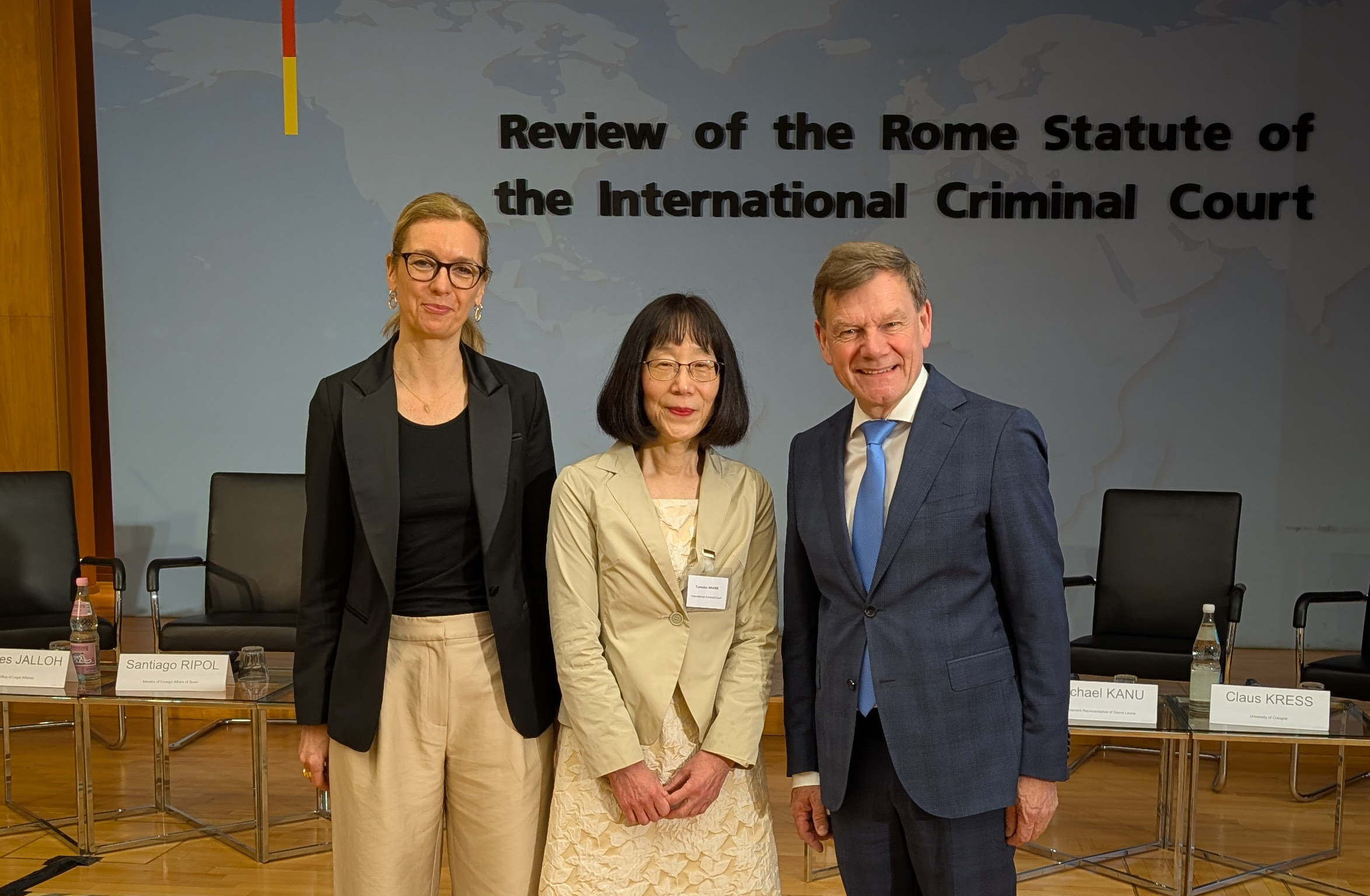
ICC President Judge Tomoko Akane with Dr Johann Wadephul, Federal Foreign Minister of Germany, and Ms Sabine Monauni, Deputy Prime Minister and Minister for Foreign Affairs, Environment and Culture of Liechtenstein.
ICC Chief’s Fiery Call to Arms at Berlin Conference
Berlin: On a crisp June 6, 2025, Berlin turned into a battleground for ideas as Judge Tomoko Akane, the President of the International Criminal Court (ICC), took centre stage at a high-stakes conference on the Rome Statute. Hosted at the invitation of Germany’s Federal Foreign Office, the event saw bigwigs like Germany’s Foreign Minister, Dr Johann Wadephul, and Liechtenstein’s Deputy Prime Minister, Sabine Monauni, rubbing shoulders with scholars, activists, and diplomats. The air was thick with resolve to protect international justice, even as the United States lobbed fresh sanctions at the ICC like uninvited masala in a perfectly balanced curry.
Dr Wadephul kicked things off with a tone of defiance, expressing his “regret” over the US sanctions imposed on June 5, 2025, targeting four ICC judges. “Germany stands like a rock for international law and the ICC,” he declared, setting the stage for a conference that wasn’t just about legal nitty-gritty but about safeguarding the very soul of global justice. His speech was a masterclass in conviction, weaving personal anecdotes with a clarion call to action. Recalling his days as a law student in 1986, he said, “I chose law because I believed it protects us all. That conviction hasn’t aged a day.” It was a desi-style reminder that principles don’t fade, even if hairlines do.
Judge Akane, not one to mince words, brought her A-game. She stressed that amending the Rome Statute is a sovereign choice for states but urged relentless efforts to strengthen the legal framework, especially in these “challenging times.” With the US sanctions hanging like a dark cloud, she didn’t just deplore the move—she threw down the gauntlet. “We need determined collective action, united by our unwavering commitment to international justice,” she thundered, rallying the room to stand up to threats against the ICC’s independence. It was the kind of speech that could make even a samosa stand up and salute.
Also read: Hungary’s ICC Exit: Orban’s Rule Trumps Law?
In a side meeting, Akane huddled with Germany’s Minister of State for Europe, Gunther Krichbaum, and didn’t hold back. Thanking Germany for being the ICC’s bhai in tough times, she called for a united EU front to shield the Court from external pressures. “These unjustified sanctions against our judges are a direct attack on justice itself,” she said, her words carrying the weight of a dabangg courtroom drama. A quick chat with Ms Monauni on the sidelines further underscored the global support for the ICC, with both leaders brainstorming ways to keep the Court’s flag flying high.
Dr Wadephul’s opening remarks were the tadka that spiced up the conference. He painted a grim picture of a world where “might is right” seems to be the new mantra, from Russia’s ongoing war in Ukraine to violations of territorial integrity worldwide. “All acts of aggression undermine the international legal order,” he said, invoking the UN Charter’s prohibition of force under Article 2 IV. With a nod to the Nuremberg trials, he reminded everyone that the ICC was born to hold even the mightiest accountable. “The law serves us all—it protects us all,” he reiterated, sounding like a professor who’d just aced his own lecture.
The conference wasn’t just a talk shop; it was a prelude to the Rome Statute Review Conference in July 2025, where 125 States Parties will gather to fortify the ICC. Wadephul pushed for aligning the jurisdictional scope of the crime of aggression with other core crimes, closing a “major accountability gap.” He also called for institutional reinforcement, urging global partners—especially from Africa and Latin America—to join hands. With a cheeky aside, he noted he’d already met nearly half of Africa’s 54 foreign ministers, adding, “I’ve got work to do to meet the other half!” It was a classic desi touch—serious intent with a sprinkle of charm.
As Berlin buzzed with ideas, one thing was clear: the ICC isn’t just a court; it’s a symbol of hope in a world where power often trumps principle. With Akane, Wadephul, and their allies leading the charge, the fight for justice is as fiery as a vindaloo—and twice as bold.
– global bihari bureau