Photo credit: @Mr_RO_KO|X
Two Greats, One Glorious Evening in Sydney
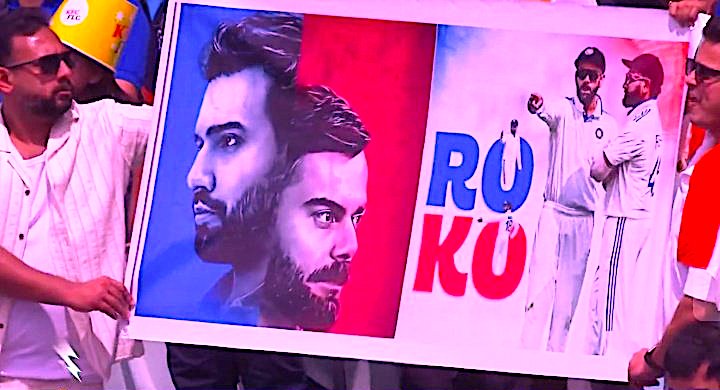
Sydney: It began under the wide Australian sky, with the Sydney Cricket Ground (SCG) washed in sunlight and scattered with blue. On a ground that has seen many Indian milestones — from Sachin Tendulkar’s tons to Rahul Dravid’s defiance — two familiar figures, Rohit Sharma and Virat Kohli, stood side by side once more. By the time they walked off unbeaten, having stitched together an unbroken 168-run stand to chase down Australia’s 236, it felt less like a win and more like a reaffirmation of faith — the faith of a cricketing nation in its two enduring icons. Ro-Ko were unstoppable today.
The chase was already underway when Virat Kohli walked in at 69 for 1, after the young skipper Shubman Gill, Rohit’s successor at the helm, departed after scoring 24 off 26 balls with two fours and a magnificent six.
Rohit Sharma had faced the new ball and kept the scoreboard moving; now, after Gill’s departure, the two veterans shared the stage. Australia had been bowled out for 236 in 46.3 overs, Harshit Rana’s 4 for 39 the decisive spell. What followed was 168 runs in 170 balls, no further wickets, the target reached in 33.4 overs.
Kohli’s first ball, from Mitchell Starc, was defended to cover—dot. The second, pushed to mid-wicket, brought a single and the first roar of the afternoon. Two ducks in the previous matches—Perth and Adelaide—were still fresh; the single off the second ball ended the streak. From there, he batted with familiar command: 74 not out from 81 balls, seven fours, one six, his 75th One Day International (ODI) fifty greeted by a raised fist and a helmet waved to the stands.
Rohit, already set, moved to his 33rd ODI hundred—ninth against Australia—in 105 balls: 121 not out, twelve fours, five sixes. The runs came in steady bursts—pulls, drives, lofts over mid-wicket—each boundary answered by 40,587 voices, most of them Indian.
Rohit’s unbeaten 121 and Kohli’s fluent 74 weren’t flamboyant fireworks. They were sculpted with the patience of masters who know the tempo of an innings better than the sound of their own pulse. Harshit Rana’s incisive 4 for 39 had already given India the foundation, but it was the old, firm, calm Rohit and driven Kohli who turned it into poetry. As the final runs were struck and the Sydney crowd rose to applaud, history seemed to whisper that few partnerships have aged with such grace and hunger.
Kohli’s words in recent months offer a window into that hunger. “I just love playing the game… I just love batting. As long as the joy of batting and the love for batting are alive, then all the other things take care of themselves,” he said recently. In Sydney, that joy was visible again — not in aggression, but in control, in the quiet precision with which he worked singles, in the economy of risk. It was a throwback to his best years, when every innings carried the certainty of craft, not luck.
Rohit, for his part, has been walking a tightrope of legacy and transition. Removed as captain despite being among India’s most successful leaders, he arrived in Australia with questions swirling around his role and future. But at Sydney, he answered them with runs — the most unanswerable of all rebuttals. His 33rd ODI hundred was both a personal statement and a continuation of India’s tradition of dignified comebacks. In his verified post-match comment, he kept his composure: “I’ve always loved coming here,” he told the broadcasters — understated, almost casual, but deeply resonant for those who understood what this ground had meant to Indian captains before him.
Today’s partnership carried the weight of their records—Rohit: 10,866 ODI runs, three double-centuries, highest score 264; Kohli: 13,906 runs, average 57.48, 50 hundreds, chase average 99.50 in wins. Together, more than 24,770 runs and 83 centuries, statistics that belong less to the modern algorithmic era and more to the timeless corridors of cricket’s grand narrative. What distinguishes them from their contemporaries is not merely consistency but the evolution of consistency — how they’ve adapted to every new challenge the white-ball game has thrown at them, from Powerplay shifts to T20 crossover fatigue. In an era of constant experimentation, they remain the last great constants.
Their partnership in Sydney also carried the weight of context. Of late, Indian cricket has been convulsed by speculation — whispers of friction, of fading relevance, of changing leadership equations. But like all enduring greats, they have outlived the gossip. There was no need for public reconciliation, no grand gestures; just runs, stitched with the quiet professionalism of men who understand that performance speaks louder than perception.
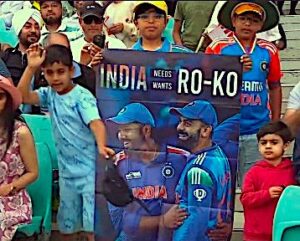
The Sydney applause mattered. Not because it was loud — crowds often cheer for milestones — but because it was informed. India lost the series 1-2, but Ro-Ko ensured it still left the shores heads held high.
Australian audiences, traditionally hard to impress, reserve respect for those who’ve earned it across time, across formats. They remember Kohli’s centuries here in 2012, Rohit’s double hundreds, India’s triumphs and heartbreaks. When they stood to applaud the Ro-Ko show, it wasn’t politeness; it was acknowledgement — the highest form of sporting tribute.
In Indian cricketing culture, the Rohit-Kohli partnership now sits in a lineage that stretches back to Sunil Gavaskar and Gundappa Viswanath, to Dravid and Ganguly, to Dhoni and Yuvraj — pairs that shaped eras. Yet, what sets Rohit and Kohli apart is how their synergy evolved amid social media scrutiny, 24-hour news, and the weight of a billion expectations. Their resilience has been psychological as much as technical. Every failure is dissected, every gesture filmed. And yet, their ability to stay grounded, to find joy in the act of batting itself, is perhaps their greatest achievement.
From a strategic standpoint, Sydney reaffirmed India’s ODI depth. It began with the toss under a clear Sydney sky, Australia opting to bat on a pitch that promised runs but delivered drama. Harshit Rana’s control, the flexibility of the middle order, and the tactical discipline in field placements under a new management structure all point to a team learning from the heartbreak of previous ICC tournaments. But more than any tactical takeaway, this match re-established a symbolic truth: that Indian cricket’s emotional centre still beats in the rhythm of two veterans who refuse to fade quietly.
For the younger generation, both are more than run machines; they are cultural archetypes. Rohit represents the artistry of timing — the idea that grace can still triumph over brute force. Kohli embodies obsession — the relentless pursuit of perfection, fitness, and competitive fire. Together, they have defined an age of Indian cricket that is as much about endurance as excellence.
As they left the field, bat in hand, helmets raised, the cameras captured a moment of rare serenity. They walked off unbeaten, and the SCG rose. Pat Cummins clapped from the balcony, Mitchell Starc nodded, and Adam Zampa smiled. The applause was long, earned, and shared across borders, dramatic, no grandstanding — just a shared glance, a nod, a small smile. It was the kind of cricketing image that tells more than any headline could: two greats, side by side, still defining what greatness means in the twilight of their careers. Sydney, in turn, had done what great venues do — it had reminded the world why we watch this game in the first place.
Rohit, deservingly adjudged the player of the match as well as the player of the series, said on the presentation dais: “You expect tough conditions in Australia. Quality bowlers. Gotta understand things and try your best. I love playing in Australia in general. I’ve had a decent memory in SCG – great ground and crowd. I love doing what I do and hope to continue to do that.” Kohli highlighted the strong partnership with Rohit, saying, “It was a match-finishing stand. From early on, we understood the game well. That’s how you become successful.” Speaking to broadcasters, Kohli addressed the ducks head-on: “Good to be out of the pond. The game shows you something even at this stage. It’s so challenging when things aren’t going your way. Situations in the middle get the best out of me. Easy to bat with Rohit, glad it was a match-finishing stand. From early on, we understood the game well. That’s how you become successful. Even back in the day, we thought we could take games away from the opposition. It all started in 2013 vs Australia, in the ODIs at home.”
New captain Shubman Gill, beaming in his maiden ODI win, praised the duo during the presentation: “Chase was pleasing to see. Our spinners, contained in the middle and pacers, took key wickets. Harshit bowled fast in the middle overs. We need that quality. Rohit, Kohli have done it for so many years. Delight to watch. Special win on a special ground.” Australia skipper Mitchell Marsh, gracious in defeat, added: “We’ve seen Rohit and Virat do that over 10 years against lots of teams.”
– global bihari bureau