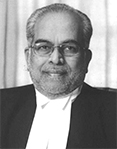
B. Sudershan Reddy
INDIA Bloc Picks Former Supreme Court Judge for Vice Presidential Race
New Delhi: The opposition Indian National Developmental Inclusive Alliance (INDIA) bloc today nominated former Supreme Court judge B. Sudershan Reddy as its candidate for the vice presidential election set for September 9, following the resignation of incumbent Jagdeep Dhankhar on July 21 due to health concerns.
Congress president Mallikarjun Kharge announced the decision after consultations with alliance partners, including the Aam Aadmi Party (AAP), which, though not formally part of the alliance, backed the choice. Kharge described Reddy as one of India’s most distinguished and progressive jurists, emphasising his nomination as a move to wage an ideological battle against the ruling National Democratic Alliance (NDA), which has fielded Maharashtra Governor and senior Bharatiya Janata Party (BJP) leader C.P. Radhakrishnan.
The Opposition framed the contest as a defence of Constitutional values, citing Reddy’s four-decade judicial career as a symbol of integrity and commitment to social, economic, and political justice. Speaking to reporters in Delhi shortly after the announcement, Reddy expressed gratitude, saying, “Thank you for projecting me as a candidate on behalf of INDIA Alliance. But for you, it would not have been possible.” He appealed to all parliamentarians, including those from the National Democratic Alliance, to support his candidature, adding, “I am very, very happy.”
Born on July 8, 1946, in Andhra Pradesh, Reddy began his legal career as an advocate in 1971 after enrolling with the Bar Council of Andhra Pradesh. He served as a judge of the Andhra Pradesh High Court from May 1995, later becoming Chief Justice of the Gauhati High Court in December 2005. Elevated to the Supreme Court of India in January 2007, he served until his retirement in July 2011. Post-retirement, Reddy was appointed the first Lokayukta, or anti-corruption ombudsman, of Goa in March 2013, a role he held until October that year. His judgments, particularly those protecting marginalised communities and Constitutional rights, have earned him recognition as a champion of democratic principles.
Opposition leaders, including Dravida Munnetra Kazhagam (DMK) MP Kanimozhi and Indian National Congress (Congress) MP K.C. Venugopal, highlighted Reddy’s nomination as a strategic choice to counter the NDA’s candidate, whose Rashtriya Swayamsevak Sangh (RSS) roots they view as ideologically opposed to their vision. A senior opposition MP also noted Reddy’s Telangana roots in undivided Andhra Pradesh as a move to appeal to regional voters and challenge the support of NDA allies like the Telugu Desam Party (TDP) and Yuvajana Sramika Rythu Congress Party (YSRCP).
The Election Commission of India (ECI) announced the election schedule on August 1, 2025, prompted by Dhankhar’s resignation, which marked the first early vice presidential poll since 1987. Under Article 68(2) of the Constitution of India, such a vacancy must be filled as soon as possible.
Reddy’s nomination papers are set to be filed on August 21 at Room RS-28, Parliament House, between 11 a.m. and 3 p.m., with scrutiny scheduled for August 22 at 11 a.m. The National Democratic Alliance named Radhakrishnan on August 17, with Defence Minister Rajnath Singh overseeing his campaign and Union Minister Kiren Rijiju as polling agent.
Polling will occur on September 9 in Room F-101, Vasudha, Parliament House, from 10 a.m. to 5 p.m., with vote counting and result declaration by the Returning Officer on the same day.
The Vice President is elected by an electoral college of 782 members of Parliament, comprising 543 from the Lok Sabha, or House of the People, and 245 from the Rajya Sabha, or Council of States, including 233 elected and 12 nominated members. Each vote carries equal weight, and the election employs proportional representation by single transferable vote (STV) through a secret ballot. Voters rank candidates by preference, requiring a candidate to secure more than half of the valid votes to win, with votes redistributed if necessary until a majority is achieved. Candidates must be Indian citizens, at least 35 years old, qualified for the Rajya Sabha election, and not hold an office of profit. Nominations require at least 20 proposers and 20 seconders from the electoral college, along with a 15,000 Indian Rupees (INR) security deposit. The Election Commission of India supervises the process, with the Rajya Sabha Secretary-General as Returning Officer, mandating the use of special commission-supplied pens and prohibiting party whips.
The National Democratic Alliance holds a numerical edge with approximately 425 members of Parliament, supported by parties like Yuvajana Sramika Rythu Congress Party and potentially Biju Janata Dal (BJD), compared to the Indian National Developmental Inclusive Alliance’s 312, with 45 from other parties, positioning Radhakrishnan as the frontrunner.
Dhankhar’s resignation sparked controversy, with opposition figures like Congress leader Jairam Ramesh and Rashtriya Janata Dal’s (RJD) Mukesh Roshan suggesting political motives. In the interim, Harivansh Narayan Singh is presiding over the Rajya Sabha.
The elected Vice President will serve a full five-year term from assuming office, not merely completing Dhankhar’s tenure, and will act as ex officio Chairman of the Rajya Sabha and Chancellor of Panjab University, University of Delhi, and Pondicherry University, as well as Visitor of Makhanlal Chaturvedi National University of Journalism and Communication. A five-judge Supreme Court bench can resolve all election-related disputes.
– global bihari bureau