Red Sanders
Once Most-Smuggled, Now India’s Richest Legal Crop
The Forbidden Tree That Now Funds Its Own Future
In the rolling red-soil hills of Andhra Pradesh, Tamil Nadu, and Telangana, a quiet agricultural revolution is underway. Once known only as the “most smuggled wood on earth,” red sanders (Pterocarpus santalinus), the deep purple-red timber prized in China and Japan for centuries, is now being openly grown by thousands of Indian farmers and legally shipped overseas for the first time in decades.
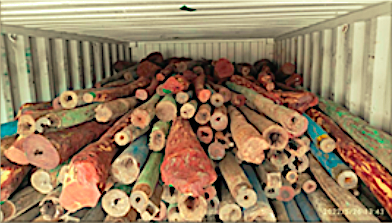
Fifteen years ago, mentioning red sanders usually meant headlines about midnight smuggling, container seizures at Mundra Port, or shoot-outs in the Seshachalam forests. The tree was bleeding India dry: between 2014 and 2024 alone, authorities confiscated more than 16,500 tonnes of illegally felled logs, enough to fill 700 shipping containers. Listed as Endangered on the International Union for Conservation of Nature (IUCN) Red List and placed under Appendix II of the Convention on International Trade in Endangered Species of Wild Fauna and Flora (CITES) since 1995, wild red sanders had become untouchable. Export of logs from natural forests has been completely banned since 2010.
Yet today, the same wood is leaving Indian shores legally, with full government paperwork. The turning point came in 2018–2022 when New Delhi and the states quietly rewrote the rules: any red sanders grown on private farmland, outside the protected forest zones, is exempt from the Wildlife (Protection) Act. Farmers only have to register their plantations and obtain a Tree Ownership Certificate. The first fully legal consignments of plantation-grown logs left Chennai and Krishnapuram ports in 2023, bound for Guangzhou and Tokyo.
A crucial international milestone made this possible. In November 2023, after years of scrutiny under the CITES “Review of Significant Trade” process, India was unconditionally removed from the watchlist for red sanders. The decision recognised India’s robust scientific Non-Detriment Findings, strict separation of wild and cultivated sources, and the dramatic drop in illegal logging. CITES continues to list the species in Appendix II, meaning all international trade still requires export permits and certificates confirming artificial propagation, but finished products such as furniture, musical instruments, and carvings remain exempt from paperwork. For plantation-grown logs and timber, the path is now clear and streamlined.
Just today, on November 21, 2025, the National Biodiversity Authority (NBA) transferred ₹39.84 crore to Andhra Pradesh — ₹38.36 crore directly to the Andhra Pradesh Forest Department and ₹1.48 crore to the Andhra Pradesh State Biodiversity Board — marking the single largest tranche yet for red sanders conservation. Generated from Access and Benefit Sharing (ABS) on legally auctioned seized timber, this money will arm frontline forest staff, fund long-term monitoring, and support one lakh new saplings for farmers under the Trees Outside Forests (ToF) programme. With total NBA disbursements for red sanders now exceeding ₹110 crore nationwide (including ₹3 crore already paid to 198 Andhra farmers and ₹55 lakh to 18 in Tamil Nadu), the circle is closing: revenue once lost to smugglers is now flowing straight back into protection and cultivation.
The economics are staggering. A single 16-year-old plantation tree can yield 150–250 kg of marketable heartwood. At current international auction prices (₹1.2–1.8 crore per tonne for top-grade), one hectare planted at 1,100 trees can return ₹25–45 crore after costs. Farmers in Chittoor and Tirupati districts now openly call it “the crimson gold crop.”
More than 4,000 hectares are already under registered commercial plantations, with Sri City (600 ha), the Tirupati–Renigunta belt (1,200 ha), and the Vellore–Ambur region leading the way. State forest nurseries sell certified seedlings for ₹15–25 each, and private nurseries have sprung up everywhere. Farmers follow a standard blueprint: 3 × 3 metre spacing, intercrops of mango or turmeric for the first six years, and rigorous pest management against termites and the dreaded red-sanders stem borer.
The pest battle remains intense. Termites can wipe out entire first-year blocks, while the stem borer Aristobia approximate still claims 20–40 % of unprotected trees. A new and worrying threat is spike disease, a phytoplasma carried by leafhoppers that turns trees into useless witches’-brooms with no heartwood at all. Farmers who ignore it risk losing everything. Yet those who follow the twice-yearly drone sprays of imidacloprid and tebuconazole, plus regular Trichoderma applications, report losses below 5 % after year five.
Globally, demand has never been higher. In China, red sanders (hong tan in Mandarin) remains the preferred wood for high-end classical furniture and antique restoration. Japan uses thin veneers for luxury shamisen and koto instruments. Prices in Guangzhou wholesale markets now range from US$25,000–40,000 per tonne for prime logs, and buyers complain they still cannot get enough legal material. Roughly 80 % of legal exports still head to China, 10 % to Japan, and the rest to South Korea and re-export hubs.
For India, the shift is historic. A resource that once enriched only smugglers and funded organised crime is now enriching farmers and state revenues. The Andhra Pradesh and Tamil Nadu forest departments, once solely focused on seizures and auctions of confiscated wood, now spend as much time issuing CITES export permits and Tree Ownership Certificates for plantation timber.
In the words of a Tirupati farmer who harvested his first 11-hectare block in March 2025, “Fifteen years ago, if you cut a red sanders tree, you went to jail for ten years. Today, the same tree pays for my daughter’s engineering college and my son’s wedding, and the forest officer himself comes to measure the logs.”
From a symbol of environmental plunder to one of the most profitable legal crops in peninsular India, red sanders has completed an extraordinary journey in less than a decade. With CITES now endorsing India’s cultivation model, global buyers paying premium prices for documented legal wood, and seized-smuggling profits now directly funding conservation and farmers, the crimson gold is here to stay — this time on the right side of both the law and conservation.
– global bihari bureau