Haiderpur (Uttar Pradesh) — On a quiet morning along the Haiderpur Wetland, conservationists watched as 20 Red-Crowned Roofed Turtles slipped into the Ganga’s waters on April 26, 2025, their shells glinting under the sun.
For the first time in three decades, this endangered species, absent from the river’s main channel, returned to its historic habitat, marking a step in the Namami Gange Mission’s efforts to restore the Ganga’s ecosystem. The release, guided by the Turtle Survival Alliance Foundation India (TSAFI) and the Uttar Pradesh Forest Department, follows years of research and planning. For locals and conservationists, the Red-Crowned Roofed Turtles’ return signals a chance to revive the river’s biodiversity, though challenges remain in ensuring their survival.
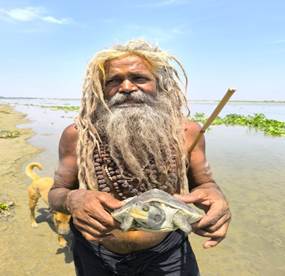
The Red-Crowned Roofed Turtle, known scientifically as Batagur kachuga, once thrived along the Ganga’s banks, its vibrant shell a familiar sight in Uttar Pradesh. By the early 1990s, sightings dwindled. A 1993 study by ecologist R.J. Rao reported only a few individuals near Bijnor barrage, and no confirmed adult sightings followed in the Ganga’s main channel for 30 years, per TSAFI records. The species, among North India’s most endangered turtles, faced threats from habitat loss, pollution, and fishing. In 2020, TSAFI surveyed the Haiderpur Wetland Complex, identifying nine turtle species but no Red-Crowned Roofed Turtles. As a designated Ramsar site, the Haiderpur Wetland is renowned for its diverse ecosystems, particularly its variety of bird species, and is situated within the boundaries of the Hastinapur Wildlife Sanctuary.
A 2022 study near a new turtle sanctuary in Prayagraj found indirect evidence of five turtle species, yet none were the elusive ≈ These findings, detailed in TSAFI reports, underscored the species’ critical status and the need for intervention.
The Namami Gange Mission, launched to clean and conserve the Ganga, provided the framework for this reintroduction. In 2020, TSAFI partnered with the Uttar Pradesh Forest Department to assess turtle diversity and habitat conditions. The Haiderpur Wetland, a Ramsar site connected to the Ganga during monsoons, emerged as a suitable release site due to its stable waters and vegetation. The 2022 Prayagraj study further mapped potential habitats, leading to the establishment of a turtle sanctuary. In the National Chambal Sanctuary, conservationists at the Garhaita Turtle Conservation Centre bred and raised 20 Red-Crowned Roofed Turtles for release. Each Red-Crowned Roofed Turtle was fitted with a sonic tag to track its movements, a method chosen to monitor their adaptation without disrupting natural behaviour, per TSAFI’s protocol.
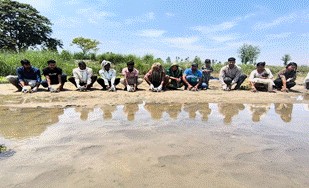
On April 26, 2025, the release took place under the supervision of Uttar Pradesh Forest Department officials. The turtles were split into two groups: ten released above the Haiderpur Wetland’s barrage and ten downstream in the Ganga’s main channel. This dual approach, described by TSAFI as a “soft” versus “hard” release strategy, tests which environment better supports the turtles’ survival. The soft release, above the barrage, allows gradual dispersal during the monsoon when the wetland connects to the Ganga. The hard release, directly into the river, assesses immediate adaptation to the main channel. Over the next two years, TSAFI and forest officials will track the turtles’ migration and health, aiming to establish a stable population.
For conservationists like those at TSAFI, the release is a milestone built on years of fieldwork. “We’ve spent decades studying the Ganga’s turtles, knowing the Red-Crowned Roofed Turtle was nearly gone,” said a TSAFI researcher, speaking on condition of anonymity due to organisational policy. “Seeing them swim again feels like a second chance for the river.” The effort required coordination among scientists, forest officials, and local communities near Haiderpur, who were briefed on protecting turtle habitats. Fishers in the area, often blamed for turtle declines, joined awareness programs, learning to avoid nesting sites. Their involvement, facilitated by Namami Gange outreach, reflects a shift toward community-driven conservation.
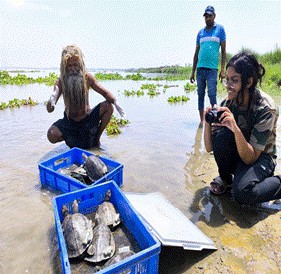
Locals in Haiderpur see the turtles’ return as more than a scientific achievement. Ram Prasad, a 45-year-old farmer whose fields border the wetland, recalls stories of turtles from his childhood. “The river was different then, full of life,” he said, standing near the release site. “If turtles come back, maybe fish and birds will too, and our children will know the Ganga we did.” His hope echoes the broader goal of Namami Gange to restore the river’s ecological balance, which supports millions of livelihoods. The mission’s work, including wetland restoration and pollution control, has improved water quality in parts of Uttar Pradesh, creating conditions for species like the Red-Crowned Roofed Turtle to return.
The Ganga’s ecosystem, stretching over 2,500 kilometres, depends on its biodiversity. Turtles play a key role, controlling aquatic vegetation and serving as prey for larger species. The absence of the Red-Crowned Roofed Turtle disrupted this balance. Its reintroduction could signal recovery for other species, such as otters and migratory birds, which rely on the Haiderpur Wetland. The 2020 TSAFI survey noted nine turtle species in the wetland, including the Indian Softshell Turtle, suggesting a resilient ecosystem if protected. The Prayagraj sanctuary, established post-2022, aims to support these species, with the Red-Crowned Roofed Turtle as a flagship for conservation.
Challenges persist. The Ganga faces ongoing threats from industrial runoff, sand mining, and unregulated fishing, which could harm the survival of the Red-Crowned Roofed Turtles. The sonic tags will help track their movements, but conservationists need data on breeding success, which may take years to confirm. The Uttar Pradesh Forest Department plans to patrol the Haiderpur Wetland and Ganga’s main channel, but resources are limited. Community support, while growing, requires sustained engagement to prevent accidental harm to turtle nests. TSAFI’s two-year monitoring period will test whether the soft or hard release strategy works better, informing future reintroductions.
The Namami Gange Mission’s collaboration with TSAFI and locals shows what coordinated efforts can achieve. The reintroduction, while small in scale, carries weight for Uttar Pradesh’s conservation landscape. Farmers like Ram Prasad, fishers turned protectors, and scientists tracking sonic signals share a stake in the Red-Crowned Roofed Turtles’ fate. Their work, grounded in data and persistence, offers a chance to restore a piece of the Ganga’s past. Sustaining this effort will demand continued cooperation, resources, and vigilance to ensure the Red-Crowned Roofed Turtle thrives again in the river’s embrace.
– global bihari bureau