

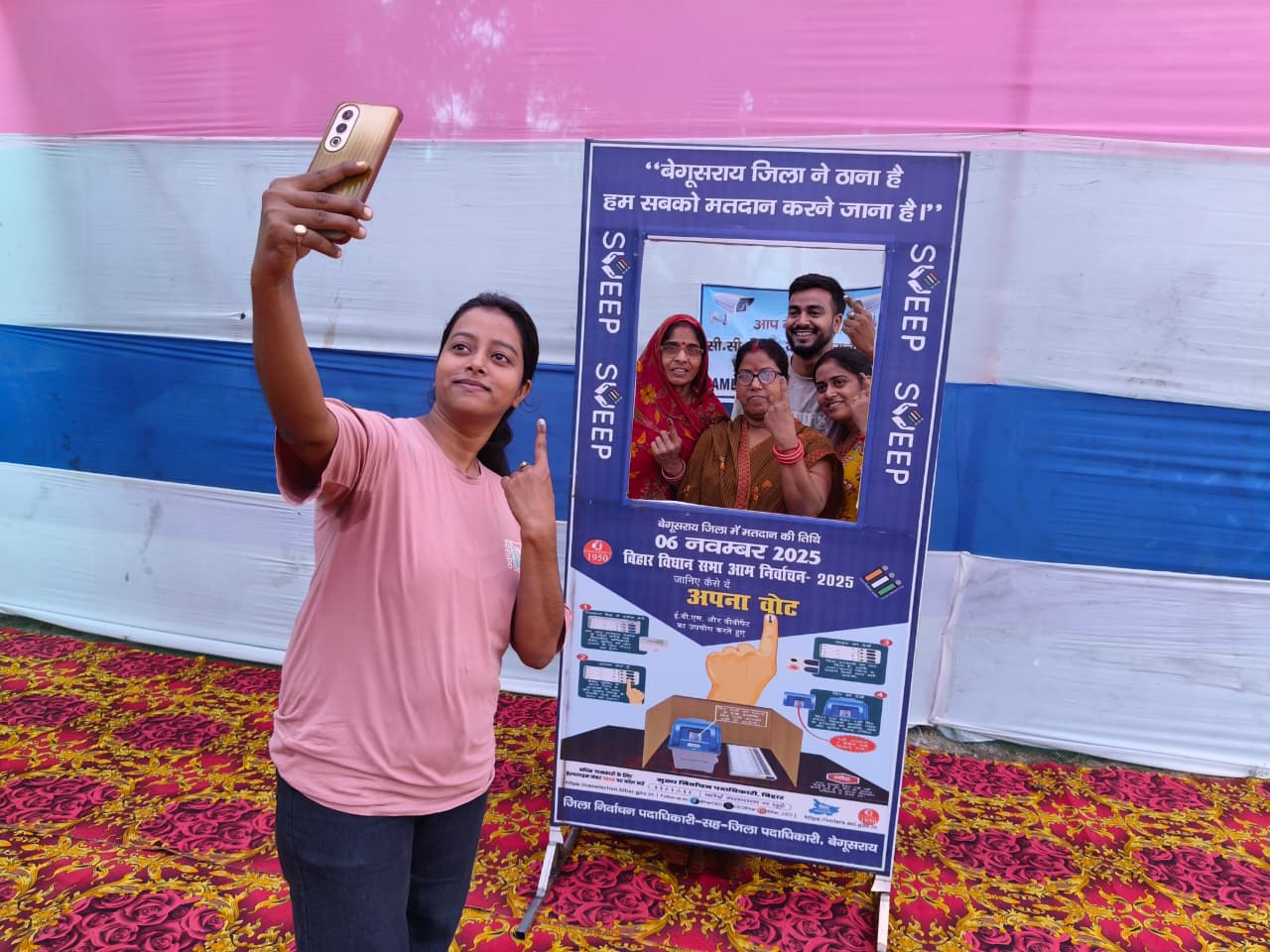
Peaceful Polling Sees Record 64.66% Turnout
Patna: The first phase of the 2025 Bihar Assembly elections drew to a close on November 6 with what the Election Commission of India (ECI) described as a peaceful, orderly and notably upbeat day of polling across 121 constituencies in 18 districts. As the evening progressed and presiding officers filed their final entries on ECINet before leaving their stations, the turnout figures settled at a provisional 64.66% as of 8:15 p.m.—the highest voter participation recorded in any phase of Assembly elections in Bihar’s history. The figure may still see minor adjustments, with reports from 1,570 presiding officers yet to be updated at the time of the Commission’s release, but even at this provisional stage, the scale of participation marks a historic moment in the state’s electoral record.
The Election Commission, led by Chief Election Commissioner (CEC) Gyanesh Kumar, along with Election Commissioners Dr Sukhbir Singh Sandhu and Dr Vivek Joshi, oversaw the polling through 100% live webcasting at all 45,341 polling stations. This is the first time in Bihar that every station offered real-time monitoring. From the central control room in Delhi, the CEC directly interacted with district election officials and presiding officers across multiple locations throughout the day, checking the pace of polling and ensuring that procedural norms were maintained to the final minute. The Commission reported that over four lakh polling personnel had reached their respective stations by 11:20 p.m. on the previous night, enabling mock polls to be completed before 7 a.m. and voting to begin simultaneously across the state.
The poll day atmosphere carried a quiet alertness. At stations in rural Samastipur, voting began with lines of elderly women wrapped in light morning shawls, but eventually it turned out to be a warmer-than-usual November morning. In parts of Lakhisarai and Rohtas, turnout surged early, with long streams of first-time voters waiting even before booths opened. Though the air was thick with slogans and campaign rhetoric in the weeks leading up to the polls, the actual day unfolded with an understated discipline, punctuated by faces bearing ink marks and an unusual number of smiles leaving the polling premises.
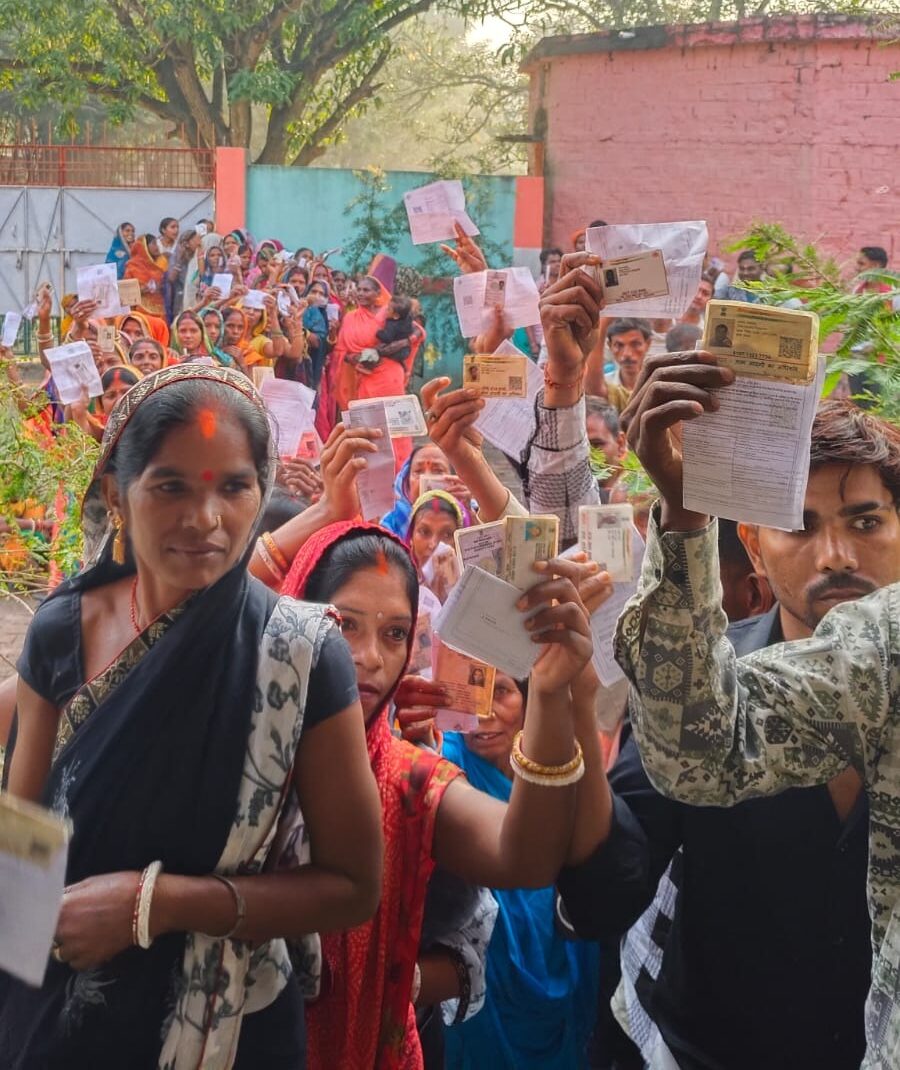
An important operational element this year was the deployment of more than 90,000 Jeevika Didis—women community workers designated to assist purdahnasheen voters. Each polling station also had at least one member of the Central Armed Police Forces for the same identification purpose. For voters with disability, e-rickshaw pick-up services and wheelchairs were made available, along with volunteers tagged to guide them through the booth process. The Commission also noted strong voter reactions to several new initiatives: redesigned Voter Information Slips for clearer readability, mobile-phone deposit counters outside booths, and colour photographs of candidates printed on the Electronic Voting Machine (EVM) ballot paper, reducing ambiguity in candidate identification.

The first phase covered over 3.75 crore eligible voters and featured 1,314 contesting candidates. The range extended from multi-decade political faces to high-profile entertainers, from first-time aspirants to candidates returning after legal or political hiatuses. The electoral map cut across regions deeply shaped by historical caste alignments, land politics, migration routes and religious demography, intersecting with increasingly urban media cultures and local economic concerns. The turnout pattern, therefore, carried layered social meaning—especially in constituencies where participation has traditionally been slower or hesitant.
Among the National Democratic Alliance (NDA) candidates, several heavyweight figures saw their electoral fate sealed in this phase. In Tarapur in Munger district, Deputy Chief Minister Samrat Choudhary, a former president of the Bihar Bharatiya Janata Party (BJP), returned to a direct electoral contest after over a decade. Tarapur is a seat he won in 2000 before his political journey moved through multiple roles. His main challenger this year is Arun Shah of the Rashtriya Janata Dal (RJD). The contest in Tarapur has drawn quiet but significant observation within political circles, as Choudhary stands as one of the NDA’s most visible faces in the campaign—his bid here is being watched for the degree of local consolidation among upper-caste and non-Yadav OBC voters.
At Lakhisarai, fellow Deputy Chief Minister and former Assembly Speaker Vijay Kumar Sinha defended a BJP bastion he has held since 2015. The region is known for its sindoor production clusters and trade communities. During the campaign, Sinha’s convoy had reportedly faced an attack, which was attributed to rival supporters, an incident that received party-level criticism but did not escalate further. His primary opponent this time is Suraj Kumar of the Jan Suraj Party. Voting in Lakhisarai proceeded with steady turnout and ended without further incident.
In Samastipur’s Kalyanpur, Janata Dal (United) or JD(U) leader and state minister Maheshwar Hazari attempted what would be his third consecutive victory. The constituency is one of several in the region marked by layered Yadav–Yadav contestation, where candidates from the same broader caste group compete for differing political alignments. Hazari faces Ranjeet Kumar Ram of the Communist Party of India (Marxist–Leninist) or CPI(ML) and Ram Balak Paswan of the Jan Suraj Party, making it a three-way field influenced by land rights, agricultural labour organisation networks and local development issues.
Mokama in Patna district drew particular attention as the constituency where Anant Kumar Singh, a controversial strongman figure previously elected as an independent and now fielded by the JD(U) within the NDA fold, is pitted against Veena Devi of the RJD, herself a former Member of Parliament and spouse of Surajbhan Singh, who has his own political legacy. A Jan Suraj candidate, Priyadarshi Piyush, added a competitive line to the race. Campaign discussions in Mokama were occasionally overshadowed by allegations related to a murder case during the campaign period, though polling day itself passed without reported confrontation.
Another seat closely watched was Alinagar in Darbhanga, where the BJP fielded 25-year-old folk singer and widely recognised Mithila cultural figure Maithili Thakur. Her campaign, marked by the presence of several women, students and cultural groups, placed emphasis on local identity and heritage. She faced RJD’s Binod Mishra and JSP’s Biplaw Kumar Chowdhary in a constituency with a significant Muslim-Yadav voter base, making the outcome here a marker of how newer public personalities intersect with older organisational voter loyalties.
In Mahnar in Vaishali, JD(U) state president Umesh Singh Kushwaha contested from a general category seat but with a strong Kushwaha community presence. And in Bankipur in central Patna, BJP candidate Deepmala Shrivastava, herself closely associated with the political work of her husband, Union Minister Nitin Nabin, campaigned heavily on development themes and women’s public safety. The Patna Sahib seat, meanwhile, saw the BJP put forward 45-year-old lawyer Ratnesh Kushwaha, replacing senior party leader Nand Kishore Yadav. The shift suggested a strategic renewal effort in urban Patna, where the BJP has historically held strong ground.
On the Mahagathbandhan side, the contests carried equally symbolic significance. At Raghopur in Vaishali, former Deputy Chief Minister Tejashwi Yadav, widely regarded as the alliance’s chief ministerial face, sought to retain a seat that has been held by the RJD for most of the post-1995 period, except for the five years between 2010 and 2015. His main opponent this time is BJP’s Satish Kumar, the same candidate who had defeated Tejashwi’s mother Rabri Devi in 2010—a detail not lost in local conversations. The Jan Suraj Party additionally fielded Chanchal Kumar, adding another competitive angle to an already layered electoral stage.
Veena Devi, contesting from Mokama for the RJD, positioned her campaign around calls for fearless voting, referring implicitly to recent tensions in the constituency. In Chhapra in Saran, popular Bhojpuri film actor Khesari Lal Yadav contested his first Assembly election under the RJD banner, his appeal rooted as much in cinematic familiarity as in community support networks. And in Raghunathpur in Siwan, Osama Shahab, the 31-year-old son of late politician Mohammad Shahabuddin, contested on the RJD ticket. His candidacy drew multiple political commentaries from the NDA during campaigning, though the RJD emphasised continuity of local-level constituency service.
For the Congress, Patna Sahib saw Shashant Shekhar—a younger face within the party—attempt to build urban appeal against the BJP’s reorganised presence. The contest forms part of the broader question of whether Congress can revive some of its political visibility in Bihar’s urban centres.
Beyond the two main alliances, other political forces also registered a presence. Tej Pratap Yadav, the elder son of Lalu Prasad Yadav, contested Mahua under the banner of his own Janshakti Janata Dal (JJD), following his separation from the RJD. His candidature has been viewed with curiosity and some caution, as he has referred to his party as a “serious force” in the making. In Kargahar in Rohtas, Bhojpuri actor Ritesh Pandey contested for the Jan Suraj Party, testing how a newly expanding formation translates public recognition into electoral performance.
The Election Commission confirmed that gender-wise turnout figures for Phase 1 had not yet been formally separated at the time of its release, and therefore, no definitive share of women voters can be stated. Historically, Bihar has often recorded high female participation in both parliamentary and assembly polls, with women’s turnout frequently equalling or exceeding men’s in several districts. Early field impressions, including from polling personnel and local news reportage, suggested steady and confident turnout among women voters, especially in rural booths. However, until the Commission issues official gender-disaggregated data, any quantified claim would remain speculative.
The broader turnout, viewed in historical context, reflects a significant shift. Bihar’s Assembly polling percentages in earlier decades varied widely: 42.6% in 1951–52, rising in cycles through the 1960s to the 1980s, reaching 62.57% in 2000—a figure that stood as the highest full-election turnout until now. More recent Assembly elections saw 56.91% in 2015 and 57.29% in 2020. The current Phase-1 turnout exceeding 64% does not automatically establish the 2025 election as the highest overall turnout, as phases remain pending. But the immediate implication is clear: citizen participation, especially in regions where turnout had been historically lower, has surged.
Observers have attributed this to a mix of factors. Some point to the Election Commission’s logistical facilitation improvements: visually clearer ballot choices, convenience facilities, mobility support and volunteer systems that reduce hesitation. Others refer to heightened political competition and sharper local stakes in constituencies where generational leadership shifts are underway. And still others cite the symbolic weight of the moment, as Bihar continues to negotiate questions of employment, infrastructure, agricultural livelihoods, migration futures and representation of local identities.
For now, the polling process itself—and its atmosphere—appear to have been the story. The day unfolded without major disruptions. A sense of civic routine accompanied the act of voting in many districts, with queues forming in early daylight and tapering by late afternoon. While political leaders across alliances issued statements thanking voters and appealing for continued turnout in the coming phase, the Election Commission reiterated its call for adherence to the code of conduct norms and assured continued logistical preparedness.
As the ballots now wait to be counted weeks later, the turnout number stands as a marker of the electorate’s engagement at this early stage. The final implications will emerge only after subsequent phases and the eventual result. But the picture that the first phase has painted is clear in its scale and tone: organised polling, significant participation and a constituency map where several key political trajectories may shift.
The wider question—how these shifts align with the aspirations of Bihar’s younger voters, its returning migrants, its agrarian workers, its small traders and its urban service classes—remains to be traced in the weeks ahead. For the moment, the ink on fingers across eighteen districts records something simpler yet deeply consequential: that the political life of Bihar continues to be shaped not by the absence of participation, but by an active, negotiated and evolving exercise of choice.
– global bihari bureau


It was interesting to read in detail on the First phase of Bihar poll, which saw a record turnout around 64 percentage and interesting to read various political parties candidates pitted against each other.
The report also highlighted Miithali Thakur the 25-year-old Maithili folk singer.
The role of EC is given more space.
When this government talks of all polls states and Lok Sabha, why can’t they conduct Bihar poll in single day and with a break of one hour after closure of poll, counting can be started same day at the polling stations instead of carrying EVMs to strong room under high security.
Earlier this was practiced in Mumbai’s civic body polls on paper ballots.