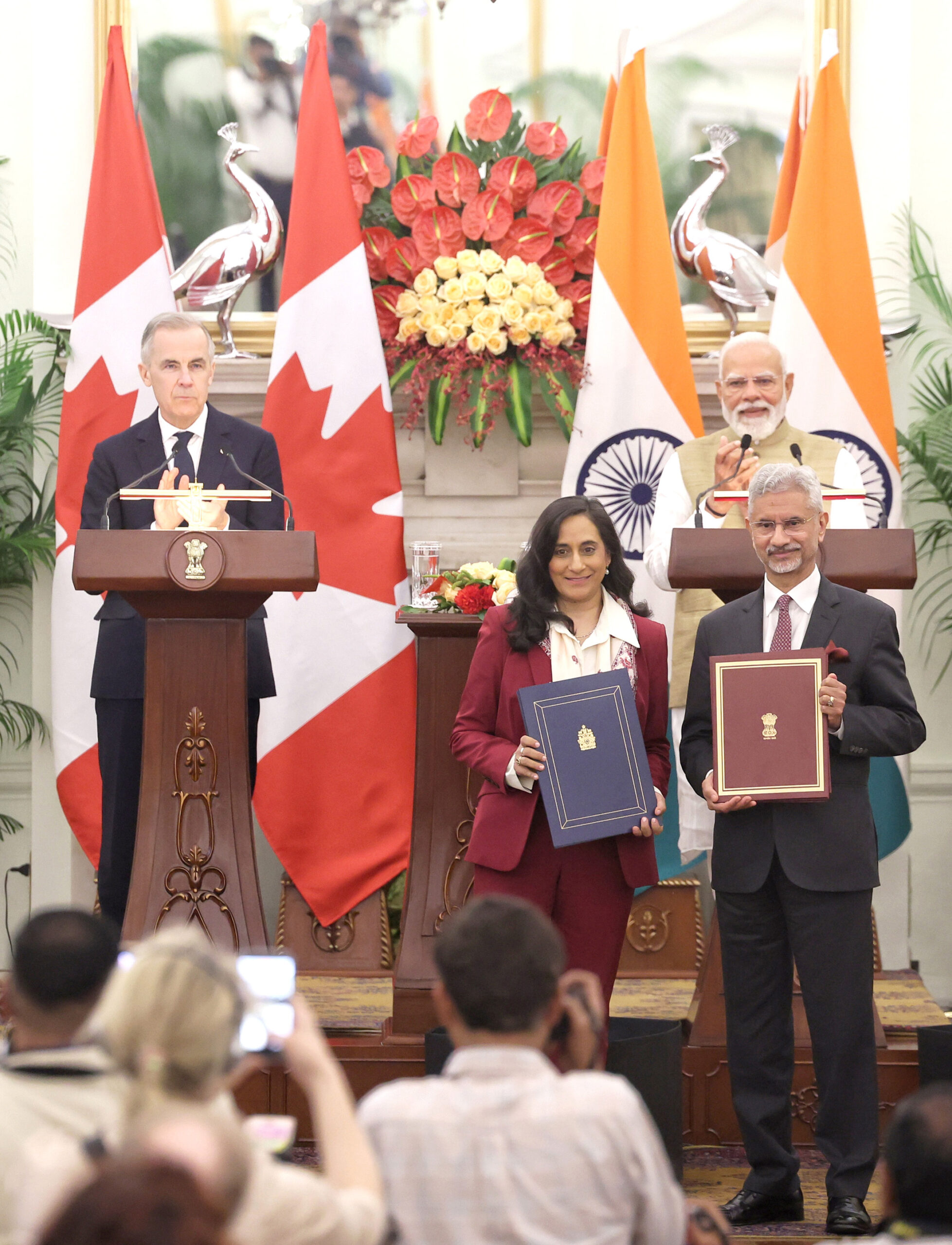
Prime Ministers of India and Canada, Narendra Modi and Mark Carney witness the Exchange of MoUs between India and Canada at Hyderabad House, in New Delhi on March 02, 2026.
India–Canada Seal Broad Strategic Reset
Uranium Deal Anchors Energy Partnership
New Delhi: Beginning with rare earths and other critical minerals that power everything from electric vehicles to advanced electronics, India and Canada have unveiled a sweeping reset of their bilateral relationship, anchored in energy security, resilient supply chains, technology cooperation and an ambitious trade pact. The agreements were finalised during the February 27–March 2 visit to New Delhi by Canadian Prime Minister Mark Carney at the invitation of Prime Minister Narendra Modi, marking the first bilateral visit by a Canadian prime minister to India since 2018.
Commemorating 79 years of diplomatic ties, the two leaders framed the renewed partnership around the principle of “Vasudhaiva Kutumbakam” — One Earth, One Family, One Future — positioning sustainability, inclusivity and shared global responsibility at its core. They linked India’s Viksit Bharat vision with Canada’s Build Canada Strong agenda, signalling that the reset is intended not merely as a commercial recalibration but as a long-term strategic alignment between two large democracies navigating an increasingly uncertain global order.
Critical minerals cooperation forms one of the central pillars of the new framework. A Memorandum of Understanding commits both countries to building secure, diversified and resilient supply chains across exploration, mining, processing and advanced manufacturing. The partnership is designed to support clean energy technologies, semiconductors, battery storage and emerging industries. India endorsed the Group of Seven Critical Minerals Action Plan, while both sides discussed facilitating reciprocal investments and technical exchanges. An Indian minister-led delegation is expected to visit Canada later this year to deepen commercial engagement in the sector.
Energy security and diversification occupy an equally prominent place in the reset. The leaders advanced an India–Canada Strategic Energy Partnership spanning hydrocarbons, civil nuclear energy, renewables and next-generation technologies such as hydrogen and carbon capture, utilisation and storage. The relaunch of the Canada–India Ministerial Energy Dialogue at India Energy Week 2026, along with the finalisation of a Joint Action Plan, provides an institutional mechanism to sustain high-level coordination.
A major outcome was the conclusion of a CAD 2.6 billion long-term commercial agreement between Cameco and India’s Department of Atomic Energy for the supply of uranium ore concentrates. The deal strengthens fuel security for India’s expanding civil nuclear programme and supports its goal of reaching 100 gigawatts of nuclear power capacity by 2047. The two sides also indicated interest in collaboration on small modular reactors and advanced reactor technologies.
Beyond nuclear energy, discussions covered expanding bilateral trade in liquefied natural gas, liquefied petroleum gas, crude oil and refined petroleum products. Canada reaffirmed its ambition to significantly scale up liquefied natural gas production by 2030 and 2040, positioning itself as a key supplier to Indo-Pacific markets, including India, one of the world’s fastest-growing energy consumers. Talks are ongoing toward what could become India’s first long-term liquefied petroleum gas supply arrangement with Canada.
Clean energy cooperation received a separate boost through a Memorandum of Understanding covering solar, wind, bioenergy, small hydro and energy storage. The two governments agreed to convene an India–Canada Renewable Energy and Storage Summit in 2026 to connect policymakers, investors and industry stakeholders. Canada announced its intention to pursue membership in the International Solar Alliance and to upgrade its participation in the Global Biofuels Alliance as a full member, reinforcing alignment on climate and clean fuel transitions.
Trade architecture constitutes the second foundational layer of the renewed partnership. The two sides finalised the Terms of Reference and formally launched negotiations for a Comprehensive Economic Partnership Agreement, aiming to conclude talks by the end of 2026. Leaders expressed confidence that a comprehensive pact would serve as a durable economic anchor and help scale bilateral trade to USD 50 billion, while the joint statement referenced a parallel objective of reaching CAD 70 billion by 2030. A renewed Ministerial Dialogue on Trade and Investment and a reconstituted India–Canada CEO Forum are expected to sustain commercial momentum, alongside four reciprocal ministerial-led trade missions.
Financial integration is also set to deepen through the launch of a Finance Ministers’ Economic and Financial Dialogue. The platform will address payments modernisation, fintech innovation, capital markets development and financial stability. Early priorities include exploring cooperation on instant payments and cross-border remittances, with potential engagement between the National Payments Corporation of India and Payments Canada. Officials said such collaboration could facilitate trade, tourism, education flows and small business transactions.
Technology and innovation feature prominently in the upgraded framework. The two countries agreed to relaunch the Joint Science and Technology Cooperation Committee to coordinate collaboration in artificial intelligence, quantum technologies, semiconductors, high-performance computing and trusted digital ecosystems. Building on bilateral efforts, India, Canada and Australia signed a trilateral Memorandum of Understanding under the Australia–Canada–India Technology and Innovation Partnership to advance cooperation in emerging technologies. The leaders also committed to developing joint workplans following recent artificial intelligence ministerial discussions.
Space cooperation will expand under an updated implementation arrangement between the Canadian Space Agency and the Indian Space Research Organisation, extending collaboration into atmospheric sciences, robotics, human spaceflight and quantum communications. Both governments signalled support for deeper integration between their space startups, research institutions and private industries.
In agriculture and food systems, the two sides announced a Declaration of Intent to establish a Canada–India Pulse Protein Centre of Excellence at the National Institute of Food Technology, Entrepreneurship and Management in Kundli. The initiative aims to combine Canada’s strength in pulse production with India’s scale as the largest producer and consumer of pulses to advance protein extraction, fortified foods and nutrition-sensitive processing.
Education and talent mobility were identified as vital to sustaining long-term ties. A Memorandum of Understanding between the All India Council for Technical Education and Mitacs will enable up to 300 Indian undergraduate students annually, beginning in 2027, to undertake fully funded research internships in Canada under the Globalink programme. Twenty-four additional institutional partnerships were announced across fields including artificial intelligence, healthcare, agriculture and innovation. The two countries also unveiled a Joint Talent and Innovation Strategy to structure two-way mobility and research collaboration, while exploring the establishment of offshore campuses of Canadian institutions in India.
Cultural and parliamentary exchanges are being revitalised alongside economic cooperation. A Memorandum of Understanding on cultural cooperation promotes collaboration in the arts, heritage, audiovisual media and creative industries, including the use of virtual reality, augmented reality and artificial intelligence in cultural sectors. Canada will participate in Bharat Tribes Fest 2026 in New Delhi, reflecting an emphasis on engagement with Indigenous and tribal communities and the preservation of traditional knowledge systems. The establishment of an India–Canada Parliament Friendship Group underscores efforts to institutionalise political dialogue.
Security and defence cooperation have been elevated through the decision to institutionalise an India–Canada Defence Dialogue and expand maritime security collaboration, defence material cooperation and joint training. The leaders reaffirmed commitments to counter terrorism, violent extremism, organised crime, cybercrime and financial fraud, and specifically highlighted cooperation against narcotics trafficking and fentanyl precursor flows. Plans for strengthened law-enforcement liaison mechanisms and the early convening of the Joint Working Group on Counterterrorism were endorsed. Canada’s appointment of a defence attaché to India and India’s concurrent accreditation of its defence attaché to Canada were described as steps toward reinforcing institutional linkages.
Civil aviation cooperation will also be deepened, with both sides expressing intent to renew their Memorandum of Understanding on Civil Aviation Cooperation to promote safe, secure and sustainable aviation ecosystems, reflecting the importance of connectivity for business, tourism and education.
On the multilateral front, the leaders reaffirmed support for a free, open and inclusive Indo-Pacific. India welcomed Canada’s interest in joining the Indian Ocean Rim Association as a Dialogue Partner, aligning Ottawa’s Indo-Pacific strategy with New Delhi’s vision for the Indian Ocean region. Both sides pledged to coordinate more closely in regional and global forums to advance climate resilience, sustainable development, maritime safety and a rules-based international order.
The visit also marked a gradual normalisation of bilateral ties following earlier strains, with both governments noting the return of diplomatic representatives and the revival of institutional dialogues. In public remarks, Modi described the relationship as entering a new chapter defined by renewed trust and clarity, while Carney expressed appreciation for India’s hospitality and reiterated Canada’s commitment to a forward-looking partnership.
Taken together, the agreements outline a comprehensive reset that spans rare earths to artificial intelligence, nuclear fuel to fintech, and maritime security to student mobility. Both governments presented the renewed India–Canada partnership as not only economically consequential but strategically aligned — a framework intended to reinforce domestic growth while contributing to regional stability and global resilience in an era of shifting geopolitical and economic currents.
– global bihari bureau