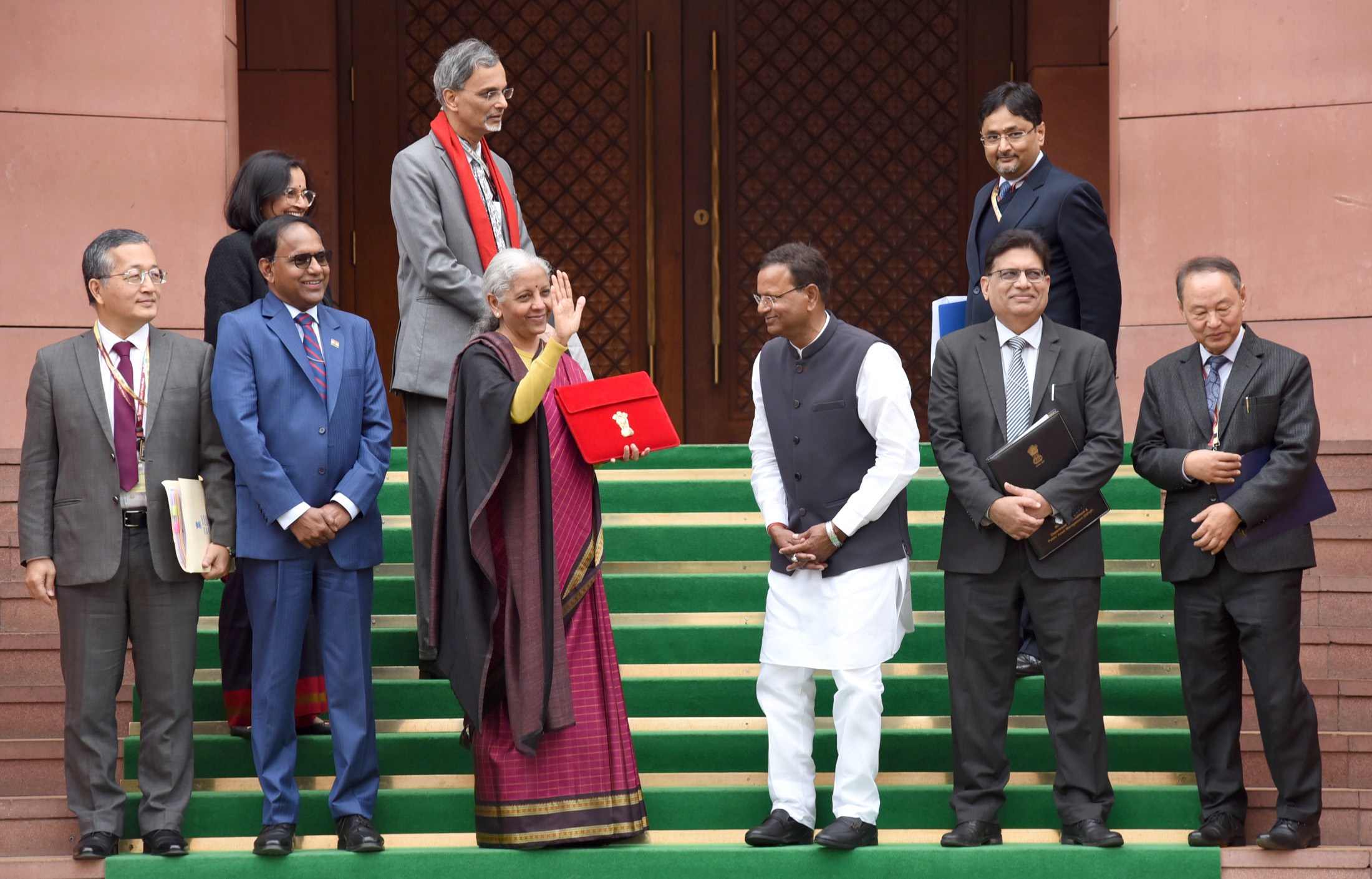
The Union Minister for Finance and Corporate Affairs, Nirmala Sitharaman along with the Ministers of State for Finance, Pankaj Chaudhary as well as her Budget Team/senior officials of the Ministry of Finance before the presentation of the Union Budget-2026 at Parliament House, in New Delhi on February 01, 2026.
 By Deepak Parvatiyar*
From Rare Earths to Rules: Inside Budget 2026
Critical Metals and Careful Maths
New Delhi: The Union Budget 2026–27 presented in Lok Sabha today placed rare earth elements and critical mineral processing at the centre of India’s industrial and trade policy, announcing wide-ranging customs duty exemptions and tax incentives for equipment and manufacturing linked to strategic minerals used in renewable energy, electronics and defence production.
The measures come amid renewed debate over domestic mining in environmentally sensitive regions such as the Aravalli hills and concerns over India’s dependence on imported supplies for energy transition technologies and advanced manufacturing. The Budget proposed to realign customs and tax policy to support domestic processing capacity in minerals considered critical to industrial competitiveness.
The focus on critical minerals was accompanied by proposals to incentivise prospecting and exploration. Certain critical minerals are to be included in Schedule XII of the Act, making expenditure on their exploration eligible for deduction under Section 51. The move is intended to attract private investment into mineral exploration, a segment that has remained limited in scale despite rising strategic demand.
This shift in fiscal treatment is linked to the government’s broader strategy under the National Critical Mineral Mission and overseas sourcing arrangements. The government-backed joint venture Khanij Bidesh India Limited has acquired 15,703 hectares in Argentina for lithium mining and entered partnerships in Australia and Chile, while India participates in international frameworks such as the Minerals Security Partnership and the Indo-Pacific Economic Framework.
The strategic dimension of critical minerals has also featured in recent diplomatic engagement. In a Republic Day statement issued on January 25, 2026, United States Secretary of State Marco Rubio referred to cooperation with India on defence, energy and critical minerals as part of a broader partnership covering emerging technologies and the Indo-Pacific region. The reference underscored the growing geopolitical weight attached to supply chains for rare earths and other strategic resources.
 The Economic Survey 2025–26 had earlier noted that metals such as lithium, cobalt, nickel, copper and rare earth elements are becoming constraints in the global low-carbon economy, with advanced economies moving toward standards-based mineral markets emphasising sustainability, traceability and governance.
The Budget’s emphasis on mineral processing and supply chains places fiscal policy within this evolving international setting.
A Scheme for Rare Earth Permanent Magnets was launched in November 2025. “We now propose to support the mineral-rich States of Odisha, Kerala, Andhra Pradesh and Tamil Nadu to establish dedicated Rare Earth Corridors to promote mining, processing, research and manufacturing, ” Finance Minister Nirmala Sitharaman announced in her Budget speech today.
The critical minerals push was accompanied by related measures in the energy sector. The Budget followed the enactment of the Sustainable Harnessing and Advancement of Nuclear Energy for Transforming India (SHANTI) Act in December 2025, which enables private-sector participation in nuclear power generation, equipment manufacturing and research. Customs duty exemptions were extended to nuclear power projects and selected energy transition technologies.
Sitharaman’s Budget speech today was organised around three stated “kartavyas” (duties): sustaining economic growth, building human capacity and expanding access to resources and opportunities. These themes were used to group proposals across taxation, infrastructure spending, financial sector reform and sector-specific incentives.
Fiscal stance and consolidation
The fiscal position remained cautious. The government projected a fiscal deficit of 4.3 per cent of gross domestic product for 2026–27, compared with 4.4 per cent in the revised estimate for 2025–26. The debt-to-gross domestic product ratio is projected to decline to 55.6 per cent, with a longer-term target of around 50 per cent by 2030–31.
Total expenditure for 2026–27 is estimated at ₹53.5 lakh crore, while non-debt receipts are projected at ₹36.5 lakh crore. Net market borrowings are pegged at ₹11.7 lakh crore. The fiscal projections assume continued buoyancy in tax collections and stable macroeconomic conditions.
Public capital expenditure has been maintained at ₹12.2 lakh crore, with allocations directed toward transport corridors, urban infrastructure and industrial clusters. An Infrastructure Risk Guarantee Fund was announced to partially cover lender risk during construction phases, reflecting continuing concerns over private sector participation in large infrastructure projects.
The fiscal projections rest on assumptions of steady nominal growth and continued buoyancy in tax revenues. The Budget did not outline contingency measures for risks such as volatility in global energy prices, geopolitical disruptions to trade or weaker demand in major export markets.
 Direct taxes: compliance reform over rate cuts
A key legislative change is the introduction of the new Income Tax Act, 2025, which will replace the Income Tax Act of 1961 from April 1, 2026. The government said simplified Income Tax Rules and redesigned forms will be notified shortly to make compliance easier for ordinary taxpayers. The change represents a procedural overhaul rather than a revision of tax rates.
Interest awarded by Motor Accident Claims Tribunals to individuals will be exempt from income tax. Tax collected at source on overseas tour packages and on remittances for education and medical purposes under the Liberalised Remittance Scheme has been reduced to 2 per cent.
Timelines for filing and revising income tax returns have been extended. Depositories will be allowed to centrally accept Form 15G and Form 15H declarations for investors holding securities in multiple companies. A one-time foreign asset disclosure scheme has been introduced for small taxpayers, including students and young professionals.
Assessment and penalty proceedings will be combined into a single order. Several technical defaults are proposed to be converted into fees, and minor offences such as non-production of books of account and certain tax deduction at source failures will be decriminalised. Maximum imprisonment terms for remaining offences will be reduced, with graded penalties linked to the amount involved.
The Budget did not propose major changes to the Goods and Services Tax rate structure or slabs. Indirect tax reform remained focused on customs duties and trade facilitation rather than domestic consumption taxation.
Corporate taxation and market measures
Corporate tax policy continued to shift firms toward the newer tax regime. Minimum Alternate Tax will be converted into a final tax at a reduced rate of 14 per cent, with limited use of carried-forward credits.
Tax treatment of share buybacks has been revised by shifting all shareholders to capital gains taxation, with additional levies on promoters to curb arbitrage. Securities Transaction Tax on futures and options has been increased.
For the information technology sector, multiple service categories were merged into a single “Information Technology Services” classification with a common safe harbour margin. Eligibility thresholds were expanded and approvals shifted to an automated process.
Incentives for foreign investment
Foreign companies providing cloud services through data centres in India will be eligible for tax holidays until 2047, subject to conditions. Safe harbour margins were introduced for bonded warehouse component storage and toll manufacturing arrangements.
Non-resident experts working under notified schemes will receive an exemption on foreign-sourced income for up to five years. Non-residents paying presumptive tax will be exempt from Minimum Alternate Tax.
The Foreign Exchange Management rules governing non-debt instruments will be reviewed to simplify investment processes.
The speech did not place emphasis on disinvestment or large-scale asset monetisation as a source of non-tax revenue.
Indirect taxes and customs reform
To reduce input costs and promote domestic manufacturing and export competitiveness, the Budget announced significant reductions in basic customs duty across critical minerals, renewable energy, nuclear power, electronics, civil aviation, defence and pharmaceuticals, effective from February 2, 2026, unless otherwise specified.
Basic customs duty on critical minerals such as monazite has been reduced from 2.5–7.5 per cent to nil. Sodium antimonate used in the manufacture of solar glass and specified capital goods for lithium-ion battery cell manufacturing have also been fully exempted.
In the nuclear energy sector, all goods for the generation of nuclear power under tariff item 84013000 and control and absorber rods under tariff item 84014000 will attract nil duty, down from 7.5 per cent. Goods required for setting up specified nuclear power projects registered with customs authorities on or before September 30, 2035, will also be fully exempted.
For electronics, specified goods used in the manufacture of microwave ovens will attract nil duty. In civil aviation, components and parts, including aircraft engines imported for manufacture or maintenance, will be exempted. Raw materials imported by public sector units under the Ministry of Defence for the repair and overhaul of aircraft will also attract nil duty.
In the pharmaceuticals sector, 17 new drugs and medicines have been added to the list of fully exempted items, along with medicines for seven rare diseases under the National Policy for Rare Diseases, 2021.
For personal imports, with effect from April 1, 2026, all dutiable goods imported under Chapter Heading 9804 will attract a uniform basic customs duty of 10 per cent, replacing the earlier 10–20 per cent structure. Drugs, medicines and food for special medical purposes imported for personal use will also receive full exemption.
Customs administration will move further toward trust-based systems. Duty deferral periods for authorised economic operators were extended, advance rulings made valid for five years, and automated clearance introduced for low-risk cargo. A single digital window for regulatory approvals is expected to be operationalised in phases by April 2026.
The Budget offered limited new measures for agriculture and rural consumption. No major changes were announced in food, fertiliser or fuel subsidy structures.
Ease of doing business and financial sector reforms
Ease of doing business measures included higher limits for equity investment by individuals resident outside India and a review of investment rules for non-debt instruments.
A High-Level Committee on Banking for Viksit Bharat will examine the structure and future role of the banking sector. Restructuring of public-sector non-banking financial companies was proposed, alongside new frameworks for corporate bond market market-making and derivatives.
Large municipal bond issuances will receive incentives, while smaller urban bodies will continue to be supported through existing financing schemes.
The Budget did not outline major shifts in fiscal devolution to states. Implementation of several proposals, particularly in mining, infrastructure and urban financing, will depend on coordination with state governments.
Several proposals relating to critical minerals, nuclear power and large infrastructure projects intersect with existing environmental and regulatory debates. Their impact will depend on how fiscal incentives are reconciled with safeguards governing mining, land use and industrial approvals.
Overall assessment
The Union Budget 2026–27 combines a strategic focus on critical minerals and energy security with incremental tax rationalisation and procedural reform. The three “kartavyas” provide a thematic structure for proposals that largely extend earlier policy trends: infrastructure-led growth, selective industrial incentives and compliance simplification.
The economic effect of the Budget will depend on how subordinate rules are framed and how investors and taxpayers respond to the incentives offered. The significance of the proposals will be determined by implementation rather than announcement.
*Senior journalist