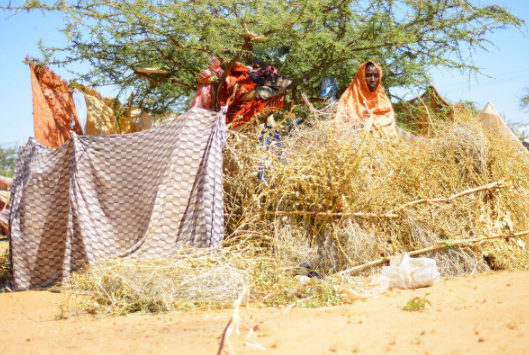
FIle photo of dire living conditions in Zamzam IDP camp in North Darfur, where famine was declared in August 2024. People are surviving on crushed peanut shells typically used to feed animals. Photo: ©WFP/Mohamed Galal
Sudan war: Aid teams plead for access to thousands trapped in El Fasher
Geneva: El Fasher, the regional capital of North Darfur, remains a city in limbo as paramilitary fighters maintain control after a 500-day siege, leaving residents facing extreme deprivation. Families outside the city are still struggling to determine how many remain trapped.
Volker Türk, the United Nations High Commissioner for Human Rights, described the situation as catastrophic at the Human Rights Council in Geneva. He said, “We warned that the fall of the city to the Rapid Support Forces would result in a bloodbath. All those involved in this conflict should know: we are watching you, and justice must prevail.” He added that bloodstains on the ground in El Fasher “can be seen from space,” underscoring the scale of atrocities reported, including mass killings and executions along ethnic lines.
The paramilitary fighters controlling El Fasher are part of the Rapid Support Forces, a militia formally established in 2013. The group has roots in militias previously active in Darfur and operates with a high degree of autonomy. Tensions between the Rapid Support Forces and Sudan’s regular army escalated sharply on April 15, 2023, leading to open conflict over authority, integration into the military, and control of strategic resources. Since then, the ordeal in El Fasher and other conflict zones has continued for more than two years, with persistent violence, repeated displacements, and shifting frontlines.
Nearly 100,000 people have fled El Fasher and surrounding villages in the last two weeks alone, according to the United Nations Refugee Agency, the UN High Commissioner for Refugees (UNHCR). Jacqueline Wilma Parlevliet, Head of the UNHCR Sub Office in Port Sudan, said families arriving in Tawila, about 50 kilometres from El Fasher, recounted “unimaginable horrors” endured both before and after fleeing the city. She highlighted widespread reports of rape and sexual violence, adding, “Parents are searching for missing children, many traumatised due to conflict and the dangerous journey to reach safety. Unable to pay ransoms, families have lost young male relatives to arrests or forced recruitment into armed groups.”
Those attempting to leave face perilous journeys, often travelling for up to 15 days with limited food and water while avoiding military checkpoints, before reaching shelter in locations including Ad Dabbah on the Nile, which now houses at least 37,000 people from El Fasher. UNHCR also reported that armed groups are forcibly returning some people to El Fasher, where conditions remain dire. “Thousands of people, particularly the elderly, those with disabilities and the wounded, remain trapped, either prevented from leaving the city or lacking the means or strength to flee,” Parlevliet said.
Sudan faces the world’s largest displacement crisis, with more than 12 million people uprooted inside and outside the country. Those attempting to return home confront risks from unexploded ordnance and landmines, particularly in urban areas. Sediq Rashid, Chief of the United Nations Mine Action Service (UNMAS) in Sudan, said, “There are many other countries that are affected by explosive remnants of war and landmines…Sudan is very different. Why? Because war is mainly happening in urban areas.” He added that in Khartoum, threats include unexploded and abandoned ammunition, anti-vehicle mines, and anti-personnel mines. Displaced families settling in unfamiliar locations are particularly at risk, “without any awareness of past conflicts or contamination,” he explained.
Civilian casualties from mines and other unexploded ordnance continue to rise, and Rashid noted, “We know that the cases that are being reported represent only a fraction of the true scale of the harm.”
The situation in El Fasher and across Sudan highlights both the ongoing humanitarian emergency and the complex dangers that displaced communities face, underscoring the urgent need for access, protection, and aid.
– global bihari bureau