Rogue State or Red Line? IAEA’s Limits Tested
Srinagar: India’s Defence Minister Rajnath Singh dropped a diplomatic bombshell in Srinagar’s Badami Bagh Cantonment, urging the International Atomic Energy Agency (IAEA) to take charge of Pakistan’s nuclear arsenal, branding it unsafe, a terrorist magnet, and the hallmark of a “rogue state.”
Speaking to troops fresh from Operation Sindoor—a precision strike against alleged terrorist camps in Pakistan—Singh’s May 15 call, delivered against a backdrop of distant snow-capped Himalayan peaks, came days after a ceasefire ended the neighbours’ fiercest clash in decades.
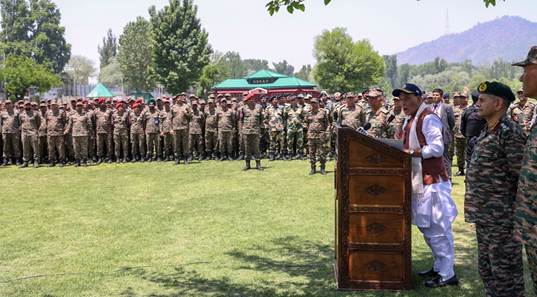
Rajnath Singh asserted that India’s unwavering resolve against terrorism can be gauged from the fact that it was not deterred by Pakistan’s nuclear blackmail, pointing out that the world has witnessed how irresponsibly Islamabad has issued nuclear threats to New Delhi several times. “I raise this question before the world: Are nuclear weapons safe in the hands of such an irresponsible and rogue nation? Pakistan’s nuclear weapons should be taken under the supervision of the International Atomic Energy Agency (IAEA),” he said.
With Pakistan’s Foreign Ministry firing back, dismissing the demand as “ignorance” of the IAEA’s mandate, the world’s nuclear watchdog finds itself in an impossible spotlight. Can the IAEA, a Vienna-based guardian of peaceful nuclear use, act on Singh’s plea, or is India’s gambit a geopolitical feint doomed to falter?
Singh’s demand, delivered amid the tension of a restive Kashmir, was blunt: Pakistan’s nuclear threats, economic woes, and alleged terror ties make its arsenal a global hazard. “Are nuclear weapons safe in the hands of such an irresponsible and rogue nation?” he asked, pointing to the nuclear watchdog as the solution. The context is raw—India’s May 7, 2025, strikes followed a deadly April 22 attack in Pahalgam, killing 26, which New Delhi pinned on Pakistan-backed terrorists. Pakistan’s retaliatory strikes and nuclear sabre-rattling, including a chilling “either we live or no one does” from its defence minister, fueled Singh’s charge.
Singh’s Call: IAEA Faces Pakistan Nuke Dilemma
Yet, the IAEA’s mandate, rooted in its 1957 statute, is a narrow path: promote peaceful nuclear energy, verify civilian programmes under safeguards, and foster safety standards. It’s not a nuclear police force, and Pakistan’s military arsenal lies far beyond its reach.
The Agency’s core mission is to ensure nuclear materials aren’t diverted to weapons in states under safeguards agreements, primarily those signed to the Non-Proliferation Treaty (NPT). Pakistan, like India, never signed the NPT, developing its nuclear weapons outside this framework. Its five nuclear power reactors and two research reactors are partially under IAEA safeguards, but its military facilities, where warheads and fissile material reside, are off-limits absent Pakistan’s consent. The IAEA can inspect civilian sites, as it has since Pakistan’s 1972 Karachi reactor, but has no authority to seize or manage nuclear weapons.
Singh’s call would require either Pakistan’s voluntary submission or a UN Security Council resolution, a tall order given China’s veto power and Pakistan’s sovereignty claims. The IAEA’s jurisdiction is limited to civilian programmes, not strategic arsenals.
Pakistan’s nuclear programme, born after India’s 1974 test and cemented by 1998 detonations, is tightly guarded by its National Command Authority (NCA). The Pakistan Nuclear Regulatory Authority (PNRA) oversees civilian safety, earning IAEA praise in 2022 for updated regulations and emergency preparedness. A 2014 IAEA mission lauded PNRA’s framework, and a 2023 report found no radiation leaks during recent India-Pakistan clashes, debunking Kirana Hills strike rumours.
Yet, concerns linger—past leaks by Abdul Qadeer Khan’s proliferation network and extremist threats in Khyber Pakhtunkhwa fuel fears of insider risks. A 2021 Arms Control Association report highlighted vulnerabilities from Pakistan’s expanding arsenal and instability, though Pakistani officials insist components are separated and safeguarded per IAEA standards.
Singh’s plea isn’t just about safety—it’s a diplomatic jab. India, too, operates outside the NPT, with 22 reactors under partial IAEA oversight. Pakistan’s Foreign Ministry, in a May 15 statement, flipped the script, accusing India of nuclear material theft and trafficking.
The IAEA can’t act unilaterally; its Incident and Emergency Centre monitors accidents, not state arsenals, and its board, including India and Pakistan, would baulk at overstepping.
A United Nations Security Council (UNSC) push, as suggested by Singh, faces gridlock—China backs Pakistan, while the U.S., per President Donald Trump’s May 15 Qatar remarks, prefers trade over escalation.
Operation Sindoor’s success, Singh argued, shows India’s resolve against “nuclear blackmail,” but the IAEA’s hands are tied without global consensus.
Nukes and Terror: IAEA’s Mandate on Trial
The fallout is prickly. Pakistan’s economy, battered and International Monetary Fund-dependent, doesn’t soften its defiance—Prime Minister Shehbaz Sharif called Singh’s remarks “insecurity” over Pakistan’s conventional strength. India’s External Affairs Minister Dr S. Jaishankar, on May 15, doubled down, demanding Pakistan end terrorism before talks, signalling no bilateral thaw.
The IAEA, caught in the crossfire, risks its neutrality if it engages, yet ignoring Singh’s call could embolden critics of its relevance. The Middle East, wary of nuclear escalation, watches nervously—Saudi Arabia’s $600 billion deals with the U.S. hinge on stability, not chaos.
Singh’s demand, bold as it is, crashes into reality: the IAEA can’t seize Pakistan’s nukes without rewriting international law or securing Pakistan’s unlikely consent. Its mandate—technical, not coercive—focuses on cooperation, not confrontation.
Pakistan’s safeguards, while imperfect, meet IAEA civilian standards, and the nuclear watchdog says there is so far no evidence of terrorist access, despite India’s fears.
The UNSC, not the IAEA, holds the keys to enforcement, but geopolitics ensures stalemate. As India and Pakistan trade barbs, the IAEA’s role remains what it’s always been: a referee, not a cop. Singh’s call may rally domestic support and rattle Islamabad, but it’s a long shot for global action, leaving the subcontinent’s nuclear standoff as tense as ever.
– global bihari bureau