India Showcases First Indigenous Quantum Magnetometer, Diamond Microscope
IIT Bombay Gets India’s first Liquid Helium Cryogenic facility
Dr Jitendra Singh Opens ₹720-Cr Quantum Facilities
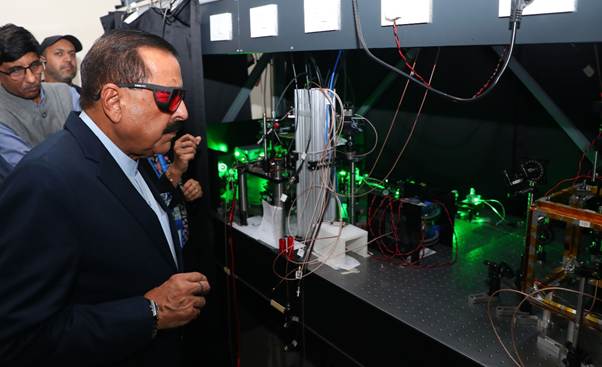
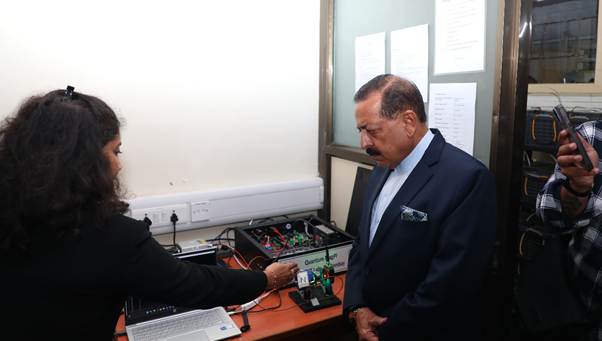
Mumbai: In a moment that felt more like science fiction stepping into reality, researchers at the Indian Institute of Technology (IIT) Bombay today switched on three revolutionary machines that can “see” magnetic fields weaker than a billionth of a refrigerator magnet, map the invisible thoughts of living brain cells, and detect cancer long before a tumour even forms—all using diamonds as their secret weapon. Union Minister of State for Science and Technology Dr Jitendra Singh walked through the gleaming Quantum Labs, watched the red glow of these diamond sensors dance in response to invisible forces, and then threw open the doors to India’s first high-efficiency Liquid Helium Cryogenic Facility while unveiling a ₹720-crore national push that will finally give Indian scientists their own world-class quantum factories.
Imagine a flaw inside a diamond—so small that a million of them could fit on the tip of a needle—acting as the most sensitive compass ever built. That flaw is the nitrogen-vacancy (NV) centre: one carbon atom swapped for nitrogen, the next simply missing. This microscopic imperfection behaves like a tiny spinning magnet that glows bright red when undisturbed and dims the instant something—be it a magnetic whisper, a temperature flicker, or a rogue oxygen molecule—nudges it. Best of all, it works perfectly at room temperature, needs only a green laser and a microwave pulse to operate, and never bleaches or dies. For the first time in India, IIT Bombay has turned this quantum magic into real instruments you can hold in your hand.
The star of the show was QMagPI—a rugged, battery-powered box no bigger than a lunchbox that can sense magnetic fields a billion times weaker than Earth’s own. Switch it on in a jungle, a desert, or a defence testing range, and it will quietly map buried structures, mineral deposits, or hidden objects with a precision that only a handful of nations on the planet can match today.
Next came the Quantum Diamond Microscope, a breathtaking wide-field camera that turns an entire sheet of diamond into millions of atomic compasses. Shine green light across it, snap a photograph of the red glow, and suddenly you can watch the magnetic heartbeat of a living neuron, trace defects inside tomorrow’s microchips, or read ancient magnetic memories locked inside million-year-old rocks—all in vivid, three-dimensional colour.
Then, in a moment that left the visiting dignitaries speechless, the team showed living cancer cells under an ordinary-looking microscope. Inside each cell floated harmless nanodiamonds, each carrying a single NV centre. As reactive oxygen species—the chemical fingerprints of disease—rose inside malignant glioblastoma cells, the diamond sensors inside them blinked in a tell-tale pattern, flagging cancer while it was still just a handful of misbehaving molecules. No dyes, no labels, no radiation—just pure quantum physics catching cancer at its earliest whisper.
From the glowing diamonds, Dr Singh moved to the heart of India’s cryogenic future: a sparkling new Liquid Helium Facility that captures and re-liquefies over ninety-five per cent of the precious gas. In one stroke, experiments that once cost lakhs of rupees per day will now cost pocket change, and Indian labs will no longer be held hostage by global helium shortages. For quantum computers that must live at temperatures a hundred times colder than deep space, this facility is the oxygen pipeline they have been waiting for.
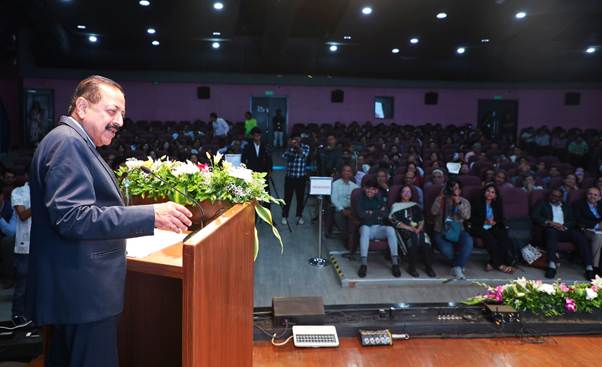
And then came the announcement of ₹720 crore to build four national quantum foundries—cleanrooms and ultra-low-temperature factories at IIT Bombay, IISc Bengaluru, IIT Kanpur and IIT Delhi—where Indian scientists and start-ups will finally design, fabricate and test their own quantum chips instead of shipping ideas overseas.
Behind this surge stands the National Quantum Mission, launched in 2023 with ₹6,003 crore and a daring deadline: by 2031, India will have its own 50–1,000-qubit quantum computers, satellite-secured quantum communication networks stretching from Kashmir to Kanyakumari, clocks so precise they won’t lose a second in billions of years, and a complete home-grown supply chain for quantum technology. Today’s new fabrication hubs are the first concrete pillars of that audacious dream.
As the minister left the stage, he turned to the young researchers—many still in their twenties—who had built these machines from scratch and said simply: “You have just shown the world that India does not need to follow in quantum technology. We have started to lead.”
With the red glow of diamond sensors still dancing in the eyes of everyone present, one thing was crystal clear: a new chapter of Indian science has begun, and it sparkles brighter than any gem on Earth.
– global bihari bureau