Qatar’s Rebuke Tests Gulf Stability, Ceasefire Hopes
Doha/Washington/Jerusalem/New York: Israel’s September 9, 2025, airstrikes on Hamas leaders in Doha have provoked a strong rebuke from Qatar, threatening to destabilise the Gulf and derail U.S.-brokered Gaza ceasefire talks.
Qatar’s Foreign Ministry today condemned Israeli Prime Minister Benjamin Netanyahu’s defence of the attack, stating, “The reckless statements made by the Prime Minister of Israel… [are a] shameful attempt to justify the cowardly attack that targeted Qatari territory.”
The ministry emphasised Qatar’s mediation role, asserting, “Netanyahu is fully aware that the hosting of the Hamas office took place within the framework of Qatar’s mediation efforts requested by the United States and Israel.”
Qatar’s Prime Minister Sheikh Mohammed bin Abdulrahman Al-Thani called the strike “state terror” that “killed any hope” for a hostage deal.
With a United Nations Security Council briefing scheduled for September 11, Qatar’s pledge to take “all necessary measures” to defend its sovereignty signals a potential crisis, undermining its mediation role for a possible ceasefire, straining U.S.-Qatar-Israel relations, and raising Gulf concerns about U.S. defence commitments.
The White House confirmed President Donald Trump spoke to Netanyahu twice after the strike, with an Israeli official describing the talks as “good” and Netanyahu expressing a desire for a quick peace. Press Secretary Karoline Leavitt expressed U.S. disapproval, stating, “The decision to bomb a sovereign ally and a critical partner in peace negotiations does not advance U.S. or Israel’s interests”.
An Israeli official reported Trump was “very unhappy” with the strike’s location in Qatar, a major non-NATO ally hosting 11,000 U.S. troops at the Al Udeid Air Base, and assured Qatar’s Emir and Prime Minister it would not recur.
The U.S. embassy in Doha issued a shelter-in-place order after the attack, which killed six: five lower-ranking Hamas members, including Khalil al-Hayya’s son, and a Qatari security officer, per Hamas. Hamas confirmed its senior leaders—al-Hayya, Zaher Jabarin, Muhammad Ismail Darwish, and Khaled Mashal—survived, stating, “The Zionist enemy’s attempt to eliminate the negotiating delegation… is a desperate attempt to thwart ceasefire efforts,” per Al Jazeera.
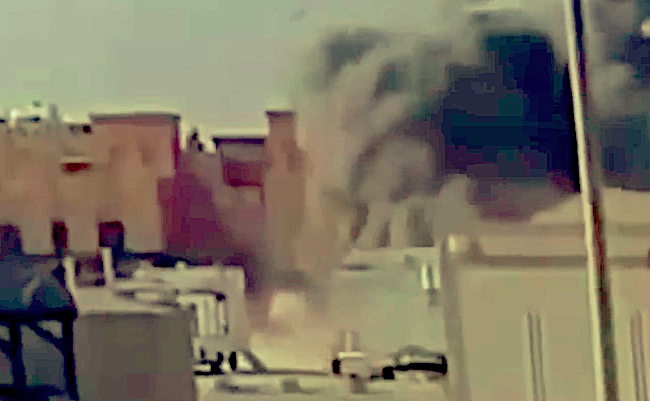
Israel’s operation, “Summit of Fire,” carried out a series of airstrikes on buildings in a residential district of Doha, the capital of Qatar, targeting senior members of the leadership of the Palestinian movement Hamas. Israel targeted Hamas negotiators in Doha’s Leqtaifiya district with missiles from Israel Defense Forces (IDF) jets, prompted by Hamas’s claim of responsibility for the September 8 Ramot Junction shooting in Jerusalem, killing six civilians, and Gaza attacks killing four soldiers, per a September 9 joint statement by Netanyahu and Defence Minister Israel Katz. The statement disclosed, “Yesterday, after the murderous attacks in Jerusalem and Gaza, Prime Minister Netanyahu directed all security elements to prepare for the possibility of striking the Hamas leadership. The Defence Minister fully supported this initiative”. At a U.S. Embassy event on September 9, Netanyahu declared, “At noon today, I convened the heads of Israel’s security organisations and authorised a surgical precision strike on the terrorist chiefs of Hamas… Israel has kept that promise.” At a Bat Yam ceremony dedicating a promenade to Trump, he warned today, “I say to Qatar and all nations who harbour terrorists, you either expel them or you bring them to justice. Because if you don’t, we will”. Bat Yam Mayor Tzvi Brot praised Trump, stating, “Throughout his terms, President Trump has stood steadfast alongside Israel… for the release of our hostages.”
Qatar’s Foreign Ministry countered, “The false comparison to the pursuit of Al-Qaeda… is a new, miserable justification for [Israel’s] treacherous practices,” emphasising that its mediation, conducted “in an official and transparent manner,” facilitated “numerous exchanges and ceasefires” since October 7, 2023.
Qatar’s mediation role, pivotal since 2012 at U.S. and Israeli request, secured a November 2023 truce releasing 105 Israeli hostages for 240 Palestinian prisoners. The strike targeting Hamas negotiators undermines this role, with Qatar’s Prime Minister stating, “This shows that the Israelis don’t have any seriousness when it comes to reaching a [ceasefire] settlement”.
Qatar previously suspended mediation in November 2024 due to stalled talks, warning it would pause until parties showed “willingness and seriousness”. The attack risks a similar withdrawal, halting negotiations for hostages held over 700 days and prolonging the Gaza war, which has killed around 64,000 people till early September 2025, as per the Gaza Health Ministry.
The strike has heightened Gulf concerns about U.S. defence commitments, as Qatar hosts 11,000 U.S. troops at Al Udeid, a cornerstone of U.S. regional strategy, per The Conversation. The U.S.’s late warning to Qatar, and reports of foreknowledge without specific location details, have sparked doubts among Gulf allies like Saudi Arabia and the United Arab Emirates(UAE), who condemned the strike. Rashid al-Mohanadi, a fellow at the Middle East Council on Global Affairs, noted, “They see this as an act of cowardice and treachery,” reflecting Qatar’s sense of betrayal, per Al Jazeera. This could strain U.S.-Gulf defence cooperation, as Qatar may question the U.S. ability to protect allies from Israeli actions, potentially impacting Al Udeid operations, per The Washington Institute.
The UN, via spokesperson Stéphane Dujarric, today expressed “grave concern” over the Doha strike and Israel’s Yemen attacks, which hit near a UN facility, stating, “What we want to see is a cessation of all military activities… to avoid anything that would escalate tensions,” per the provided briefing.
The UN Security Council briefing by Assistant Secretary-General Khaled Khiari, set for September 11, could propose resolutions condemning Israel or urging de-escalation, potentially shaping international responses, per Dujarric’s remarks. Saudi Arabia, the UAE, Egypt, Türkiye, China, Russia, and the United Kingdom (UK) condemned the strike, with UK Prime Minister Keir Starmer warning, “This risks further escalation in the region,” per CBC. European Commission President Ursula von der Leyen proposed sanctions and trade suspension against Israel over Gaza actions, per prior reports. Iran called the strike a “criminal act,” referencing its June 2025 attack on a U.S. base in Qatar. Iranian President Masoud Pezeshkian stated, “The United Nations, the Organization of Islamic Cooperation, and other international bodies are expected to respond immediately, decisively, and practically to this blatant aggression”. He said Israel’s strikes “not only violated international laws and humanitarian principles but also made peace and stability in the region the target of its blatant aggression…Attacking an independent country is a clear violation of national sovereignty and the UN Charter, and the indifference of global powers to such behaviors will double the risk of escalating crises and wars in the region”. Russia also termed the Israel’s aggressive act as a flagrant violation of international law and an unacceptable assault on the sovereignty and territorial integrity of Qatar. “Serious concern was articulated regarding Israel’s actions, which risk further destabilising the situation in the Middle East,” the Russian foreign ministry stated after Foreign Minister Sergey Lavrov called up Qatar’s Prime Minister and Foreign Minister Mohammed Al Thani today.
The Doha strike threatens Gaza ceasefire talks, with Hamas deepening mistrust, per its statement. Israel’s Yemen strikes, targeting Houthi facilities after their Ramon Airport attack, escalate tensions, with Netanyahu vowing today, “Whoever attacks us – we will reach them”. Iran’s condemnation and Houthi ties raise fears of proxy conflicts. Qatar’s potential to seek UN sanctions or scale back mediation, backed by global condemnation, could isolate Israel, prompting further actions, as Ambassador Yechiel Leiter’s vow to pursue Hamas suggests.
Yet, UN and UK calls for de-escalation, per Dujarric and Starmer, alongside Qatar’s commitment to “establish security and stability,” may encourage diplomatic resolutions, with the UN briefing offering a critical opportunity to redirect focus to peace.
– global bihari bureau