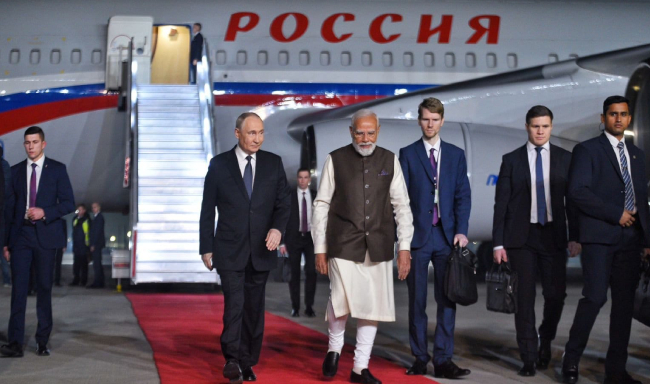
Prime Minister Narendra Modi receives President of Russian Federation, Vladimir Putin at the airport, in New Delhi on December 04, 2025.
India-Russia Summit Seals $100B Pact
New Delhi: Russian President Vladimir Putin arrived here this evening for a two-day state visit, marking his first visit to India since the outbreak of the war in Ukraine. The visit coincides with the 23rd India–Russia Annual Summit, reinforcing what both Moscow and New Delhi call a “Special and Privileged Strategic Partnership.” In a striking departure from diplomatic protocol, Prime Minister Narendra Modi personally greeted Putin at the steps of the plane, signalling India’s intent to assert its strategic autonomy on the global stage. The Kremlin, in a statement released on November 28, described the visit as “of great importance,” noting that it would cover the full spectrum of bilateral cooperation: political, trade and economic relations, science and technology, cultural and humanitarian affairs, as well as pressing international and regional issues. Putin is also scheduled to meet President Droupadi Murmu, with both sides expected to adopt a joint statement and sign a wide array of interdepartmental and business agreements.
Accompanying Putin is a high-ranking delegation spanning Russia’s key ministerial and economic leadership. Officially named members include Andrei Belousov, Defence Minister; Anton Siluanov, Finance Minister; Oksana Lut, Agriculture Minister; Maxim Reshetnikov, Economic Development Minister; Mikhail Murashko, Health Minister; Vladimir Kolokoltsev, Interior Minister; and Elvira Nabiullina, Head of the Central Bank. Senior officials from Russian state enterprises, covering defence, energy, heavy industry, banking, and technology, are also part of the delegation, reflecting the multi-sectoral nature of the agenda. The presence of this broad roster signals that the visit is designed to encompass not only defence and energy cooperation but also diversified economic, industrial, and technological collaboration.
Defence Deals Dominate Putin Visit
Defence issues are expected to feature prominently, particularly following the recent ratification in Moscow of the Reciprocal Exchange of Logistic Support (RELOS) pact, which allows Russian and Indian forces to access each other’s bases and ports for exercises, humanitarian operations, and disaster relief. Reports indicate discussions will cover additional deliveries of S-400 Triumf missile systems, potential supply or joint-production of fifth-generation Su-57 stealth fighters, upgrades to existing platforms including Su-30MKI aircraft, and expanded submarine and naval cooperation. Technology transfer and local assembly under “Make in India” frameworks are likely to form part of these deals, underscoring the strategic and industrial ambitions behind the visit.
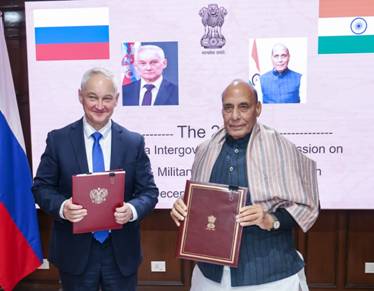
Further deepening the defence agenda, the Defence Minister and his Russian counterpart co-chaired the 22nd session of the India-Russia Inter-Governmental Commission on Military & Military Technical Cooperation (IRIGC-M&MTC) at the Manekshaw Centre, New Delhi. Both sides reiterated that India-Russia ties are based on a deep sense of trust, common principles, and mutual respect. The Defence Minister voiced India’s determination to strengthen the capacity building of its indigenous defence industry for both local production and exports under the vision of “Aatmanirbhar Bharat,” and stressed new opportunities for collaboration across niche technologies. Russian Defence Minister Andrei Belousov highlighted the readiness of the Russian defence industry to support India in becoming self-reliant in defence production and extended an invitation to visit Russia to co-chair the 23rd session of the IRIGC-M&MTC in 2026. The two ministers signed the protocol of the 22nd IRIGC-M&MTC meeting, emphasising ongoing and prospective areas of cooperation. Prior to the meeting, they paid respects at the National War Memorial and inspected the Ceremonial Tri-service Guard of Honour, reaffirming the symbolic and operational significance of defence cooperation.
Trade Boost: India Eyes Russian Markets
Economic engagement is also a key pillar. The India–Russia Business Forum, held alongside the summit, highlighted opportunities for expanding Indian exports to Russia. Commerce and Industry Minister Piyush Goyal described Russia as India’s “Sukh Dukh Ka Saathi,” emphasising the resilience and depth of the bilateral partnership. Trade between the two nations has reached approximately USD 70 billion, yet India’s share of Russian imports remains below 2 per cent, illustrating the untapped potential. Both sides have set a target of USD 100 billion in bilateral trade by 2030, with a focus on balancing the trade basket. Sectors identified for expansion include automobiles, electronics, heavy machinery, pharmaceuticals, textiles, food products, digital services, industrial components, and skilled labour mobility. Key Indian officials, including secretaries from Pharmaceuticals, Electronics & IT, Textiles, and Commerce and Industry, participated alongside Russian ministers such as Reshetnikov, Lut, Maksut Shadayev, and Alexey Gruzdev, discussing trade facilitation, investment promotion, industrial cooperation, and regulatory alignment to reduce asymmetries and create new commercial opportunities.
Concrete developments are emerging alongside broad discussions. Indian fertiliser firms are set to enter a joint venture with Russia’s Uralchem to build a gas-powered urea plant in Russia, ensuring long-term fertiliser security for India while establishing an industrial footprint in the Russian market. This aligns with India’s broader economic strategy to diversify beyond energy and defence imports and establish multi-sectoral trade and investment partnerships. The presence of ministers responsible for finance, economic development, and central banking reflects a concerted push to institutionalise economic and industrial collaboration at multiple levels.
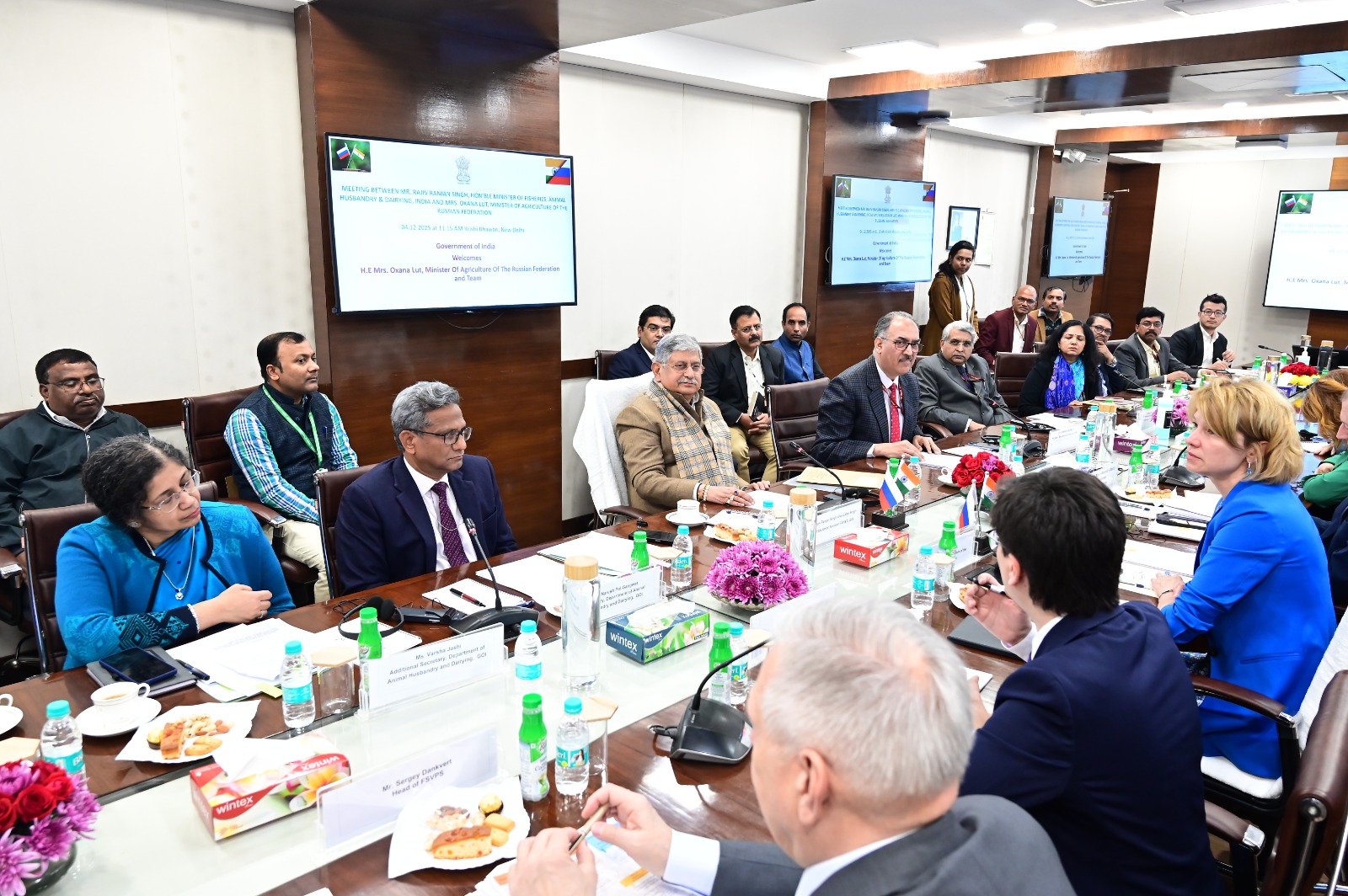
On the sidelines of the summit, high-level engagement in the agricultural and fisheries sector is also underway. Minister of Fisheries, Animal Husbandry & Dairying, Rajiv Ranjan Singh, held a bilateral meeting with Oksana Lut, Russia’s Minister of Agriculture, to strengthen trade in fisheries, animal, and dairy products. The discussions focused on resolving market access issues, fast-tracking establishment listings for exports, and collaboration in research, education, and emerging aquaculture technologies, including deep-sea fishing vessels, Recirculating Aquaculture Systems (RAS), and Biofloc. Minister Singh highlighted that India exported fish and fishery products worth USD 7.45 billion in 2024–25, including USD 127 million to Russia, and identified opportunities to diversify exports with shrimp, prawns, mackerel, sardines, tuna, crab, squid, and cuttlefish. The Russian delegation expressed readiness to take Indian products, including meat and dairy, and interest in developing the trout market through joint technical projects, potentially leading to joint ventures. Both sides discussed coldwater fisheries, genetic improvement, veterinary vaccine development, and capacity-building for deep-sea fishing and on-board processing, with an emphasis on exchange programs for officials, researchers, and students to strengthen mutual expertise. The meeting concluded with an agreement to create a structured mechanism for cooperation through a Memorandum of Understanding, building on the historic friendship between the two countries.
Modi’s Putin Hug Signals Autonomy
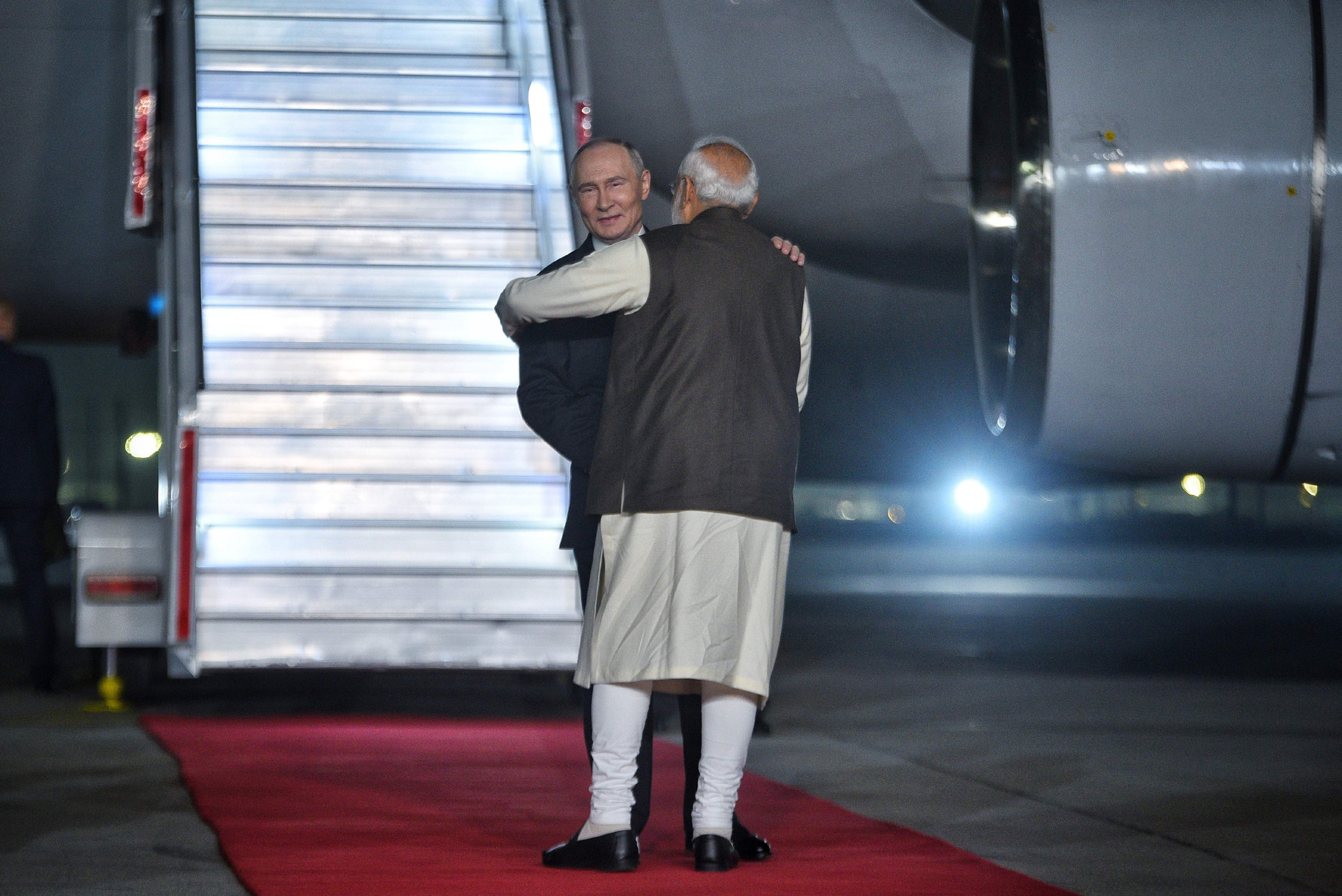
The visit is set against a complex geopolitical backdrop. Putin travels under an International Criminal Court (ICC) arrest warrant relating to alleged war crimes, including the deportation of Ukrainian children. India, as a non-signatory to the Rome Statute, has no legal obligation to act on the warrant. Nevertheless, the optics of Modi personally welcoming Putin highlight India’s calculated diplomatic autonomy and willingness to pursue strategic interests despite international scrutiny. The United States, which has imposed tariffs on India due to its ongoing Russian energy imports, is watching closely, as are European capitals, which face a balancing act between moral pressure and practical dependencies. For the Global South, India’s approach offers a model of strategic autonomy, maintaining relations with multiple powers while seeking diversified economic partnerships.
The visit’s layered agenda also reflects India’s domestic priorities. Macro-economic stability, robust GDP growth of 7.8–8.2 per cent, low inflation, and structural reforms such as the Goods and Services Tax and updated labour codes strengthen India’s bargaining power and capacity to deliver on new industrial and trade initiatives. India produces 2.4 million STEM graduates annually, offering skilled talent to meet Russia’s projected shortfall of three million professionals, a factor that could reinforce bilateral collaboration in technology, research, and industrial innovation.
Yet, risks persist. Defence and technology deals are complex and long-term, with delivery timelines subject to industrial constraints and sanctions-related challenges. Trade diversification requires regulatory alignment, capacity building, and financing mechanisms. International diplomatic costs remain, with Western capitals and civil society watching the optics of hosting a Russian leader under ICC indictment. Execution risk, both in industrial projects and joint ventures, could limit the immediate impact of announced agreements.
Overall, Putin’s 2025 visit to India represents a strategically layered engagement that seeks to deepen defence, economic, industrial, technological, and human-capital ties. The combination of ceremonial symbolism, ministerial-level coordination, business sector involvement, and high-level agricultural and fisheries cooperation is designed to institutionalise the Special and Privileged Strategic Partnership and create a durable framework for collaboration. The visit is simultaneously a statement of India’s diplomatic independence, a recalibration of its long-term strategic and economic engagement with Russia, and a test of both countries’ capacity to translate agreements into tangible, resilient outcomes amid a shifting international order.
– global bihari bureau