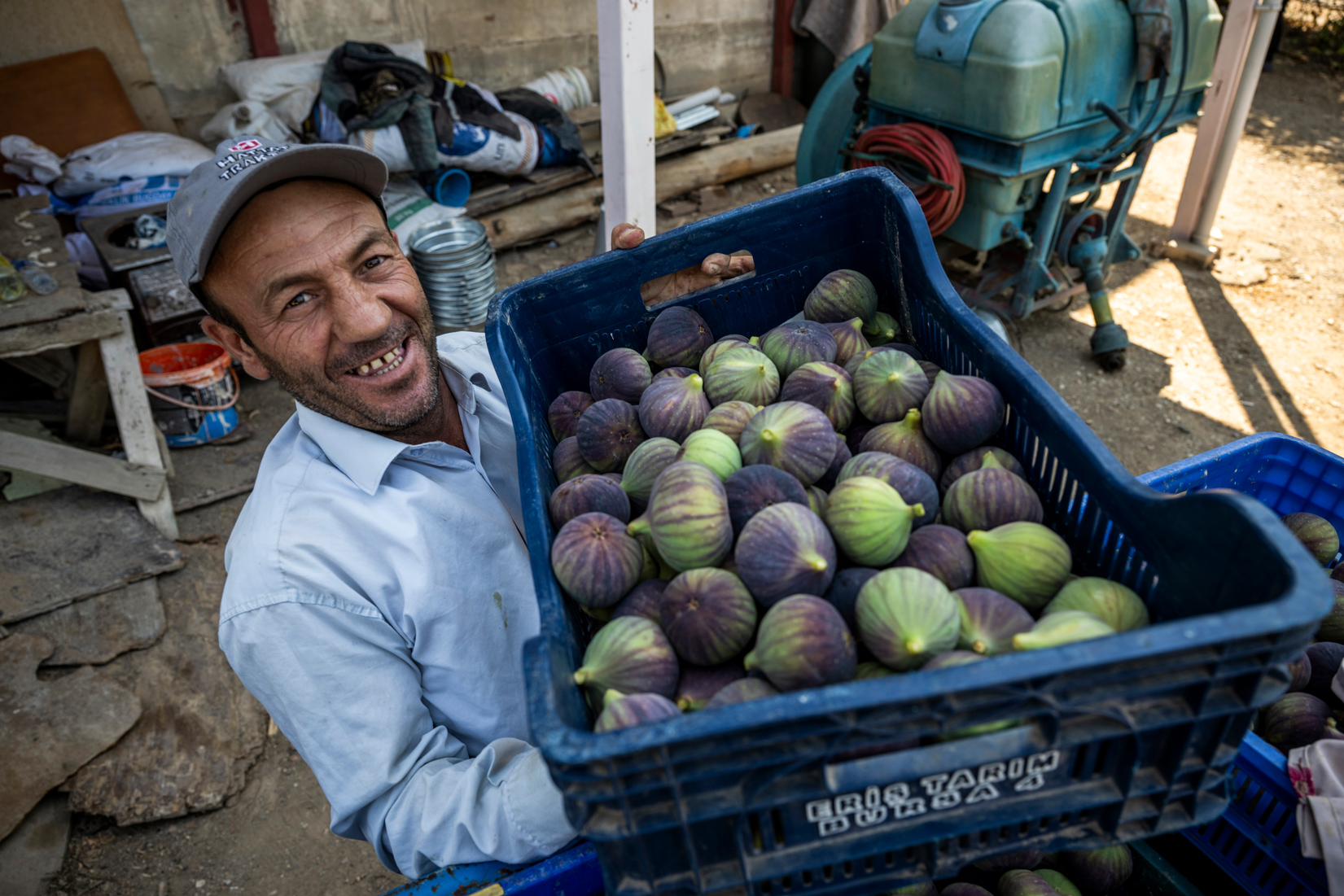
Careful sorting, grading and crating practices help preserve the fruits’ shelf life. GIs let consumers know they are buying the real deal. © FAO / Onur Coban
Black Bursa Figs: A Global Delicacy
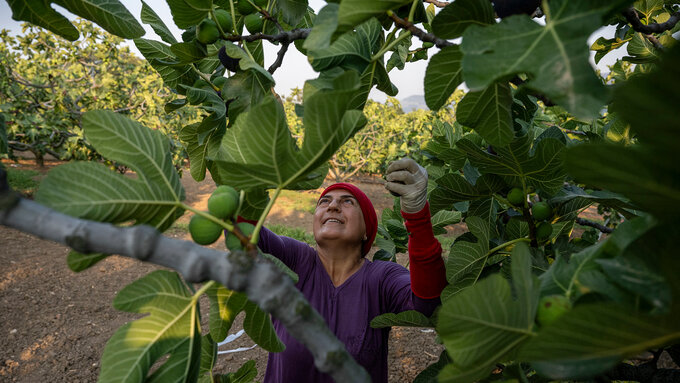
In the rolling hills of Bursa’s Karabalçık village, where orchards form a vibrant mosaic of fruit trees, olives, and vines, Hacer Şimşek navigates the branches with practised grace. The 42-year-old farmer, clad in latex gloves and red arm warmers to shield her skin from the stinging fig sap, carefully plucks ripe black figs and drops them into metal buckets carried by her daughter toward the shed. As dawn breaks during harvest season, Hacer and her family rise at 5 a.m., tending nearly 400 trees across their 3.1 hectares with relentless focus. “We work like robots for two months,” she explains, emphasising that mature figs must be picked within three days or they are lost forever.
This intense effort powers a thriving export market for Türkiye’s renowned Bursa black figs, alongside its celebrated peaches. Each tree yields 100 to 120 kilograms annually, and at this year’s farmgate price of around 150 Turkish lira (about USD 3.50) per kilo, the returns allow families like Hacer’s to thrive. “We can save and invest,” she says proudly. “Last year, we bought a new tractor and a car.” Yet the labour remains gruelling, with seasonal workers scarce and climate shifts pushing harvests earlier each year. Her husband, Sabahattin, highlights the drip irrigation lines weaving through the groves, a vital defence against prolonged droughts. Though fig trees prove resilient, Hacer treats them with tender devotion after the season ends, calling them “my babies.”
Bursa’s black figs and peaches stand out in a region famed for its produce, their exceptional quality tied inextricably to local conditions. In 2018 and 2019, Türkiye’s patent and trademark agency granted national geographical indication (GI) status to the black fig and peach, respectively, formally recognising this origin-linked excellence. By 2024, the European Union followed suit, elevating its protected status internationally. The Bursa Agricultural Cooperatives Union (Köy-Koop) led the registration drive, collaborating with producers, officials, academics, and experts. Support from the Food and Agriculture Organization of the United Nations (FAO) and the European Bank for Reconstruction and Development (EBRD) proved instrumental, offering expertise, awareness-building, and a study tour to France, where 15 local stakeholders learned GI protection strategies firsthand.
These partners also guided the establishment of rigorous production standards, drawing on global best practices for certification and quality control while building local expertise to sustain the fruits’ prestige. For Osman Özkan, head of Bursa Köy-Koop, the GI’s core value lies in defence: only figs and peaches grown in Bursa according to these exacting rules—encompassing the area’s unique Mediterranean-Black Sea microclimate, specific varieties, pollination methods, and harvesting techniques—can bear the name. Distinctive traits, like the black fig’s sturdy “button” stalk that seals in moisture for extended freshness, or its deep purple skin encasing vivid crimson flesh, set them apart.
Türkiye harvested 356,000 tonnes of figs (black and green combined) in 2025 and 822,000 tonnes of peaches in 2024, with Bursa typically contributing 30,000 to 50,000 tonnes of its signature black figs and about 100,000 tonnes of peaches. Securing the GI marked a milestone, but ongoing protection and promotion—from orchard to consumer—ensure lasting success. Local authorities aid with irrigation upgrades and early warning systems, while farmers adopt weather insurance, hail netting, certified saplings, and vigilant practices to avoid contamination from nearby fields.
Post-harvest, meticulous sorting, grading, crating, advanced cold storage, premium packaging with GI labels, and digital traceability enhance appeal and authenticity. Efforts to boost awareness include an annual Bursa GI festival and plans for agritourism routes, alongside partnerships with modern retailers featuring dedicated displays of these certified products nationwide.
Sertaç Dokuzlu, a Bursa Uludağ University economist involved in the project, notes a broader impact: building trust that extends to other local crops like pears and cherries from the same cooperatives. Osman views the GI as an enduring commitment, urging consumers to appreciate the immense effort behind each fruit. Ultimately, as Dokuzlu reflects, words can describe their uniqueness, but only tasting them reveals the true magic of Bursa’s black figs and peaches.
Source: The FAO News And Media Office, Rome
– global bihari bureau