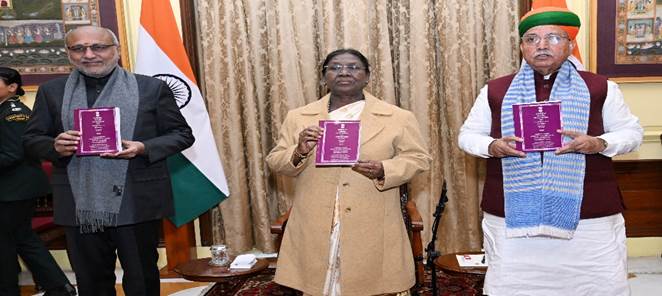
President of India Droupadi Murmu unveils the Constitution of India in Santhali language today.
Santhali Version of Constitution Released on Ol Chiki Centenary
New Delhi: In a historic milestone for linguistic inclusion and tribal empowerment, the President of India, Draupadi Murmu, released the Constitution of India translated into the Santhali language at a ceremony in Rashtrapati Bhavan today. The publication, prepared by the Legislative Department, Ministry of Law and Justice, marks the first time the Constitution has been officially made available in Santhali.
The event coincides with Good Governance Day and the 100th anniversary of the creation of the Ol Chiki script, developed by Pandit Raghunath Murmu in 1925, which enabled Santhali literature and literacy in the mother tongue. The release was attended by Vice-President C.P. Radhakrishnan, Minister of State for Law and Justice (Independent Charge) Arjun Ram Meghwal, and distinguished members of the Santhali-speaking community.
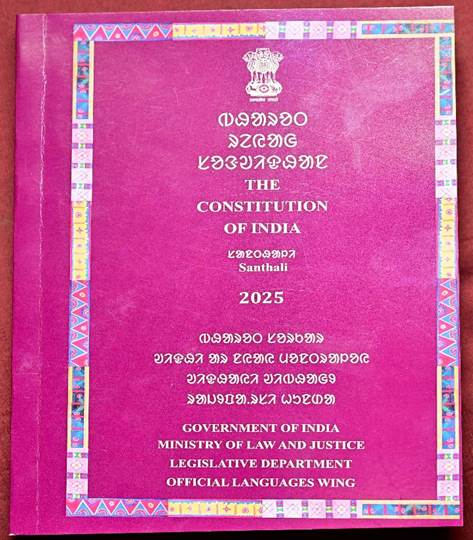
President Murmu lauded the initiative, emphasising that making the Constitution available in mother tongues strengthens democratic engagement and allows citizens to read and understand the foundational legal document of India in their own language, fostering constitutional awareness and civic literacy.
Santhali, included in the Eighth Schedule of the Constitution through the 92nd Amendment Act, 2003, is one of India’s principal tribal languages, spoken by over 7.3 million people across Jharkhand, West Bengal, Odisha, and Bihar, with smaller populations in neighbouring states. The Eighth Schedule recognises 22 official languages, reflecting India’s linguistic diversity and ensuring that speakers of each language can access legal, cultural, and educational resources in their mother tongue. Translating the Constitution into these languages, including Santhali, is a step toward making the principles, rights, and responsibilities enshrined in the Constitution accessible to all citizens, particularly marginalised tribal communities.
Belonging to the Austroasiatic language family within the Munda subgroup, Santhali has a rich oral tradition and cultural heritage. The Ol Chiki script, created by Pandit Raghunath Murmu, has been central to formalising the written tradition of Santhali, enabling generations to preserve folk literature, educational materials, and community records. Santhali also holds official status as an additional official language in states like Jharkhand and West Bengal, further underscoring its importance in governance and education.
This translation is part of a broader initiative led by the National Translation Mission (NTM) and the Legislative Department to make the Constitution accessible in all scheduled languages. India’s Constitution has now been translated into 36 languages, including major regional languages like Hindi, Bengali, Tamil, Telugu, Marathi, Odia, Gujarati, Kannada, Malayalam, Punjabi, Assamese, and several tribal languages, allowing citizens across diverse linguistic communities to engage with India’s democratic and legal framework.
The release of the Constitution in Santhali is being widely hailed as a major step toward linguistic inclusion, tribal empowerment, and constitutional literacy, reaffirming India’s commitment to unity in diversity and ensuring that all citizens, irrespective of language, can access and understand the country’s foundational legal document.
– global bihari bureau