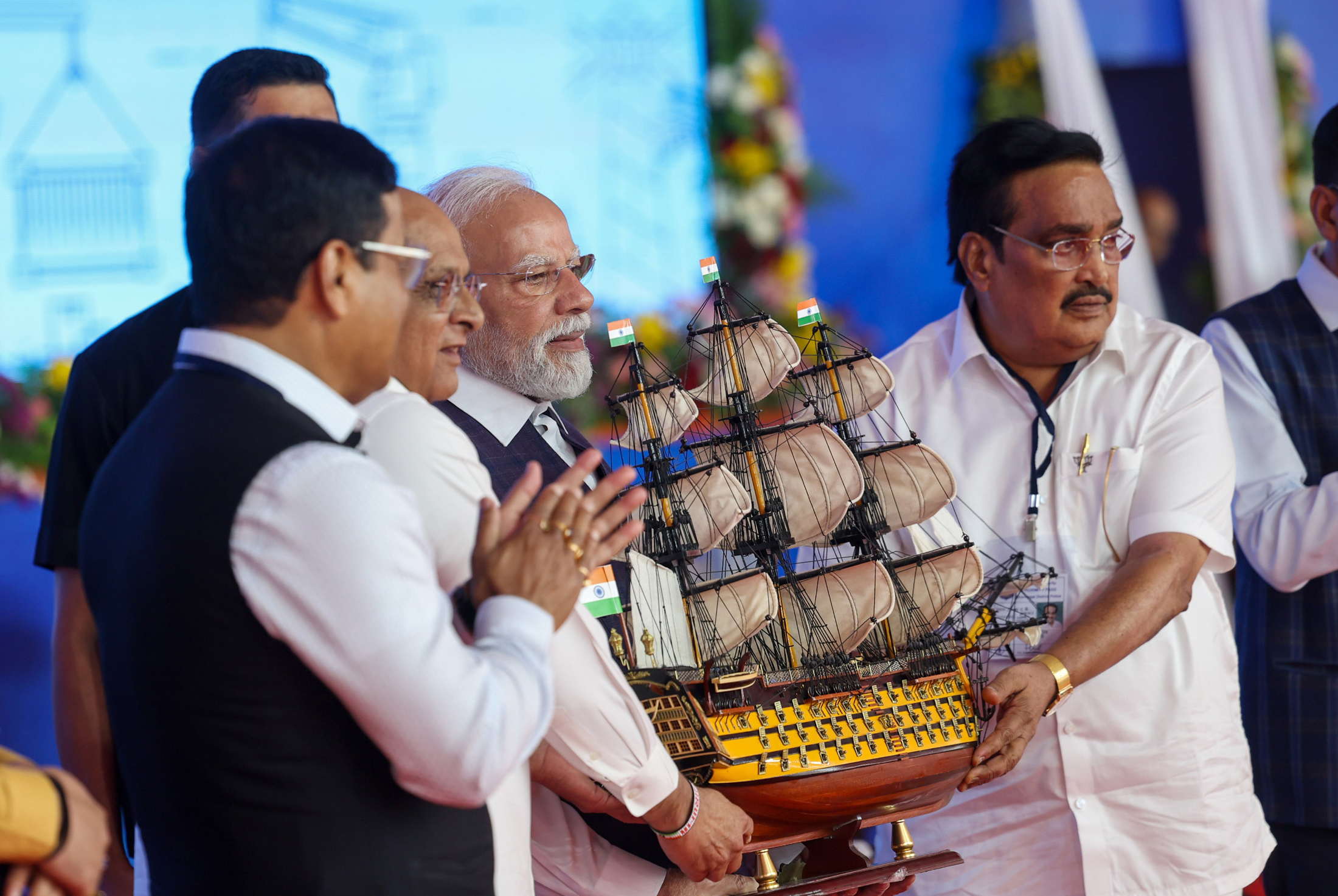
Prime Minister Narendra Modi at Samudra se Samriddhi programme on the sidelines of the inauguration and laying the foundation stone of multiple development projects at Bhavnagar, in Gujarat on September 20, 2025.
Shipbuilding Elevated to Infrastructure Status
₹70,000 Cr Fuels Maritime Sector Overhaul
Bhavnagar: In a sweeping move to transform India’s maritime sector, Prime Minister Narendra Modi announced a series of policy reforms aimed at simplifying operations and boosting global competitiveness. Effective immediately, all major ports will adopt the ‘One Nation, One Document’ and ‘One Nation, One Port’ Process, eliminating multiple documents and fragmented procedures to streamline trade and commerce. Additionally, a landmark decision taken yesterday grants infrastructure status to large ships, enabling shipbuilding companies to secure bank loans more easily at reduced interest rates, with all the benefits of infrastructure financing extended to these enterprises to alleviate financial burdens and strengthen their position in the global market. To further bolster the sector, the government has committed over ₹70,000 crore to three major schemes designed to provide financial support, modernise shipyards with advanced technology, and elevate design and quality standards. During the recent Monsoon Session, five new maritime laws were introduced, replacing outdated colonial-era regulations to overhaul shipping and port governance.
At the ‘Samudra se Samriddhi’ event, Modi inaugurated and laid the foundation stone for maritime development projects worth over ₹34,200 crore. These include the Mumbai International Cruise Terminal at Indira Dock, a new container terminal and associated facilities at Syama Prasad Mookerjee Port in Kolkata, a new container berth and cargo handling facilities at Paradip Port, the Tuna Tekra Multi-Cargo Terminal, firefighting facilities, and modern road connectivity at Kamarajar Port in Ennore, coastal protection works with sea-walls and revetments at Chennai Port, sea-wall construction at Car Nicobar Island, a multi-purpose cargo berth and Green Bio-Methanol Plant at Deendayal Port in Kandla, and ship repair facilities at Patna and Varanasi. These projects aim to enhance port infrastructure and operational efficiency across the country.
Modi underscored shipbuilding’s role as the “Mother of All Industries,” driving growth in allied sectors like steel, machinery, electronics, textiles, paints, and IT systems, while delivering significant benefits to small and medium enterprises. He cited research showing that every rupee invested in shipbuilding yields nearly double the economic return, and each shipyard job generates six to seven additional jobs in the supply chain, meaning 100 shipbuilding jobs could create over 600 related jobs. To support this, Industrial Training Institutes will strengthen essential skill sets, and the Maritime University’s role will expand to meet industry demands.
Beyond maritime initiatives, Modi inaugurated and laid the foundation stone for projects in Gujarat worth over ₹26,354 crore, spanning energy, infrastructure, and healthcare. These include the HPLNG Regasification Terminal at Chhara Port, the Acrylics & Oxo Alcohol Project at Gujarat IOCL Refinery, the 600 MW Green Shoe Initiative, the PM-KUSUM 475 MW Component C solar feeder for farmers, the 45 MW Badeli Solar PV Project, and the complete solarisation of Dhordo village. Additional projects encompass LNG infrastructure, renewable energy initiatives, coastal protection works, highways, expansions at Sir T. General Hospital in Bhavnagar and Guru Govind Sinh Government Hospital in Jamnagar, and the four-laning of 70 km of national highways.
Modi conducted an aerial survey of the Dholera Special Investment Region, envisioned as a greenfield industrial city centred on sustainable industrialisation, smart infrastructure, and global investment. He also reviewed the National Maritime Heritage Complex at Lothal, developed at a cost of ₹4,500 crore to preserve India’s ancient maritime traditions and serve as a hub for tourism, research, education, and skill development. Highlighting a critical issue, he noted that India spends approximately $75 billion—equivalent to six lakh crore rupees—annually on foreign shipping services, an amount comparable to the national defence budget. Over seven decades, this outflow has created millions of jobs abroad, and Modi suggested that earlier investments in India’s shipping industry could have positioned the country to earn substantial revenue through global shipping services. He stressed that achieving a developed India by 2047 hinges on self-reliance, with a unified resolve among 140 crore citizens to produce both chips and ships domestically, marking these reforms as a step toward next-generation advancements in the maritime sector.
– global bihari bureau