Bonanza Continues to Rain on Bihar
New Delhi: As Bihar gears up for its assembly elections slated for October or November, the Central government continues its flurry of infrastructure approvals, with the Cabinet Committee on Economic Affairs greenlighting two major projects worth over Rs 6,000 crore today to bolster connectivity and economic growth in the poll-bound state.
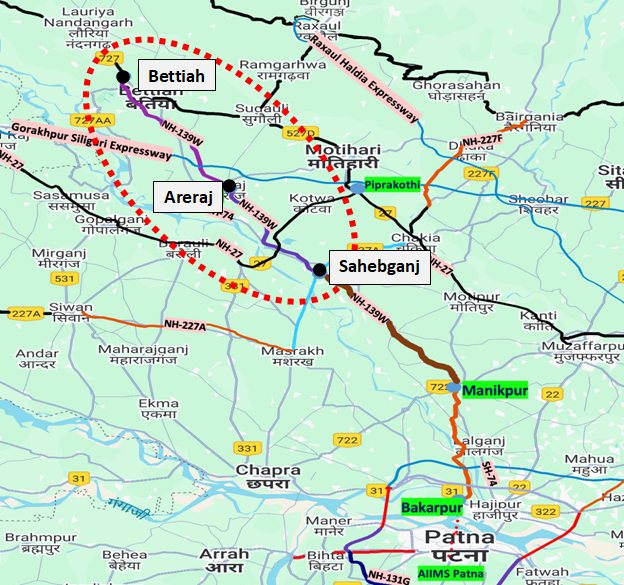
The first initiative approves the construction of the 4-lane Sahebganj-Areraj-Bettiah section of National Highway-139W (NH-139W) in Bihar on Hybrid Annuity Mode (HAM) with a total project length of 78.942 km worth Rs 3,822.31 crore. This proposed four-lane greenfield project is to improve connectivity between the State Capital Patna with Bettiah, connecting the North Bihar Districts of Vaishali, Saran, Siwan, Gopalganj, Muzaffarpur, East Champaran and West Champaran up to the areas along the Indo-Nepal border. The project will support the movement of long-distance freight traffic, improve access to key infrastructure and facilitate regional economic development by improving connectivity to agricultural zones, industrial areas, and cross-border trade routes.
Building on this momentum, the Cabinet has also approved the doubling of the Bakhtiyarpur – Rajgir – Tilaiya single railway line section (104 km) in Bihar with a total cost of Rs 2,192 crore (approx.). The project covering four Districts in the state of Bihar will increase the existing network of Indian Railways by about 104 km. These approvals come amid a series of pre-poll announcements, including earlier clearances for road and rail projects worth Rs 7,616 crore such as the Mokama-Munger highway and Bhagalpur-Dumka rail line, as well as a Rs 10,000 crore push for water and road infrastructure earlier this year, signaling the government’s focus on Bihar’s development ahead of the polls where the National Democratic Alliance seeks to retain power against the INDIA bloc.
The highway project will connect seven PM Gati Shakti economic Nodes, six Social Nodes, eight Logistic Nodes, nine Major Tourism and Religious Centers by improving access to key heritage and Buddhist tourist sites including the Kesariya Buddha Stupa (Sahebganj), Someshwarnath Mandir (Areraj), Jain Mandir and Vishwa Shanti Stupa (Vaishali), and Mahavir Temple (Patna), thereby strengthening the Buddhist circuit and international tourism potential of Bihar. The NH-139W has been planned to provide a high-speed connectivity to alternate routes that are presently congested and geometrically deficient, and pass-through built-up areas and will serve as an important link to the NH-31, NH-722, NH-727, NH-27 and NH-227A. The proposed greenfield alignment will support average vehicular speeds of 80 km/h against the design speed of 100 km/h. This will reduce the overall travel time between Sahebganj and Bettiah, from 2.5 hours to 1 hour, compared to existing alternatives, while offering safe, fast and uninterrupted connectivity for both passenger and freight vehicles. The proposed project, with a length of 78.94 km, is expected to generate close to 14.22 lakh man-days of direct employment and 17.69 lakh man-days of indirect employment. The project also aims to induce additional employment opportunities due to an increase in economic activity in the vicinity of the proposed corridor.
Complementing these efforts, the railway doubling will enhance connectivity to prominent destinations such as Rajgir (Shanti Stupa), Nalanda, Pawapuri, etc., attracting pilgrims and tourists from across the country. Multi-tracking projects will enhance connectivity to approximately 1,434 villages and about 13.46 lakh population and two Aspirational Districts (Gaya and Nawada). This is an essential route for the transportation of commodities such as coal, cement, clinker, fly ash, etc. The capacity augmentation works will result in additional freight traffic of magnitude 26 MTPA (Million Tonnes Per Annum). The Railways, being an environmentally friendly and energy efficient mode of transportation, will help both in achieving climate goals and minimising logistics cost of the country, reduce oil import (5 Crore Litres) and lower CO2 emissions (24 Crore Kg), which is equivalent to the plantation of 1 (One) Crore trees. These initiatives align with recent launches during Prime Minister Modi’s September 15 visit to Purnea, where projects worth over Rs 36,000 crore—including thermal power plants, river-linking schemes, and the National Makhana Board—were unveiled to support Bihar’s agriculture and energy sectors, further underscoring the strategic timing ahead of the elections expected in two to three phases starting post-Chhath Puja.
The enhanced line capacity aims at improving mobility, providing enhanced efficiency and service reliability for Indian Railways. The multi-tracking proposal will ease operations and reduce congestion, providing the much-needed infrastructural development on the busiest sections across Indian Railways. The projects aim at making people of the region “Atmanirbhar” by way of comprehensive development in the area, which will enhance their employment/ self-employment opportunities. The projects are planned on the PM-Gati Shakti National Master Plan with a focus on enhancing multi-modal connectivity & logistic efficiency through integrated planning and stakeholder consultations. These projects will provide seamless connectivity for the movement of people, goods, and services.
– global bihari bureau