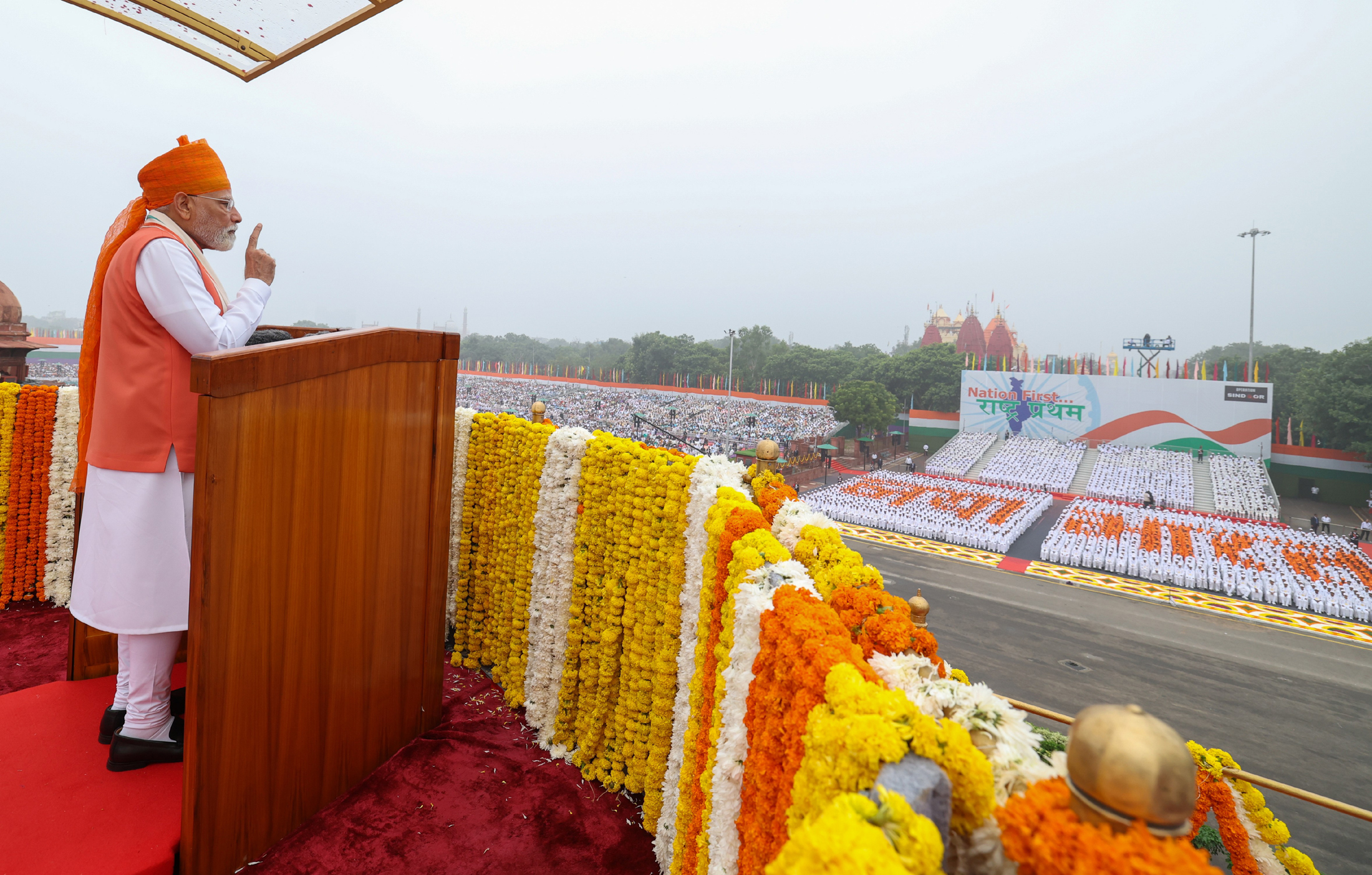
Prime Minister Narendra Modi addressing the Nation on the occasion of 79th Independence Day celebrations at Red Fort, in Delhi on August 15, 2025.
Bold Plans Meet Partisan Backlash
New Delhi: Prime Minister Narendra Modi saluting the Rashtriya Swayamsevak Sangh (RSS) as the world’s largest NGO for its century of service, in the course of his record-breaking 103-minute address from the ramparts of the Red Fort on India’s 79th Independence Day today, has sparked immediate outrage from opposition parties across the spectrum. The Opposition decried it as an affront to the freedom struggle, historical revisionism, and a breach of secular ethos on a national platform, even as supporters defended it as recognition of grassroots contributions amid escalating debates on unity and ideology.
While describing the RSS’s 100 years as a “proud and golden chapter”, Modi, who himself was an RSS Pracharak, said the nation “takes pride in this grand and dedicated journey of the Rashtriya Swayamsevak Sangh, which will continue to inspire us”.
Opposition Blasts Red Fort RSS Nod
However, the Prime Minister’s selective RSS nod drew sharp rebukes; Congress General Secretary Jairam Ramesh labelled the entire address “stale, hypocritical, insipid, and troubling,” accusing Modi of using the RSS tribute as a “desperate attempt to appease” the organisation ahead of his 75th birthday to secure tenure extension, calling it a “blatant breach of the spirit of a constitutional, secular republic.” The All India Majlis-e-Ittehadul Muslimeen (AIMIM) chief Asaduddin Owaisi termed it “an insult to the freedom struggle,” alleging the RSS “served as British foot soldiers” and “hated [Mahatma] Gandhi more than they ever opposed the British,” questioning its praise from the Red Fort instead of Nagpur. The Communist Party of India (Marxist) (abbreviated as CPI(M)) General Secretary MA Baby echoed this, stating the RSS had “no role whatsoever in these struggles” and sought to “undermine national unity along religious lines,” deeming the tribute “profoundly unacceptable and shameful.” Samajwadi Party leader Akhilesh Yadav suggested the RSS should “thank the British” for its centenary, arguing Independence Day should remain apolitical. Congress leader Salman Khurshid highlighted the RSS’s 52-year delay in hoisting the national flag and opposition to the Quit India movement, while party MP Manickam Tagore charged it with “spreading hate and division” rather than fighting colonialism. Trinamool Congress’s Sagarika Ghose accused Modi of over-promising and under-delivering, viewing the speech as targeting “new enemies” like infiltrators. The Rashtriya Janata Dal (RJD) MP Manoj Kumar Jha lamented the absence of a malice-free address, finding it laden with “dog-whistling and politics” that distorted history. Modi’s Bharatiya Janata Party countered by asserting that RSS ideology now shapes public discourse, dismissing critiques as outdated.
Modi’s speech today marked his 12th Independence Day oration and was described in government highlights as the “longest and most decisive” from the Red Fort, focusing on self-reliance, innovation, and empowerment to propel India toward a $10 trillion economy that is globally competitive, socially inclusive, and strategically autonomous.
He opened by celebrating the collective resolutions of 140 crore Indians, with the Tricolour fluttering nationwide under ‘Har Ghar Tiranga‘, and paid homage to the Constitution’s makers, including Dr. Rajendra Prasad, Babasaheb Ambedkar, Pandit Jawaharlal Nehru, Sardar Vallabhbhai Patel, Dr. Sarvepalli Radhakrishnan, and women like Hansa Mehta and Dakshayani Velayudhan. He commemorated Dr. Syama Prasad Mookerjee’s 125th birth anniversary, linking his sacrifice to the abrogation of Article 370 and “One Nation, One Constitution.”
Security themes loomed large, with Modi saluting Operation Sindoor—a strike penetrating enemy territory to dismantle terrorist hubs after a Pahalgam massacre—as embodying national outrage and ‘Made in India’ prowess. He declared a “new normal”, equating terrorism nurturers with perpetrators, rejecting nuclear blackmail, and vowing army-led responses on India’s terms. The Sudarshan Chakra Mission, drawing from mythological precision, aims to develop indigenous systems for targeted retaliation, expanding a security shield to cover strategic and civilian sites by 2035.
Modi critiqued the Indus Waters Treaty as one-sided, pledging waters for Indian farmers only. While supporters saw this as assertive sovereignty, opposition viewed it warily; no immediate Pakistani response was noted, but critics like Ghose interpreted it as divisive posturing. The High-Powered Demography Mission to counter infiltration and border demographic shifts, framed as safeguarding livelihoods and security, was flagged by Jha and Ghose as inflammatory dog-whistling, potentially sowing social tension.
Economically, Modi positioned self-reliance as Viksit Bharat‘s foundation, warning against dependency habits eroding capabilities. He announced ‘Made in India’ semiconductor chips by year’s end, overcoming 50-60 year delays, with six units operational and four approved. Energy independence featured a tenfold nuclear capacity boost by 2047, private sector entry, solar’s thirtyfold growth, and achieving 50% clean energy in 2025—five years early. The National Deepwater Exploration Mission targets offshore resources, alongside green hydrogen and hydropower. Next-generation GST reforms, a “Diwali gift,” promise tax cuts on essentials for MSMEs and consumers. The ₹1 lakh crore Pradhan Mantri Viksit Bharat Rozgar Yojana offers ₹15,000 to new hires, targeting 3.5 crore youth. A reform task force will streamline laws, scrapping obsolete ones for 21st-century alignment.
The Opposition, however, highlighted unfulfilled promises; Ramesh pointed to stalled semiconductors, repealed farm laws, and ignored unemployment, inequality, and economic distress. Congress president Mallikarjun Kharge accused the BJP of institutional misuse and declining global standing. Yadav questioned Swadeshi amid trade deficits with China and the US. Congress MP Rajeev Shukla noted a “tradition not to give credit” to predecessors, implying a selective narrative.
In agriculture, Modi hailed farmers as self-reliance pillars, leading globally in milk, pulses, jute, and second in rice, wheat, fruits, and vegetables, with ₹4 lakh crore exports. The PM Dhan-Dhanya Krishi Yojana aids 100 backward districts, complemented by PM Kisan, irrigation, seeds, fertilisers, and 125 crore free livestock vaccinations. Yet, critics like Ramesh saw “Atmanirbhar Bharat” as slogan-heavy without metrics.
Socially, Modi celebrated two crore Lakhpati Didis, Namo Drone Didi, and 25 crore lifted from poverty, creating a “neo-middle class.” Saturation schemes like Jan Dhan, Ayushman Bharat, PM Awas, and Direct Benefit Transfers were touted for empowerment. Naxalism’s drop from 125 to 20 districts transformed “Red Corridors” into development zones, honouring Bhagwan Birsa Munda. Cultural elements included classical status for Marathi, Assamese, Bengali, Pali, and Prakrit; Gyan Bharatam for manuscripts; and tributes to Guru Tegh Bahadur. Space achievements like Gaganyaan and 300 startups, obesity warnings, and Khelo India were noted.
Opposition, however, focused on partisanship; Tagore and Baby saw RSS praise as corrosive to democracy.
Reiterating Panch Prana—eradicating slavery remnants, heritage pride, unity, duties—Modi urged “Vocal for Local” and Swadeshi. While analyses noted vulnerability and opposition outreach shifts to attacks, the discourse reveals polarised views: a visionary blueprint versus divisive rhetoric amid natural disasters and global instability.
– global bihari bureau