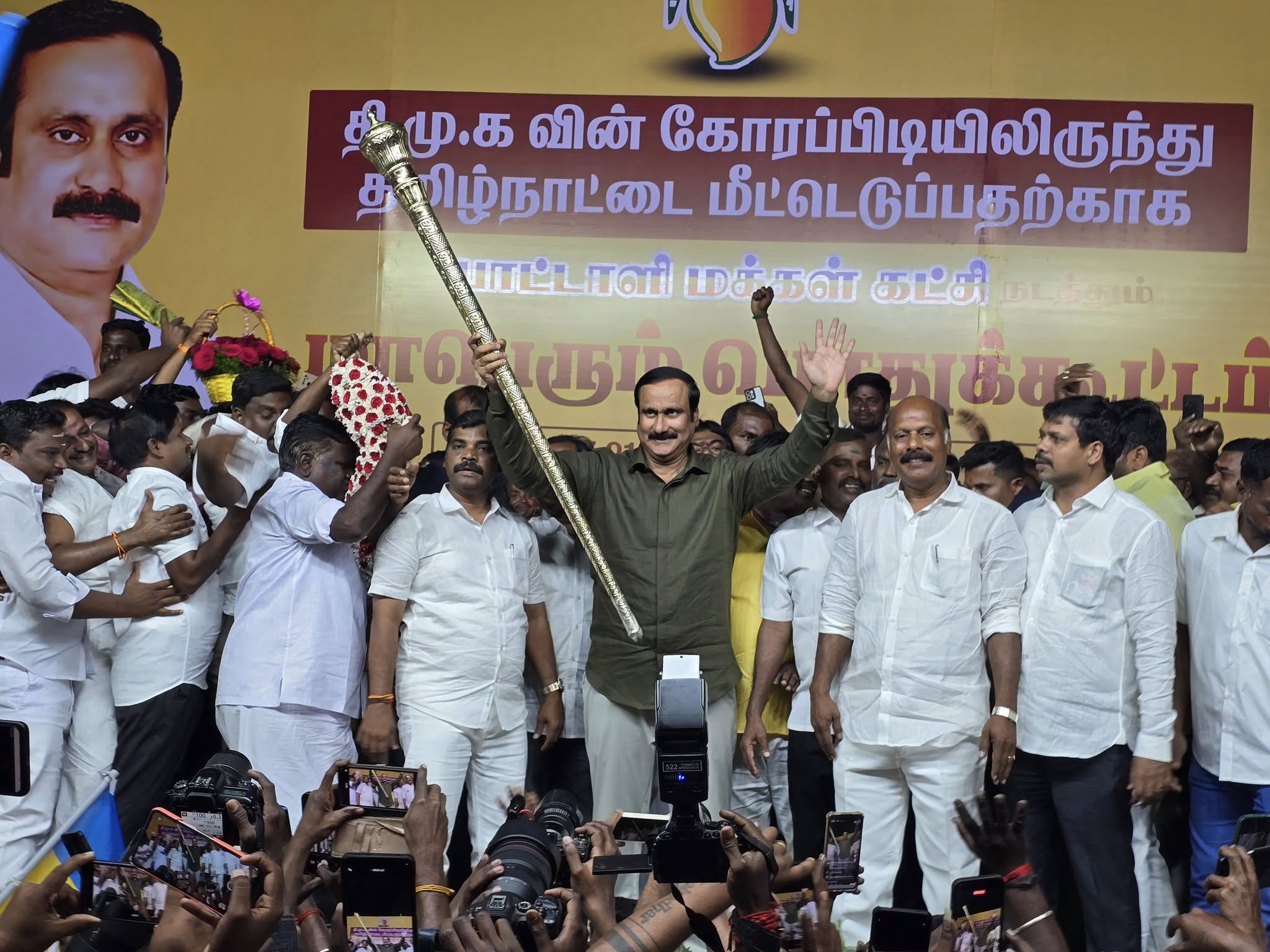
Paattali Makkal Katchi (PMK) leader Anbumani Ramadoss holding a sceptre at a public meeting in Cuddalore today.
How PMK’s Return to NDA Reshapes Tamil Nadu’s Electoral Race
Chennai: With Tamil Nadu heading toward Assembly elections due by April–May 2026, political alliances are rapidly taking shape, underscored by a significant realignment as the Pattali Makkal Katchi (PMK), led by Anbumani Ramadoss, has formally rejoined the National Democratic Alliance (NDA). This move reintegrates the regional party into a three‑way opposition structure alongside the All India Anna Dravida Munnetra Kazhagam (AIADMK) and Bharatiya Janata Party (BJP), crystallising the principal contest against the incumbent Dravida Munnetra Kazhagam (DMK)‑led coalition in the run‑up to next year’s polls. The renewed alliance pact is being positioned as a strategic manoeuvre to consolidate anti-DMK votes, although its ultimate impact will depend on broader electoral equations and the stability of the coalition itself.
On January 7, 2026, PMK leaders formally announced that the party had joined the AIADMK–BJP‑led NDA. At a press conference in Chennai, coalition leaders presented this realignment as a “victory alliance” aimed at challenging the DMK government’s governance record. Seat sharing and discussions with other smaller parties were indicated, highlighting a concerted effort by the opposition to present a unified front. This development sets the stage for examining the party’s historical influence and role in Tamil Nadu politics, while giving voters an early indication of the alliances shaping the upcoming polls. Beyond the immediate strategic optics, the PMK’s influence lies in its concentrated support base, which could prove pivotal in northern Tamil Nadu constituencies.
The PMK’s significance in the NDA largely stems from its regional and caste-based support, particularly among the Vanniyar community, which is widely estimated at 10–12% of Tamil Nadu’s population. Its core influence is concentrated in northern districts such as Dharmapuri, Krishnagiri, Villupuram, Tiruvannamalai, Cuddalore, and parts of Vellore and Kallakurichi. Even small swings in PMK votes in these areas can materially affect outcomes in closely contested constituencies, making the party a strategically important ally despite its limited ability to win a large number of seats on its own.
Understanding PMK’s current positioning requires a look at recent electoral history and vote shares. In the 2021 Tamil Nadu Legislative Assembly election, the DMK-led Secular Progressive Alliance (SPA), which included the Indian National Congress, Communist Party of India, Communist Party of India (Marxist), and allied regional parties, won 159 out of 234 seats, with the DMK alone securing 133. Its main rival, the NDA, comprising AIADMK, BJP, PMK, and smaller allies, won 75 seats: 66 for AIADMK, five for PMK, and four for BJP. In terms of vote shares, the DMK secured approximately 45% of the total votes, AIADMK about 39%, BJP around 5%, and PMK roughly 3%. These figures underscore the importance of coalition dynamics, as even a small party like PMK can influence outcomes in closely contested northern constituencies.
These assembly results set the stage for understanding the fragmented opposition scenario witnessed in the 2024 Lok Sabha elections, where separate contests highlighted the electoral challenges facing the NDA.
In the 2024 Indian general election for the Lok Sabha (the lower house of India’s Parliament), Tamil Nadu’s 39 constituencies were contested under fragmented opposition arrangements. The All India Anna Dravida Munnetra Kazhagam (AIADMK) had broken its alliance with the Bharatiya Janata Party (BJP) in September 2023 and contested with partners like Desiya Murpokku Dravida Kazhagam (DMDK), Social Democratic Party of India (SDPI), and Puthiya Tamilagam under its own banner. Meanwhile, the BJP contested separately, with some smaller parties such as the Pattali Makkal Katchi (PMK) and Amma Makkal Munnetra Kazhagam (AMMK) contesting in coordination with the BJP, but there was no formal, unified NDA slate in the state. Both AIADMK’s and BJP’s arrangements failed to win any seats, while the DMK-led Indian National Developmental Inclusive Alliance (INDIA), including the Indian National Congress and regional allies, won all 39 seats, reflecting its dominance in the state. AIADMK secured about 20.7% of the vote share and BJP around 11.4%. The AIADMK and BJP later reunited to form a combined NDA in April 2025 ahead of the 2026 Assembly elections. These results highlight both the electoral challenges facing the opposition in Tamil Nadu and the strategic significance of PMK’s return to the NDA.
The PMK has historically demonstrated a pragmatic approach to alliances, prioritising electoral viability over strict ideology. Since its founding by Dr S. Ramadoss in 1989, the party has aligned with both DMK and AIADMK at different points—joining the NDA in 1999 and 2011, allying with DMK in 2006 and 2011—depending on political circumstances and bargaining power. Its 7 January 2026 return to the NDA follows this pattern, reflecting both a strategic assessment of opposition strength and the party’s goal of retaining influence ahead of the Assembly polls. This pragmatism has consistently allowed PMK to leverage its concentrated support among the Vanniyar community and northern districts, translating localised influence into broader coalition relevance.
Following the 2021 elections, the AIADMK split from the BJP in 2023 due to strategic disagreements, temporarily dissolving the NDA in Tamil Nadu. During this period, PMK remained outside the principal alliances, choosing not to join the DMK-led INDIA bloc, which left the party politically marginal. Its reentry into the NDA in 2026 can therefore be seen as a pragmatic decision to regain influence ahead of the upcoming Assembly polls.
The reunification of AIADMK and BJP in 2025, and the inclusion of PMK, represents a calculated attempt to consolidate opposition forces. For the NDA, PMK’s presence strengthens the alliance in northern constituencies, where its regional support can influence outcomes through vote transfers. While this may not translate into a statewide surge on its own, it provides the NDA with additional leverage in key battleground areas. Recent campaigning signals show AIADMK, BJP, and PMK leaders holding rallies in northern districts, emphasising development promises and targeted caste outreach, reflecting the strategic importance of these constituencies.
The DMK and its INDIA allies have responded to PMK’s move with measured commentary, framing it as a tactical adjustment rather than an ideological shift. Senior DMK figures emphasised governance continuity and alliance stability, while Congress leaders reaffirmed their commitment to the INDIA front, suggesting that opposition reconfigurations, though noteworthy, do not pose an immediate threat to the ruling coalition’s dominance.
As of now, the PMK holds five seats in the 234-member Tamil Nadu Legislative Assembly. It does not have representation in either the Lok Sabha or Rajya Sabha (the upper house of India’s Parliament), indicating that its importance lies more in coalition leverage than in numerical strength. In a state where electoral margins are often narrow, this leverage can prove decisive, particularly in constituencies influenced by regional and caste dynamics.
It is important to understand the broader political context. Tamil Nadu politics is dominated by two major Dravidian parties, DMK and AIADMK, with smaller regional parties like PMK playing crucial roles in alliance dynamics. Election outcomes are often decided by narrow margins in specific districts where caste, community, and local factors dominate, making smaller parties disproportionately influential despite limited statewide vote shares. The 2026 elections are shaping up as a contest between the incumbent DMK-led INDIA bloc and the revived NDA alliance, with PMK’s return potentially tipping the balance in several constituencies.
As campaigning intensifies toward the 2026 Assembly elections, the durability of this renewed alliance, PMK’s role in vote transfers, and the DMK’s ability to retain its broad coalition will determine whether this realignment is decisive or merely incremental in Tamil Nadu’s complex political landscape.
– global bihari bureau