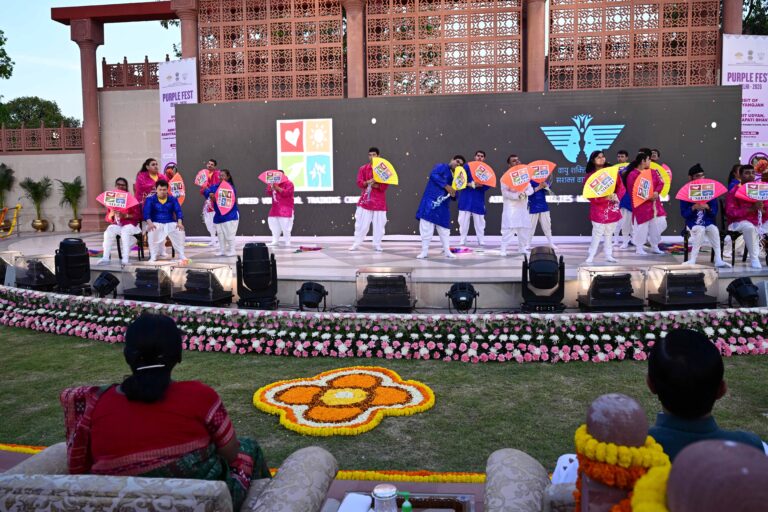
Prime Minister Narendra Modi at the laying of foundation Stone of Polypropylene Plant at Golaghat, in Assam on September 14, 2025.
Modi’s ₹27,000 Cr Semiconductor Push for Assam
Golaghat: The Assam Bioethanol Plant at Numaligarh Refinery Limited (NRL) in Golaghat, Assam, was formally inaugurated today by Prime Minister Narendra Modi, marking a step toward producing ethanol from bamboo to promote clean energy and reduce India’s reliance on fossil fuels, with full production expected to commence by December 2025.
A polypropylene plant at the same site also had its foundation stone laid, set to enhance Assam’s petrochemical sector by manufacturing materials for products like buckets, carpets, medical kits, and automotive components. These projects, part of ₹18,000 crore allocated to Assam, aim to boost industrial growth, create jobs for farmers and youth, and strengthen the state’s role in India’s self-reliance in energy and manufacturing.
The bioethanol plant will benefit thousands of local farmers and tribal communities through a steady bamboo supply chain, supported by government-backed cultivation and bamboo chipping units, with an annual investment of ₹200 crore, Modi claimed. He contrasted this with past opposition-led governments’ restrictions on bamboo cutting, which could lead to imprisonment, and highlighted how the current government’s removal of these bans is delivering benefits to the North East. He emphasised ethanol as a viable alternative fuel, noting that the bioethanol plant, set to produce 48,900 metric tonnes annually from bamboo, will benefit Assam’s farmers and tribal communities.
The polypropylene plant will support the ‘Make in Assam’ and ‘Make in India’ initiatives, adding textiles to Assam’s traditional Gamosa and Eri and Muga silk identity. The Prime Minister explained that polypropylene is essential for products like buckets, mugs, carpets, ropes, medical kits, and automotive components, making modern life unimaginable without it. The new polypropylene plant will strengthen ‘Make in Assam’ and ‘Make in India’ initiatives and boost manufacturing industries. He noted that alongside Assam’s traditional Gamosa and Eri and Muga silk, the state’s identity will now include polypropylene-based textiles.
Additionally, a ₹27,000 crore semiconductor factory in Morigaon underscores Assam’s growing role in India’s Semiconductor Mission, complementing its energy contributions. The Prime Minister underscored Assam’s role in the Aatmanirbhar Bharat campaign, particularly in the Semiconductor Mission. He cited Assam’s proven potential, referencing how Assam Tea became a global brand, and emphasised that energy and semiconductors are critical for India’s self-reliance, with Assam playing a pivotal role in both. He explained that electronic chips are central to devices like bank cards, mobile phones, cars, and space missions, and domestic chip production is essential for manufacturing these products.
The Prime Minister, addressing the gathering, highlighted India’s rise as the fastest-growing major economy, with increasing demand for electricity, gas, and fuel. He noted India’s progress in green energy, ranking among the top five globally in solar capacity, and emphasised efforts to explore domestic crude oil and gas reserves through the ‘Samudra Manthan’ initiative and National Deepwater Exploration Mission. He also contrasted past restrictions on bamboo cutting with the current government’s removal of bans, enabling economic benefits for the North East.
Modi outlined broader development efforts, including over 20 lakh permanent houses provided to Assam’s poor, rapid progress in tap water supply, and welfare schemes for tea garden workers focusing on women’s health and children’s education. Mission Basundhara has delivered land pattas to lakhs of families, recognised land rights for Ahom, Koch Rajbongshi, and Gorkha communities, and reclaimed land from illegal infiltrators for tribal families. Cultural preservation efforts include renovating Rang Ghar in Sivasagar, developing Batadrava as a tourism centre, and granting classical language status to Assamese, alongside promoting local language education under the National Education Policy. The government also honoured Veer Lachit Borphukan with national celebrations, a biography in 23 languages, and a statue in Jorhat.
Chief Minister Himanta Biswa Sarma, Union Ministers Sarbananda Sonowal and Hardeep Singh Puri, and other dignitaries attended the event. These initiatives position Assam as a hub for trade, tourism, and industrial growth, contributing to a developed India.
– global bihari bureau