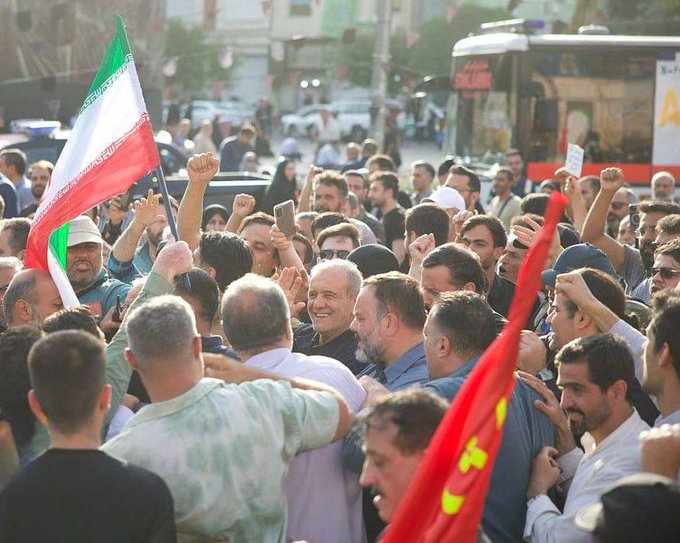
Iranian President Masoud Pezeshkian in Tehran today.

After the United States military strikes on Iran’s nuclear facilities at Fordow, Natanz, and Isfahan today earlymorning, intensifying regional tensions, Iranian President Masoud Pezeshkian called Indian Prime Minister Narendra Modi to discuss the conflict. His call follows a similar call from Israeli President Benjamin Netanyahu to Modi on June 13, the day when Israel launched the strike on Iranian nuclear facilities. In both conversations, Modi expressed deep concern and advocated for immediate de-escalation, dialogue, and diplomacy to restore peace, security, and stability.
Pezeshkian’s call to Modi appeared a strategic outreach to non-aligned powers, countering Western support for Israel amid diplomatic setbacks. Pezeshkian briefed Modi in detail, sharing Iran’s perspective on the conflict. Modi expressed India’s deep concern, affirmed India’s commitment to peace and humanity, and reiterated the need for immediate de-escalation, dialogue, and diplomacy as the way forward for the early restoration of peace, security, and stability. He thanked Pezeshkian for Iran’s continued support in repatriating the Indian community and discussed measures to strengthen bilateral cooperation in trade, economic cooperation, science, technology, and people-to-people ties, agreeing to remain in touch.
The Indian Prime Minister’s statement echoed these sentiments, stating, “Spoke with President of Iran @drpezeshkian. We discussed in detail about the current situation. Expressed deep concern at the recent escalations. Reiterated our call for immediate de-escalation, dialogue and diplomacy as the way forward and for early restoration of regional peace, security and stability.”
The significance of Pezeshkian’s call lies in Iran’s effort to secure diplomatic allies, particularly India, whose global influence and non-aligned position could facilitate de-escalation. Modi’s consistent messaging underscores India’s role as a bridge, advocating for peace to avert a broader regional crisis.
Modi’s diplomatic engagements with Pezeshkian and Netanyahu highlight India’s pivotal role in advocating for dialogue, underscoring the urgent need to de-escalate a region on the brink of wider conflict. India’s role as a peacemaker, exemplified by Modi’s diplomatic engagements with Pezeshkian and Netanyahu, is widely regarded as a stabilising force in a volatile region, based on the provided inputs. Modi’s consistent advocacy for immediate de-escalation, dialogue, and diplomacy, expressed during Pezeshkian’s call on June 22, 2025, and Netanyahu’s earlier call, positions India as a neutral mediator trusted by both conflicting parties. The international community, particularly non-aligned and Islamic nations, views India’s non-partisan stance favourably, as evidenced by Iran’s strategic outreach to Modi amid Western support for Israel.
Pezeshkian’s detailed briefing and Modi’s commitment to peace and humanity, coupled with gratitude for Iran’s repatriation support, signal India’s potential to bridge divides. Similarly, Netanyahu’s call underscores Israel’s recognition of India’s diplomatic influence. India’s discussions with Iran on strengthening trade, science, technology, and cultural ties during this crisis highlight its ability to maintain constructive relations, enhancing its credibility as a mediator.
Globally, India is seen as a pivotal actor capable of fostering dialogue to avert a broader conflict, leveraging its non-aligned status and growing geopolitical influence to promote peace in a region teetering on the edge of chaos. The Organisation of Islamic Cooperation’s condemnation of Western silence aligns with Iran’s appeal to India, suggesting that Islamic nations see India as a counterbalance to Western bias. Egyptian President Abdel Fattah el-Sisi’s diplomatic alignment with Modi’s call for dialogue further indicates regional support for India’s peacemaking efforts. Canada’s Foreign Minister Anita Anand’s emphasis on diplomacy during her call with Araghchi reinforces the global preference for India’s approach, as Modi’s neutral platform facilitates communication between adversaries.
Nonetheless, the Iran-Israel conflict escalated with the United States jumping into the fray by striking Iran’s nuclear establishments. The International Atomic Energy Agency responded decisively to the U.S. strikes on Iran’s nuclear facilities at Fordow, Natanz, and Isfahan, emphasising nuclear safety and diplomatic solutions.
The IAEA confirmed no increase in off-site radiation levels following the attacks, including at Fordow’s uranium enrichment site, and pledged ongoing assessments as more information emerges.
IAEA Director General Rafael Mariano Grossi, synthesising urgent communications, announced an emergency meeting of the IAEA Board of Governors for June 23, 2025, to address the critical situation in Iran. In an official update on June 22, Grossi stated that the extraordinary session would tackle the increasingly serious situation in terms of nuclear safety and security, which he would personally address. He noted that Iranian authorities reported no off-site radiation increase, stating, “As of this time, we don’t expect that there will be any health consequences for people or the environment outside the targeted sites,” while committing to continued monitoring.
Grossi highlighted that before the attacks began on June 13, 2025, the targeted sites contained uranium enriched to various levels, posing risks of radioactive and chemical contamination within the facilities. Echoing his June 20, 2025, statement to the UN Security Council, Grossi reiterated, “I have repeatedly stated that nuclear facilities should never be attacked,” urging military restraint and indispensable work towards a diplomatic solution. He emphasised the need for a cessation of hostilities to enable the IAEA to resume critical inspection work, including verifying Iran’s stockpile of highly enriched uranium. He stressed the importance of timely information exchange with Iran on nuclear safety, security, and safeguards. The IAEA’s call for diplomacy aligns with the peacemaking efforts of figures like Modi and el-Sisi, reinforcing the global imperative for dialogue to mitigate nuclear risks and stabilise the region.
Interestingly, Israeli Prime Minister Benjamin Netanyahu claimed today that the overnight American strikes were executed in full coordination with U.S. President Donald Trump, with operational alignment between the Israel Defense Forces (IDF) and the U.S. military, fulfilling Israel’s pledge to dismantle Iran’s nuclear programme, which he deemed a threat to Israel’s existence and global peace. However, Trump claimed sole credit, declaring the operation a spectacular military success that obliterated Iran’s nuclear capabilities, without acknowledging Israeli involvement.
Netanyahu conceded that only the U.S. possessed the B-2 stealth bombers and GBU-57 Massive Ordnance Penetrator bombs capable of penetrating Fordow’s fortified facility, underscoring U.S. military supremacy.
It may be recalled that yesterday, Global Bihari had reported that while Trump has bolstered Israel with military aid since the conflict’s onset, his independent regional diplomacy has now apparently sidelined Israel, creating tension but not abandonment, as Iran’s fierce retaliation and the conflict’s intensity underscore the stakes of their relationship. The same was very much at play today. Netanyahu, in statements today, praised Trump as a strong leader of the free world and an unparalleled ally, recounting a very warm, very moving post-strike call where Trump blessed Israel’s army and people, and Netanyahu congratulated U.S. pilots and Americans. He aligned the operation, dubbed Am Kalavi, with their shared peace through strength doctrine, crediting Trump’s decisive action.
Iran condemned today’s U.S. strikes in the strongest terms, with the Ministry of Foreign Affairs describing them as a brutal military aggression and a grave and unprecedented violation of the UN Charter’s fundamental principles, particularly Article 2(4) on territorial integrity, and international law. The Ministry held the U.S. fully responsible for the “dangerous consequences and far-reaching implications of this heinous crime”, accusing the war-mongering and lawless U.S. regime of colluding with the “genocidal” Israeli regime to wage war against Iran’s peace-seeking and independence-loving people.
Iran claimed the strikes, occurring on the 10th day of Israel’s aggression during indirect U.S.-Iran nuclear negotiations, exposed Washington’s criminal complicity and dealt a devastating blow to the global non-proliferation regime, violating UN Security Council Resolution 2231. Iran warned that silence would plunge the world into unprecedented danger and chaos, urging the UN, Security Council, UN Secretary-General, IAEA, and member states to act decisively.
The Ministry called for an emergency Security Council session to condemn the U.S. and hold it accountable, and urged the IAEA Board of Governors to address the attack on Iran’s safeguarded nuclear facilities. Iran’s Foreign Ministry Spokesperson Esmaeil Baqaei reiterated that the U.S., a nuclear-armed state and Nuclear Non-Proliferation Treaty (NPT) depository, betrayed international norms by attacking a non-nuclear weapon state, emphasising Iran’s resolve to defend its sovereignty, security, and people under Article 51.
Iranian Foreign Minister Seyyed Abbas Araghchi, in a call with Canada’s Foreign Minister Anita Anand detailed Israel’s strikes on public infrastructure, residential areas, and civilians, including senior military figures, academics, and women and children, condemning the targeting of nuclear sites as a breach of international norms and the UN Charter. Araghchi warned that U.S. complicity risked regional and global escalation, while Anand stressed diplomacy as the only solution. Araghchi noted that Israel disrupted U.S.-Iran talks the previous week, followed by the U.S. disrupting E3/EU talks, questioning calls for Iran to return to negotiations it never abandoned.
Trump’s sudden and clandestine strikes, after he had sought a two-week window to assess diplomatic prospects with Iran, asserted U.S. supremacy, leveraging capabilities Israel lacks. He deployed six B-2 bombers with 12 GBU-57 bombs on Fordow and 30 Tomahawk cruise missiles on Natanz and Isfahan.
Executed after Israel’s week-long campaign weakened Iran’s air defences, the operation disrupted Iran’s diplomatic efforts, as Araghchi noted, aligning with Israel’s objectives while undermining Iran’s position. This move, following Israel’s earlier sabotage of U.S.-Iran talks, solidified Trump’s image as a decisive leader, reinforcing the peace through strength narrative and demonstrating strategic coordination despite his claim of sole credit, highlighting a divergence in U.S.-Israel messaging.
In a call with Egyptian President Abdel Fattah el-Sisi on June 21, 2025, Pezeshkian emphasised that Israel’s efforts to divide Iran and its neighbours would fail, stating, “The Zionists will not succeed in pitting us against each other.” He noted Iran was engaged in U.S. negotiations when Israel’s aggression began, asserting, “We did not initiate this conflict, nor do we wish to prolong it. However, if the aggression persists, we will respond decisively.” Pezeshkian reaffirmed Iran’s commitment to civilian-only nuclear programmes, addressing el-Sisi’s concerns, and emphasised fostering consensus within Iran and cooperation with neighbouring Islamic countries for shared interests, pursuing a policy of unity and engagement. El-Sisi condemned Israel’s aggression, expressed optimism for diplomatic resolutions to Iran’s nuclear disputes, cautioned that military strategies would exacerbate tensions, and noted Egypt’s consultations with the U.S. and others to de-escalate, aligning with Modi’s diplomatic stance.
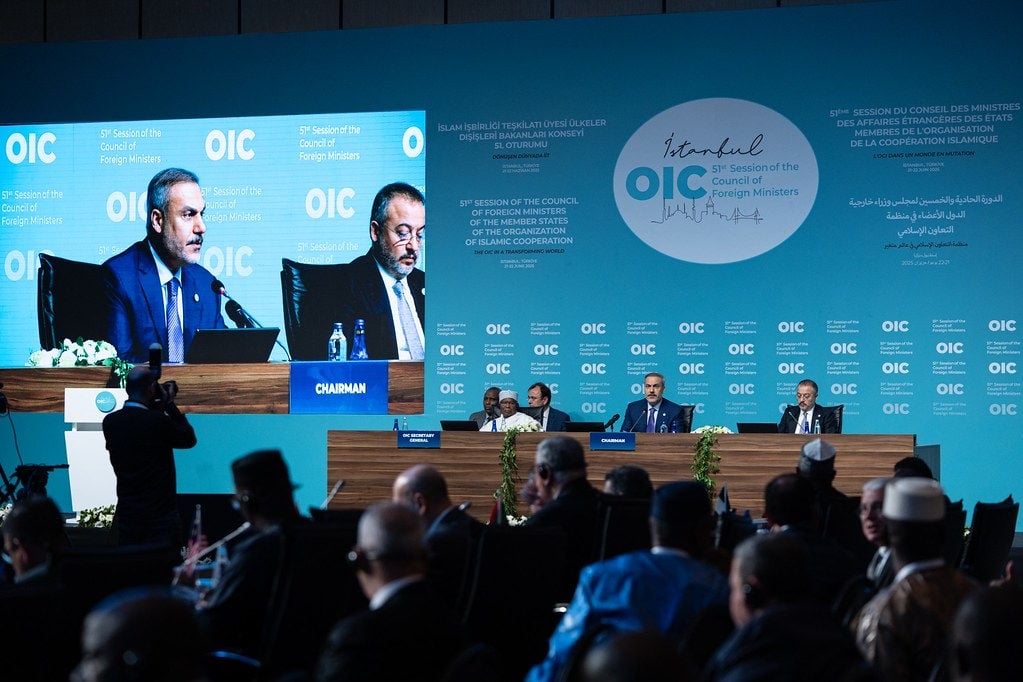
While the international community remains polarised, the Organisation of Islamic Cooperation (OIC) expressed full and unequivocal support for Iran, condemning Israel’s atrocities against Iran and Muslims regionally, noting unprecedented outrage and a groundswell of solidarity in the Islamic world and criticising the West’s lost moral compass. The Istanbul Declaration, adopted by the 51st Session of the OIC Council of Foreign Ministers today, condemned destabilisation policies of Israel in the region and its recent attacks on Iran, Syria, and Lebanon, constituting a flagrant violation of the sovereignty and security of these countries and international law. The OIC called on the international community to take deterrent measures to stop this aggression and make Israel accountable for the crimes committed. It further decided to establish an open-ended Ministerial Contact group, which will be tasked with establishing regular contacts with the relevant regional and international parties, in the aggression of Israel against Iran, stressing the urgent need to stop Israeli attacks. The OIC members expressed their “great concern regarding this dangerous escalation, threatening the human, economic and environmental situation in the region”.
Iran urged the UN Security Council, UN Secretary-General, IAEA, and member states to act decisively, warning that inaction risks global chaos.
Meanwhile, the IDF detailed other extensive operations during the day, with approximately 30 Israeli Air Force (IAF) fighter jets striking dozens of military targets across Iran, including the Imam Hussein Strategic Missile Command Center in Yazd, housing 60 long-range Khorramshahr missiles launched toward Israel, missile launchers, the Third Brigade UAV command centre, a UAV storage facility, and military sites in Isfahan, Bushehr, and Ahvaz producing aerial defense batteries, using over 60 munitions.
Earlier, the IAF neutralised eight missile launchers, six ready for immediate launch, two Iranian F-5 fighter jets at Dezful Airport, and military infrastructure at Isfahan Airport to hinder Iranian Air Force operations. Over 20 IAF jets also struck a military site producing explosive materials.
*Senior journalist