 By Deepak Parvatiyar*
Patel in Patna: Iron Icon, Kurmi Calculus
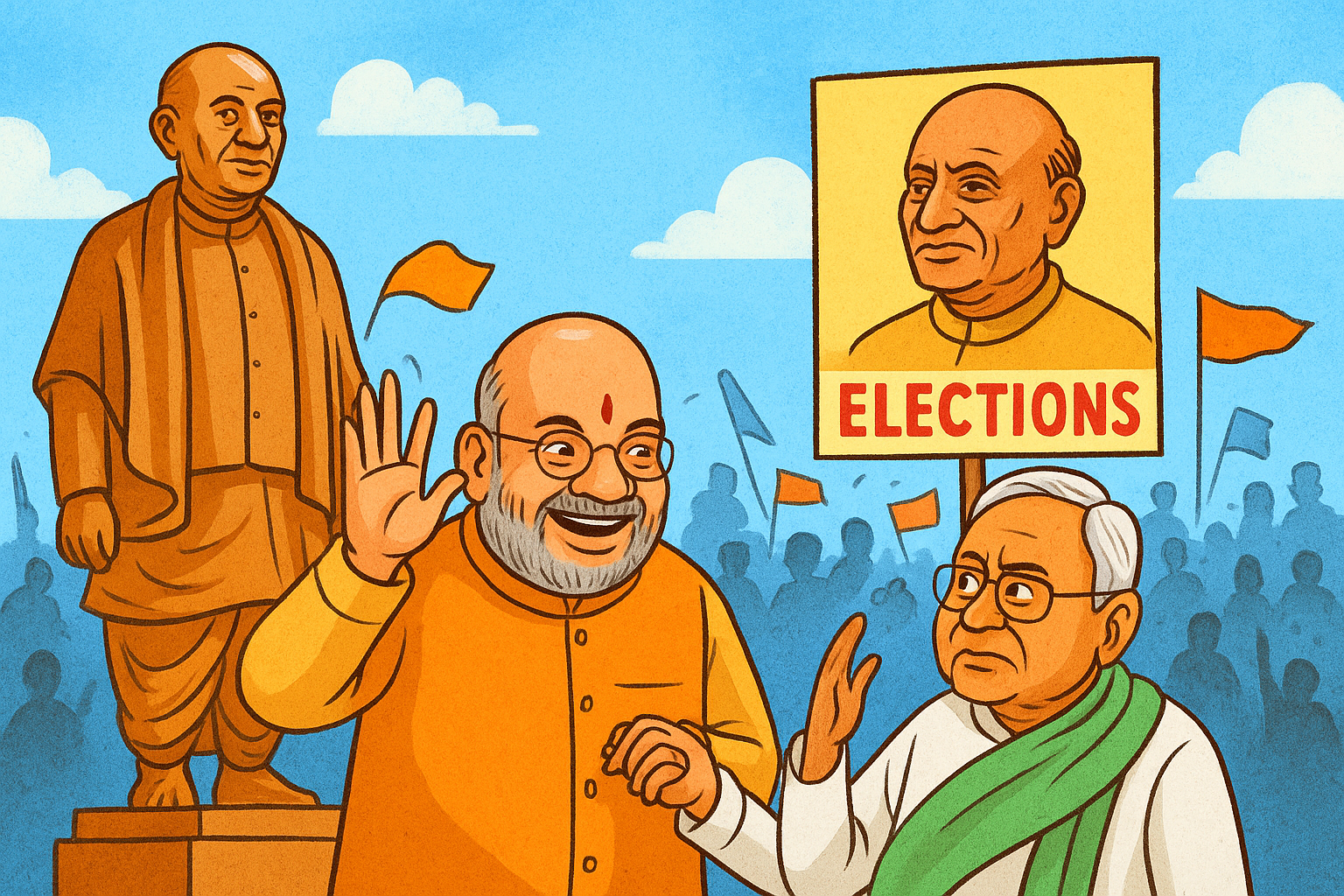
In election-season Bihar, even history seems to arrive with a poll schedule. Union Home Minister Amit Shah’s Patna press conference today on the 150th birth anniversary of Sardar Vallabhbhai Patel may have been billed as a national tribute, but the echoes sounded distinctly local. The Iron Man of India, born in Gujarat, was suddenly speaking to the heartland of Kurmi politics.
Shah’s announcement that October 31 will henceforth host an annual “Unity Parade” at Ekta Nagar, Kevadia in Gujarat — with Prime Minister Narendra Modi taking the salute before the Statue of Unity — came wrapped in patriotic grandeur. Yet, its timing, tone, and venue left little doubt that the message had more than administrative intent. Bihar goes to polls in weeks, and the symbolism of Patel — a fellow agrarian son of Gujarat often invoked by Chief Minister Nitish Kumar as a Kurmi icon — has rarely been so electorally convenient.
Patel, Gandhi, Shah and Modi all hail from Gujarat, but it is Patel’s legacy that the Bharatiya Janata Party has steadily recast in bronze and rhetoric. Shah called him “an ideology, not just an individual,” praising his unification of 562 princely states, his resolve in Hyderabad and Junagadh, and his vision that “gave India its map.” The statue itself is the silent co-star. Built in 57 months with iron from farmers’ sickles. But the ideology has a caste code. Bihar’s 2023 caste census lists Kurmis at 2.8%—small, but decisive in 60-odd seats. Nitish Kumar, Kurmi chieftain and leader of Janata Dal (United) or JD(U), has long claimed Patel as blood kin: Patels are Kurmis, he declared years ago, forging a trans-state bond of soil, sweat, and self-reliance. Now the Bharatiya Janata Party (BJP), sensing drift in the JD(U) camp, recasts that bond in bronze. By placing Patel centre-stage, the party ostensibly whispers to Kurmi voters: Your icon is national, not merely Nitish’s.
There was no mention, however, that Patel was also the Congress’s senior statesman — a nationalist who shared Gandhi’s discipline but not necessarily his methods. The Rashtriya Swayamsevak Sangh, never comfortable with Gandhi’s moral vocabulary, has long preferred Patel’s steel to his spinning wheel.
That preference now shines through in political engineering. The 150th anniversary celebrations, beginning with the “Run for Unity” and culminating in a fortnight-long Bharat Parv at Ekta Nagar, double as a cultural festival and an ideological rally. “Ek Bharat, Shreshtha Bharat,” as Shah described, will parade the Central Armed Police Forces, state contingents, and over 900 artists — all performing unity before the cameras and, incidentally, before Bihar’s voters.
Image by sandeep darji from Pixabay
The story will begin at dawn in Ekta Nagar, Kevadia. Prime Minister Narendra Modi will stand before the 182-meter Statue of Unity. Nine hundred marchers will lock step. Assam Police motorcycles will flip. Border Security Force (BSF) camels will play brass. Indian Air Force (IAF) jets will carve tricolours in the sky. Central Armed Police Forces (CAPF) contingents, state police from six regions—none named Bihar—will salute the Iron Man who welded 562 princely states into one nation. The cameras will drink it in. The message will stream nationwide.
Cut to Bihar, 8 a.m. sharp. In 1,061 police stations, 75,000 schools, and every university quadrangle, the Run for Unity will begin. Teachers will count heads. Sub-inspectors will jog in boots. Students will recite the pledge: India is one, indivisible. In flood-scarred Darbhanga, the loudspeaker will crackle. In Nitish’s Bakhtiyarpur, the headmaster will mark the boy absent whose voter ID vanished in the Election Commission of India’s (ECI) June purge of 6.85 million names. No one from Bihar will march in Kevadia. No one was asked.
In Bihar’s electoral lexicon, unity comes with subtext. The Kurmi community, to which Nitish Kumar belongs, has long drawn inspiration from Patel’s legacy as an OBC reformer who rose from the soil. Analysts say that by invoking Patel, the BJP is subtly trying to detach Kurmi pride from Nitish’s exclusive claim and weave it into its own national narrative of unity. “By reclaiming Patel, the BJP reclaims a constituency,” said one Patna-based political observer.
The subplots are as layered as the parade lineup. Sardar Patel’s delayed Bharat Ratna, the “opposition’s neglect,” the engineering marvel of the Statue of Unity — all featured prominently in Shah’s remarks. Each fact is verifiable, each inference political. As he reminded reporters, over 2.5 crore visitors have already paid homage to the statue, now surrounded by 14 Modi-era tourist attractions — Jungle Safari, Ekta Mall, and light-and-sound shows —a geography of memory as much as of marketing. Shah recites the numbers like a proud estate agent. Bihar’s own heritage—Nalanda’s silence, Mahabodhi’s serenity—remains off-script. Funding for 75,000 school runs? “Centrally coordinated.” Translation: local budgets, local headaches.
Patna, meanwhile, watched the announcement with the half-smile of a state accustomed to campaign pageantry. Bihar knows its politics of symbolism: from Ambedkar Jayanti to Gandhi’s Champaran, every anniversary has an electoral afterlife. Now, Patel joins that calendar, dressed in khadi, cast in bronze, and delivered with poll-season precision.
As the Home Minister extolled Patel’s “ideology of unity,” his words carried an echo from the state’s political past — the same unity Nitish Kumar once sought through social engineering, and the same integrity that every alliance now claims to defend. In this season, even statues seem to speak in dialects of caste arithmetic. A journalist asked: “Will Bihar host the parade next year?” Shah smiled. “The nation is one.” The room hears the footnote: One nation, one statue, one host state.
Sardar Patel unified a map with treaties and threats. Amit Shah unifies a coalition with bronze and timing. The iron is commemorative. The leverage is live. And so, the Iron Man returns to Patna — not by train, but by campaign trail — recast as the bridge between Gujarat’s bronze and Bihar’s ballot. Tomorrow, Gujarat salutes. November 6, Bihar votes. History, once again, keeps a voter list.
– global bihari bureau