
Democracy’s Downpour: Bills & Bickering
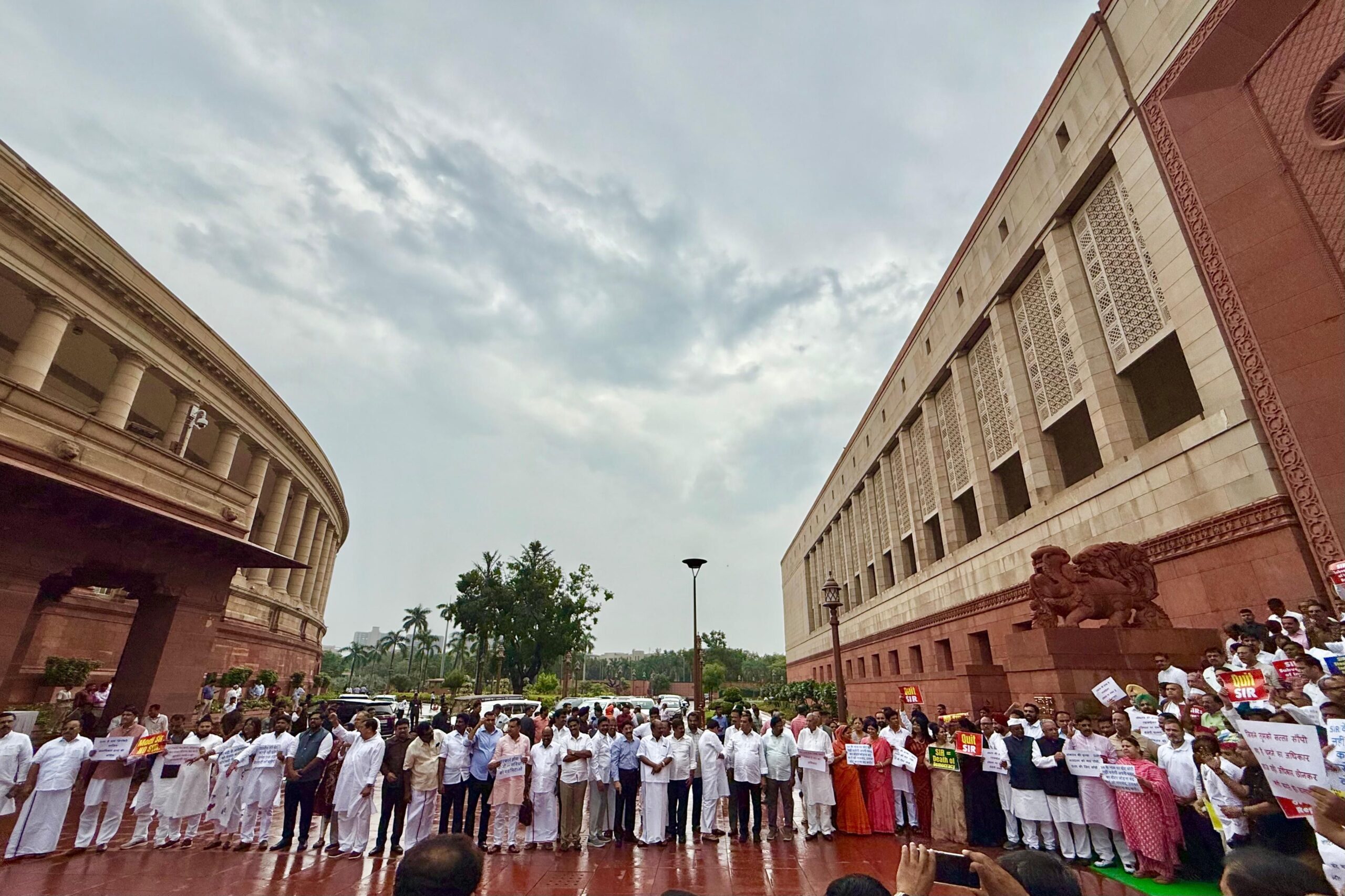
New Delhi: The Monsoon Session 2025 of the Indian Parliament, which adjourned sine die today, stood as a crucible of contention, where the government’s legislative ambitions clashed with the Opposition’s fierce defence of federalism, electoral integrity, and national security.
Debates raged over bills accused of centralising power, voter suppression claims in Bihar, Operation Sindoor’s fallout, and Trump’s Kashmir mediation remarks, testing the government’s credibility.
Towards the end of the highly volatile Session, heated debates swirled around three provocative bills introduced by Home Minister Amit Shah, on August 20: the Constitution (One Hundred and Thirtieth Amendment) Bill, 2025; the Government of Union Territories (Amendment) Bill, 2025; and the Jammu and Kashmir Reorganisation (Amendment) Bill, 2025.
These proposals, aimed at disqualifying the Prime Minister, Chief Ministers, or Ministers detained for over 30 days on charges carrying at least five years’ imprisonment, were lambasted by the Indian National Developmental Inclusive Alliance (INDIA) bloc as tools for centralising power. The INDIA bloc slammed them as power grabs, and it warned that they could empower the Union to override state governments and Union Territories, potentially targeting Opposition-led regions and eroding Jammu and Kashmir’s fragile autonomy. Leader of the Opposition in the Lok Sabha, Rahul Gandhi, donning a black T-shirt in symbolic protest, evoked a “medieval” spectre of arbitrary ousters, decrying the potential misuse of agencies like the Enforcement Directorate (ED) to subvert electoral mandates.
The government, framing these as essential anti-corruption safeguards, faced such uproar—including Opposition MPs tearing bill copies—that the measures were referred to a Joint Parliamentary Committee (JPC), a tactical retreat amid escalating tensions.
Compounding the federalism furore was the Special Intensive Revision (SIR) of electoral rolls in Bihar, where the INDIA bloc accused the Election Commission of India of manipulating over 100 lakh voter records to disenfranchise marginalised communities—a pattern allegedly mirrored in Uttarakhand, Madhya Pradesh, and Chhattisgarh.
Bihar’s upcoming October-November 2025 elections amplified the SIR controversy into a political battleground. The controversy morphed into a high-stakes arena of political posturing, amplifying partisan divides and electoral strategies.
With the National Democratic Alliance (NDA), comprising the Bharatiya Janata Party (BJP) and Janata Dal (United) under Chief Minister Nitish Kumar, aiming to consolidate its hold on the state’s 243 constituencies, opposition parties like the Rashtriya Janata Dal (RJD), Congress, and Communist Party of India (Marxist-Leninist) rallied under the INDIA bloc to portray the voter roll revisions as a deliberate ploy to suppress votes from marginalised castes and minorities, potentially tilting the scales in favour of the ruling coalition.
The government’s dismissal of these claims as unfounded, coupled with its refusal to permit a dedicated debate, triggered Session washouts on July 31 and August 1, dramatic protests like the shredding of “SIR” posters, and a defiant march to the Election Commission that ended in detentions, including Gandhi’s.
This narrative fueled nationwide protests during the Session, positioning the Opposition as defenders of democratic fairness while the NDA countered by emphasising routine electoral hygiene and grassroots mobilisation efforts, such as forming 14 teams to engage workers in 84 key seats for coordinated campaigning. The uproar not only disrupted parliamentary proceedings but also served as a prelude to the Bihar polls, where issues like anti-corruption bills and federal overreach could sway voter sentiment in a state pivotal to national power dynamics.
Operation Sindoor, India’s strike on Pakistan terror camps post the April 22 Pahalgam attack killing 26, drew Opposition flak for intelligence lapses. While the Opposition, led by voices like Rajya Sabha MP Renuka Chowdhury of the Congress party, lambasted intelligence lapses, the government touted the operation’s success with indigenous equipment, which purportedly exposed Pakistan’s complicity on the global stage. Adding diplomatic intrigue, United States President Donald Trump’s mediation remarks on Kashmir sparked salvos from the Opposition against the government’s foreign policy credibility, painting a picture of vulnerability on multiple fronts.
The Parliament Session’s volatility was further amplified by Vice President Jagdeep Dhankhar’s abrupt resignation on July 21, ostensibly for health reasons, after chairing the Rajya Sabha and greenlighting an Opposition motion to impeach High Court judge Justice Yashwant Varma over a cash-related scandal.
Speculation abounded, with Congress’s Jairam Ramesh hinting at deeper machinations, suggesting the BJP was incensed by Dhankhar’s move, which preempted their anti-corruption narrative. Reports of the NDA collecting no-confidence signatures as an ultimatum, coupled with Trinamool Congress’s Kalyan Banerjee alleging prime ministerial coercion and Congress’s Manish Tewari questioning the swift acceptance by President Droupadi Murmu, underscored institutional strains. Dhankhar’s recent angioplasty and packed schedule cast doubt on health as the sole motive, revealing fissures in the governance edifice.
Amid these upheavals, the extension of President’s Rule in Manipur for six months from August 13—approved under Article 356(4) on July 30 in the Lok Sabha and August 5 in the Rajya Sabha, alongside the state’s 2025-26 budget—drew sharp rebukes for sidestepping ethnic conflicts and demands for Jammu and Kashmir’s statehood restoration. Lingering issues, such as attacks on Kashmiri Pandits and migrant workers, alongside the Varma impeachment backed by over 100 MPs, highlighted persistent judicial and security oversight gaps. Even celebratory discussions, like India’s first astronaut aboard the International Space Station as a milestone toward Viksit Bharat by 2047, devolved into chaos on August 18, eclipsing accolades including lifting 25 crore people out of poverty, maintaining 2 percent inflation, leading in United Payments Interface adoption, and the World Health Organization’s declaration of India as trachoma-free.
In response, the treasury benches, spearheaded by the BJP and NDA, met the Opposition’s onslaught—an eight-point attack strategy encompassing suspension notices, adjournment motions, and the Election Commission march—with procedural fortitude and pointed rhetoric. Prime Minister Narendra Modi, in his July 21 address and during the exhaustive Operation Sindoor debates (spanning 18 hours and 41 minutes in the Lok Sabha with 73 members participating, including his reply; and 16 hours and 25 minutes in the Rajya Sabha with 65 members, replied by Amit Shah), called for national unity while lambasting the Opposition’s “insecure leadership” and purported external ties, branding disruptions as anti-national. Union Parliamentary Affairs Minister Kiren Rijiju emphasised adherence to rules, accusing adversaries of engineered pandemonium that squandered public resources. Amit Shah pressed on with his bills despite “Tadipar Go Back” chants referencing his past, while External Affairs Minister S Jaishankar ridiculed Opposition flip-flops on China border disputes. Lok Sabha Speaker Om Birla and Rajya Sabha Deputy Chairman Harivansh lamented the loss of time since both the Houses witnessed continuous disruptions throughout the Session.
Central to the Opposition’s narrative was Rahul Gandhi’s evolving stature as Leader of Opposition in the Lok Sabha. His accusations of muffled dissent, denied speaking rights on Operation Sindoor without formal notice, clashes over China and electoral fraud, black T-shirt symbolism, and an INDIA bloc dinner to consolidate allies bolstered his image as a tenacious guardian of democracy. This despite government barbs about his arrogance, absences from pivotal events, and internal Congress rifts.
Incidentally, while the Opposition’s unyielding tactics cratered productivity—31 per cent in the Lok Sabha (37 hours out of 120) and 39 per cent in the Rajya Sabha (41 hours and 15 minutes), they could not derail the government’s agenda.
Statutory Resolution seeking approval for Extension of President’s Rule in the State of Manipur for a further period of six months with effect from 13th August, 2025 under Article 356(4) of the Constitution of India was adopted in the Lok Sabha on July 30 and in the Rajya Sabha on August 5.
General Discussion on the Budget for the State of Manipur for 2025-26, and Demands for Grants for the State of Manipur for the year 2025-26 were taken up in the Lok Sabha on August 7. The Demands were voted in full, and the related Appropriation Bill was introduced, considered and passed by the Lok Sabha. In the Rajya Sabha, General Discussion on the Budget for the State of Manipur for 2025-26, and the Manipur Appropriation (No. 2) Bill, 2025 were taken up, and the Bill was returned on August 11.
The Government in the Budget Session of Parliamentin July 2024 announced that a time-bound comprehensive review of the Income-tax Act, 1961, would be undertaken to make the Act concise, lucid, easy to read and understand. Accordingly, the Income-tax Bill, 2025, was introduced in the Lok Sabha on February 13, 2025, and it was referred to the Select Committee for examination. The report was presented in the Lok Sabha on July 21, 2025. Almost all of the recommendations of the Select Committee were accepted by the Government. In addition, suggestions were received from stakeholders about changes that would convey the proposed legal meaning more accurately. There were also corrections in the nature of drafting, alignment of phrases, consequential changes and cross-referencing. Therefore, a decision was taken by the Government to withdraw the Income-tax Bill, 2025, as reported by the Select Committee. Consequently, the Income-tax (No. 2) Bill, 2025 was introduced, considered and passed by the Lok Sabha on August 11 and returned by the Rajya Sabha on August 12.
During the Session, 14 Bills were introduced in the Lok Sabha. 12 Bills were passed by the Lok Sabha and 15 Bills were passed by the Rajya Sabha, and a total of 15 Bills were passed by both the Houses of Parliament. Also, one Bill was withdrawn in the Lok Sabha.
Key enactments included the Income-Tax Bill, 2025, streamlining the 1961 Act based on post-2024 Budget Select Committee recommendations; the Promotion and Regulation of Online Gaming Bill, 2025, establishing an authority for e-sports oversight and youth protection; the National Sports Governance Bill, 2025, promoting ethical standards and athlete welfare; and a suite of five maritime reforms—the Bills of Lading Bill, 2025; Carriage of Goods by Sea Bill, 2025; Coastal Shipping Bill, 2025; Merchant Shipping Bill, 2025; and Indian Ports Bill, 2025. Additional passes encompassed the National Anti-Doping (Amendment) Bill, 2025; Manipur Goods and Services Tax (Amendment) Bill, 2025; Manipur Appropriation (No. 2) Bill, 2025; Taxation Laws (Amendment) Bill, 2025; Mines and Minerals (Development and Regulation) Amendment Bill, 2025; Indian Institutes of Management (Amendment) Bill, 2025, for a Guwahati campus; and Readjustment of Representation of Scheduled Tribes in Assembly Constituencies of the State of Goa Bill, 2025. The Insolvency and Bankruptcy Code (Amendment) Bill, 2025, and Jan Vishwas (Amendment of Provisions) Bill, 2025, were routed to a Select Committee. A pre-session all-party meeting on July 20 aimed for harmony, but Dhankhar’s resignation injected further instability.
Ultimately, this Parliament Session emerged as a turbulent yet transformative chapter in Indian parliamentary history. The alleged SIR scandal, federalism skirmishes, and JPC deferral laid bare democratic frailties without compelling government concessions, while the passage of 15 bills affirmed executive resilience.
Dhankhar’s exit exposed institutional vulnerabilities. Rahul Gandhi’s opposition role grew through accusations of suppressed dissent, China clashes, and INDIA bloc unity efforts. His bold analogies—likening bills to medieval tyranny—signalled a defining phase in his leadership, one that champions democratic ideals. Government critiques of his arrogance and Congress’s disunity risked alienating moderates, testing his leadership trajectory. Whether he can win votes for his party remains to be tested at the hustings, and Bihar will be crucial for him.
Overall, in this maelstrom, the Monsoon Session of Parliament not only tested the bounds of governance but also reinforced the enduring contest over India’s federal soul.
*Senior journalist