
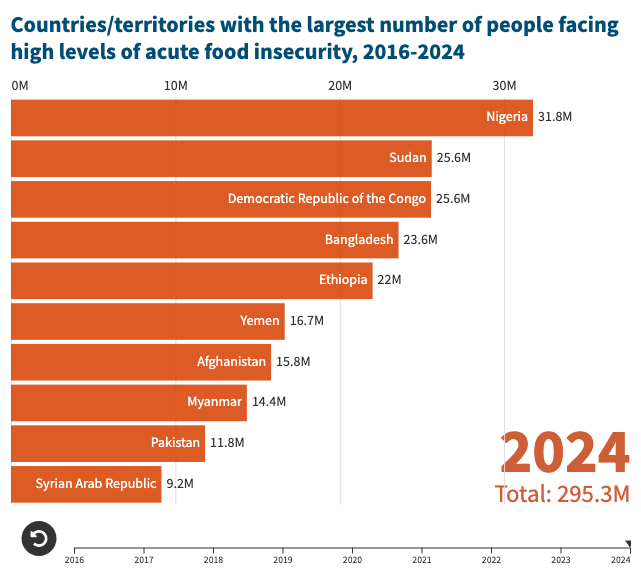
Geneva/New York/Rome/Washington: Pakistan, Bangladesh, and Myanmar have among the largest numbers of hungry people facing high levels of acute food insecurity, according to the Global Report on Food Crises (GRFC) released today.
In Pakistan, 11.8 million people or 32% of the analysed population, were projected to face high levels of acute food insecurity in 43 rural districts of Balochistan, Khyber Pakhtunkhwa and Sindh provinces during the winter lean season of 2024. Of them, 2.2M were in Emergency (IPC Phase 4), according to the report.
Thirty of the 32 analysed areas in parts of Balochistan, Khyber Pakhtunkhwa and Sindh provinces of Pakistan were classified in Serious or worse (IPC AMN Phase 3 or above). Of these, 12 districts in Sindh and Balochistan were in Critical (IPC AMN Phase 4). Only four districts overlap with the previous 2021–2022 analysis, and they remained in IPC AMN Phase 4, the report stated. It revealed that Children’s diets were of insufficient quality and quantity, exacerbated by acute food insecurity, which worsened during the winter months (December–February) when food prices are higher, livelihood opportunities are restricted, and access to markets is reduced. A high prevalence of acute malnutrition among pregnant and breastfeeding women was accompanied by a high proportion of children being born with a low birth weight, particularly in Sindh and Khyber Pakhtunkhwa provinces (IPC, October 2023). At least 2.14 million children under 5 in Pakistan suffer from acute malnutrition.
In Bangladesh, 23.6 million people or 26% of the population, faced high levels of acute food insecurity. The analysis included the Rohingya refugee population. 0.3 million or 30% of them faced high levels of acute food insecurity.
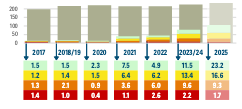
Acute food insecurity and child malnutrition have surged for the sixth consecutive year, with over 295 million people across 53 countries facing acute hunger in 2024, a rise of nearly 14 million from 2023, the Global Report on Food Crises (GRFC) report revealed.
The number of people enduring catastrophic hunger (Integrated Food Security Phase Classification/Cadre Harmonisé Phase 5) has reached a record 1.9 million, doubling since 2016, as conflicts, economic shocks, climate extremes, and forced displacement push vulnerable regions to the brink.
The report, a joint effort by the European Union (EU), Food and Agriculture Organization (FAO), International Fund for Agricultural Development (IFAD), United Nations High Commissioner for Refugees (UNHCR), United Nations Children’s Fund (UNICEF), World Bank, and World Food Programme (WFP), reveals that 22.6% of assessed populations faced acute food insecurity in 2024, marking the fifth year this figure has exceeded 20%. “This Global Report on Food Crises is another unflinching indictment of a world dangerously off course,” said United Nations Secretary-General António Guterres. “Hunger in the 21st century is indefensible. We cannot respond to empty stomachs with empty hands and turned backs.”
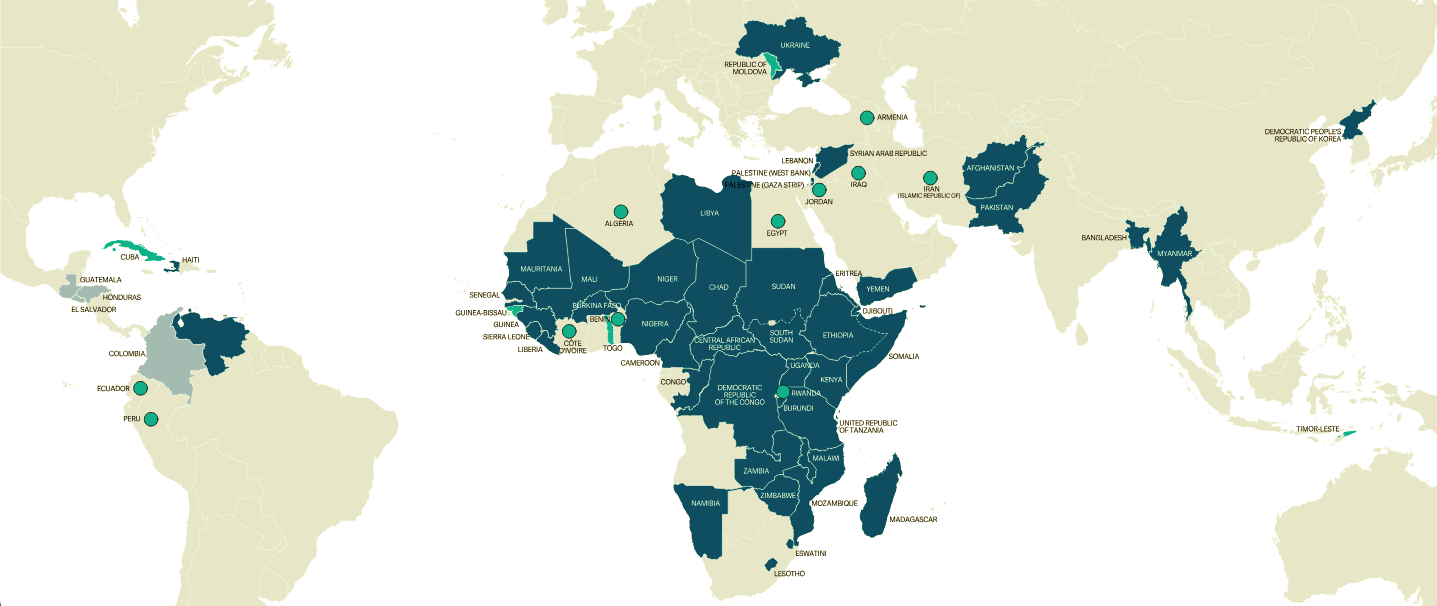
 Conflict remains the primary driver, affecting 140 million people in 20 countries, with famine confirmed in Sudan and catastrophic hunger reported in the Gaza Strip, South Sudan, Haiti, and Mali. Economic shocks, including inflation and currency devaluation, impacted 59.4 million people across 15 countries, notably Afghanistan, the Syrian Arab Republic, and Yemen. Weather extremes, such as El Niño-induced droughts and floods, drove food crises in 18 countries, affecting over 96 million people, particularly in Southern Africa, Southern Asia, and the Horn of Africa.
Malnutrition among children has reached alarming levels, with nearly 38 million children under five acutely malnourished in 26 nutrition crises, including the Gaza Strip, Mali, Sudan, and Yemen. “In a world of plenty, there is no excuse for children to go hungry or die of malnutrition,” said United Nations Children’s Fund Executive Director Catherine Russell. “Hunger gnaws at the stomach of a child. It gnaws, too, at their dignity, their sense of safety, and their future.”
Forced displacement has exacerbated hunger, with 95 million displaced people—out of a global total of 128 million—living in food-crisis countries like the Democratic Republic of the Congo, Colombia, Sudan, and the Syrian Arab Republic. “People who have been displaced show remarkable strength, but resilience alone can’t end hunger,” said United Nations High Commissioner for Refugees Assistant High Commissioner for Operations Raouf Mazou. “We need to shift from emergency aid to sustainable responses.”

The Global Report on Food Crises warns that hunger shocks will likely persist into 2025, compounded by a historic reduction in humanitarian funding. “Like every other humanitarian organisation, World Food Programme is facing deep budget shortfalls which have forced drastic cuts to our food assistance programs,” said World Food Programme Executive Director Cindy McCain. “We have tried and tested solutions to hunger and food insecurity. But we need the support of our donors and partners to implement them.”
The report calls for a “bold reset” to break the cycle of rising hunger, emphasising evidence-driven action, investment in local food systems, and integrated nutrition services. “The report makes clear that humanitarian responses must go hand-in-hand with investments in rural development and resilience building,” said International Fund for Agricultural Development President Alvaro Lario. “Rural communities—especially smallholder farmers—are central to food security, resilience, and growth.”
European Union Commissioner for Equality, Preparedness and Crisis Management Hadja Lahbib underscored the urgency: “This year’s Global Report on Food Crises paints yet another stark and unacceptable picture of rising hunger. This is not merely a call to action—it is a moral imperative. We will not abandon the most vulnerable, especially in fragile and conflict-affected countries.”
FAO Director-General QU Dongyu highlighted the role of agriculture: “Investment in emergency agriculture is critical, not just as a response, but as the most cost-effective solution to deliver significant long-lasting impact.” World Bank Senior Managing Director for Development Policy and Partnerships Axel van Trotsenburg added, “The global hunger crisis threatens not just lives, but the stability and potential of entire societies. What is needed now is collective action so we can build a future free of hunger.”
The report urges prioritising the needs of affected communities and scaling solutions to address long-term vulnerabilities, particularly in regions where 70% of rural households rely on agriculture. As funding dwindles and political momentum weakens, the Global Network Against Food Crises warns that unified action is critical to avert further escalation of this humanitarian crisis.
– global bihari bureau