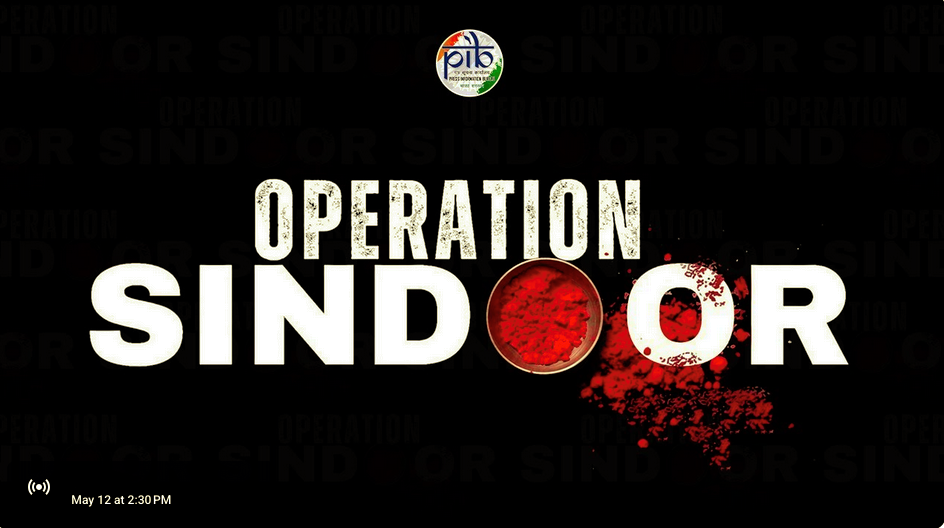

New Delhi: A month has elapsed since Operation Sindoor unleashed its fury, yet its reverberations continue to shake India’s political core. The operation, a surgical strike that obliterated multiple terror camps in Pakistan’s territory, showcased the Indian armed forces’ precision and valour, cementing their reputation as a formidable force. However, since the ceasefire on May 10, 2025, halted hostilities between the two rivals, the domestic political arena has erupted into a fierce battleground, with the opposition Congress and the ruling Bharatiya Janata Party trading fiery accusations daily.
Initially, Operation Sindoor forged rare unity. The entire opposition, led by Congress, stood firmly behind the government, applauding the military’s success. But this consensus crumbled post-ceasefire. Congress leader Rahul Gandhi has since launched a relentless critique, questioning the abrupt end to hostilities and slamming the Narendra Modi government for failing to isolate Pakistan internationally. While praising Operation Sindoor’s execution, Congress accuses the Modi administration of a “total failure” in foreign policy and diplomacy, unable to brand Pakistan as a terrorist state before the world.
Foreign policy observers note that India’s military dominance over Pakistan was resounding, but its diplomatic efforts faltered. The narrative that “Pakistan is a failed state and should be declared a terrorist state” never gained global traction. All-party parliamentary delegations, dispatched to various countries over the last fortnight, did make some impact, but much more was needed diplomatically to yield desired results, to fully convince the international community of Pakistan’s role in cross-border terrorism. India’s long-standing suffering from Pakistan’s terror sponsorship—evidenced by the brutal April 22, 2025, Pahalgam massacre—remains underemphasized globally, a point critics say India failed to communicate effectively. A complex interplay of diplomatic gains, specific assurances, domestic challenges, and competing narratives, with Muslim and opposition MPs shaping India’s outreach, fetched limited support from key powers, and Pakistan’s regional ties tempered its global consensus.
Also read: Sindoor Outreach: India’s Global Gains, Pakistan’s Narrow Reach
The opposition’s sharpest jab targets the BJP’s alleged politicisation of Operation Sindoor. With Bihar elections looming in a few months, the BJP’s “Sindoor campaign” and “Operation Tiranga Yatra” are accused of exploiting the operation for electoral gains, echoing their post-Balakot success in the 2019 Lok Sabha elections. Congress has also highlighted the government’s failure to identify or apprehend the terrorists behind the Pahalgam massacre, where unarmed tourists were mercilessly killed in Kashmir. The opposition labels this a glaring intelligence failure and a lapse in security deployment in tourist-heavy areas, pointing out that no accountability has been fixed for this incompetence.
Rahul Gandhi has intensified his campaign, accusing Prime Minister Modi of “surrendering” to U.S. pressure by agreeing to the ceasefire. When U.S. President Donald Trump repeatedly claimed credit for brokering the peace, Modi neither refuted Trump nor condemned his interference, drawing Congress’s wrath. The government insists the ceasefire was resolved bilaterally, aligning with India’s policy against third-party intervention in Kashmir. Congress, undeterred, demands an all-party meeting and a special parliamentary session to discuss Operation Sindoor’s impact and any U.S. role. Congress President Mallikharjun Kharge has repeatedly called for this session, but the BJP, unmoved, announced 40 days in advance that the regular monsoon session will run from July 21 to August 12, 2025, sidestepping the Opposition’s plea.
Domestically, the past three weeks have been a verbal slugfest, with the government and opposition clashing over Operation Sindoor’s legacy. Internationally, however, India’s all-party delegations spoke with one voice, defending the operation. While many nations supported India’s fight against terrorism, few were convinced Pakistan was the mastermind. Only Israel and Afghanistan explicitly named Pakistan as a sponsor of cross-border terrorism.
Shockingly, the global tide favoured Pakistan. On June 4, less than a month after hostilities focused on Pakistan-based terror groups, the United Nations Security Council named Pakistan vice-chair of its Counter-Terrorism Committee—a diplomatic slap to India. On May 9, as Operation Sindoor raged, the International Monetary Fund’s executive board voted to extend a $2 billion loan to Pakistan, with India alone abstaining. All Group of Seven members supported the decision, followed by financial aid from the World Bank and the Asian Development Bank. Defence Minister Rajnath Singh’s belated criticism of the IMF’s move was a lone voice, dismissed as an afterthought.
Adding insult to injury, Trump’s dozen-plus statements claimed credit for the ceasefire, even equating India and Pakistan as “good friends” of the U.S. and nuclear powers destined to trade peacefully to avoid future conflict. India’s official denials—that the U.S. had no role in the bilateral ceasefire—failed to counter Trump’s narrative, deepening India’s diplomatic wounds. Pakistan, by contrast, played its cards deftly during and after Operation Sindoor, securing global sympathy. Operation Sindoor may have been a military masterstroke, but India’s struggle for global perception remains a bitter, uphill battle.
*Senior journalist