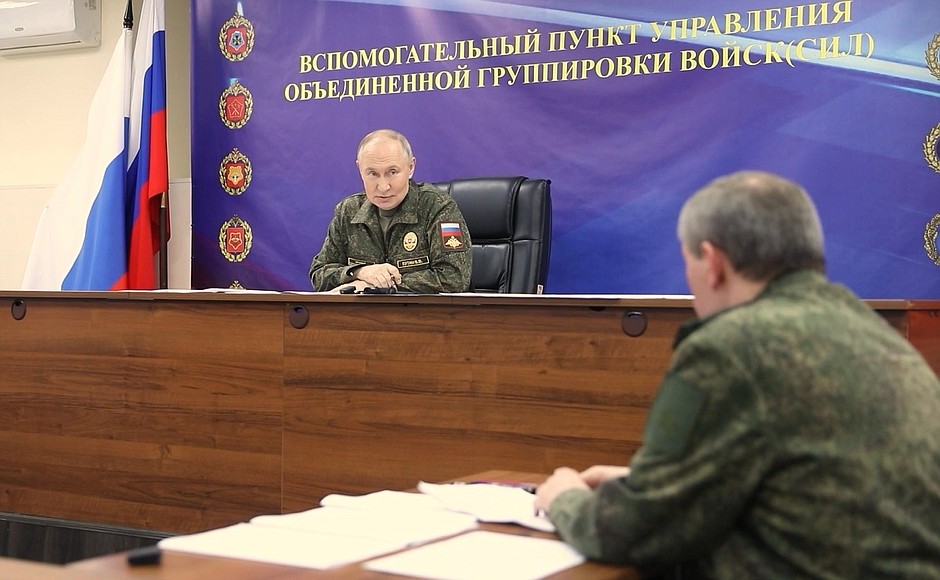
Russian President Vladimir Putin at the Joint Force command post on Sunday October 26, 2025.
Putin’s Power Play, Zelenskyy’s Siege: A War Without End
Moscow/Kyiv: As winter’s unforgiving grasp tightens over the battle-scarred expanses of Ukraine, the protracted conflict between Russia and Ukraine has evolved into a perilous mosaic of nuclear brinkmanship, ceaseless drone and missile assaults. The systematic assaults on energy lifelines, all underscored by the ever-present dread of a nuclear catastrophe, could transcend borders and redefine global stability.
Russian President Vladimir Putin’s October 26, 2025, declaration, delivered from a concealed command post in military garb during a briefing with Chief of the General Staff Valery Gerasimov and frontline commanders, celebrated what Russia describes as the triumphant trial of the Burevestnik cruise missile—a nuclear-powered, nuclear-capable system designed for nearly unlimited range and unpredictable low-altitude manoeuvres. Kremlin officials claimed it travelled 14,000 kilometres over approximately 15 hours during an October 21 test flight.
Portrayed as an untouchable deterrent against NATO’s expansions and U.S. sanctions on Russian petroleum giants, this revelation serves as a stark emblem of Moscow’s resolve to reclaim strategic dominance, fitting into a week of broader nuclear exercises involving launches of Yars and Sineva intercontinental ballistic missiles alongside Kh-102 air-launched cruise missiles from the strategic triad. However, scrutinizing the assertion through a journalistic prism reveals layers of uncertainty: devoid of third-party validation beyond Kremlin visuals and Gerasimov’s endorsements, it echoes a lineage of mishaps, including the 2019 Arctic debacle that dispersed radiation and earlier test failures plagued by reliability issues, prompting Western pundits from the Middlebury Institute and UK intelligence to spotlight its subsonic frailties—potentially allowing interception by NATO aircraft—and conspicuous exhaust trails from the nuclear propulsion as exploitable weaknesses, potentially relegating this purported revolution to elaborate posturing in a theater where perception often trumps capability.
Delving deeper into the geopolitical ramifications, the Burevestnik’s emergence amid stalled U.S.-Russia dialogues and a scrapped Vladimir Putin-US President Donald Trump summit amplifies tensions, positioning it as a calculated retort to perceived Western encirclement, much like its 2018 unveiling in response to the U.S. exit from the Anti-Ballistic Missile Treaty. Experts view this as part of Moscow’s broader nuclear signalling, including recent triad drills with Yars and Sineva ICBMs, aimed at deterring escalated aid to Ukraine while projecting invincibility to domestic audiences. Yet, the missile’s moniker as a “flying Chernobyl” in Western discourse underscores profound risks: its nuclear propulsion could unleash environmental hazards during tests or failures, destabilising arms control frameworks and inviting reciprocal advancements that erode global security architectures. Social media echoes from analysts highlight BRICS frictions and NATO vulnerabilities, suggesting the test could reshape alliance dynamics, compelling Europe to bolster defenses against unpredictable threats while questioning the weapon’s practicality given its checkered development history—overcoming initial expert skepticism but still requiring substantial work for classification, employment modes, and infrastructure integration, as Putin himself acknowledged in directing preparations without a specified timeline.
This orchestrated display of might contrasts sharply with the entrenched ground warfare, where Russian officials boast of enveloping thousands of Ukrainian soldiers in pivotal enclaves such as Kupyansk and Krasnoarmeysk, corralling over 10,500 from crack formations—including the 25th Airborne, 79th Airborne Assault, and 68th Jaeger Brigades—in maneuvers Putin praises for their valor and synergy, all while urging adherence to humanitarian standards for POWs, emphasizing mercy in line with Russian traditions and decrying unconfirmed Ukrainian fratricide via shootings and drones against surrendering troops—a storyline disputed by Kyiv’s charges of Russian violations. Conversely, President Volodymyr Zelenskyy’s steadfast communiqués portray a resilient bulwark, recounting how Ukrainian contingents have consistently thwarted Moscow’s assault blueprints over the preceding ten months, with praises for divisions like the 82nd Bukovynska in the arduous Pokrovsk arena—where Russia masses its primary strike force amid fierce urban clashes and sabotage incursions—enhancing leverage through endeavors like Dobropillia for detainee exchanges and operations yielding hard-won ground in Myrnohrad. Zelenskyy’s narratives expose the human anguish: a week’s torrent of nearly 1,200 drones and 50 missiles—mostly ballistic, per Ukrainian government figures—pummeled Kyiv and beyond, exacting three fatalities and 31 casualties in the capital alone, seven of them minors, necessitating gruelling salvage operations amid enduring infernos and outages that turned residential blocks into smouldering ruins. This unremitting onslaught, he posits, mandates concerted worldwide reinforcement, eliciting assurances from confederates like France’s Mirage fighters and Aster missiles, Britain’s expanded interceptor drone production, and pan-European collaborations via the PURL initiative for Patriot munitions—actions that gauge the West’s allegiance without tipping into overt hostility, while Zelenskyy pushes three-year contracts for domestic long-range weapons to lock in deep-strike goals by year’s end.
Beneath the surface skirmishes, the strife’s core manifests in a merciless offensive against energy underpinnings, engineered to harness winter’s severity, where sustained blackouts and frigidity might erode morale distant from combat zones. Moscow’s operatives have relentlessly assailed Ukrainian grids since late September, deploying hordes that disrupted supplies in Zaporizhzhia and Chernihiv at October’s onset—killing five overall and leaving 73,000 without power in one early barrage—intensifying to mid-month salvos reported by Ukrainian sources as paralyzing nine districts including Kharkiv and Sumy, enforcing countrywide curtailments that consign communities to ceaseless precarity and heroic repair crews racing against drone overwatch. Kyiv counters with its expanding unmanned arsenal, penetrating Russian heartlands to enflame processing plants from Orenburg—where a massive fire suspended Kazakh gas intake—to Ryazan and Novokuibyshevsk, severing conduits and igniting blazes in over 60 attacks since August with ranges up to 2,000 kilometers, striving to asphyxiate the foe’s economic and belligerent apparatuses while affirming autonomy via prolonged fabrication accords for systems like Liutyi swarms. Zelenskyy casts this “extended-reach presence” as crucial for self-determination, aligning with international restrictions to coerce Moscow toward a just settlement. Expert dissections from entities like the Institute for the Study of War and Brookings Institution frame this energy domain as a pivotal theatre, where Russia’s pre-winter strikes seek to impose “energy exhaustion,” compelling Ukraine into concessions by disrupting heat, light, and industry during subzero months, potentially triggering humanitarian crises and migration waves that strain European allies. The International Energy Agency’s pre-winter evaluations warn of heightened vulnerabilities, with Russian adaptations like modified drones breaching defences at elevated rates, exacerbating imbalances in gas flows that ripple across central Europe and underscore the conflict’s transnational economic fallout, from Russian shortages to EU price spikes.
Probing this facet unveils acute hazards linked to Ukraine’s atomic framework, where the Zaporizhzhia Nuclear Power Plant—Europe’s colossus housing six VVER-1000 reactors and 5,700 MW capacity, seized by Russian contingents since March 2022—suffered its tenth and most prolonged blackout since the incursion, a 30-day tribulation commencing September 23 that isolated its final external 750 kV Dniprovska conduit amid military actions, compelling dependence on backup diesel units amid war-torn supply chains and up to 100,000 liters of fuel daily at peak. The International Atomic Energy Agency’s vigilant oversight affirmed steady coolant thresholds and absent radiation surges, yet labeled the predicament as deeply volatile, with Director General Rafael Mariano Grossi commending the valor of repair crews who, beneath a provisional local armistice across the Dnipro frontline, rehabilitated the line by October 23—replacing severed cables, a damaged tower arm, and insulators—reinstating network linkage and mitigating proximate threats to idled reactors and spent fuel pools.
Broadening the lens on this fragility, the Zaporizhzhia narrative epitomises wider menaces besetting Ukraine’s nuclear holdings, recurrently imperilled by adjacent clashes that jolt edifices and jeopardise protocols, from shelling vibrations to drone interceptions mere hundreds of meters from perimeters like South Ukraine’s. IAEA surveillance, enduring three years with a 15-person on-site team, has chronicled operational contingency mechanisms—including full sprinkler ponds and pumping stations—baseline radiation metrics, and sufficient aquatic stockpiles in refrigeration conduits, but Grossi has steadfastly championed de-escalation, compliance with foundational safeguards such as proscribing assaults or armed utilization, and shielding operatives amid mutual indictments of peril, including Ukraine’s appeals for demilitarization and Russia’s counter-claims of protective intent. Recent restorations, witnessed by agency squads from the control room, encompassed mine clearance and structural rectifications in disputed territories, though persistent impairments to auxiliary circuits like the 330 kV Ferosplavna-1—newly damaged outside truce zones with broken cables 1.8 km from adjacent thermal plants—necessitate additional halts in hostilities, illuminating how even ameliorated predicaments harbor latent susceptibilities prone to amplification should combat surge, with Grossi noting the updated Emergency Preparedness plan’s off-site center in Enerhodar as a frontline hedge.
In its most recent statement on October 23, the IAEA detailed the successful reconnection of the ZNPP to Ukraine’s electrical grid after the month-long outage, with the 750 kV Dniprovska line energized at 09:30 local time and full site power restored by 13:00, allowing the shutdown of the last emergency diesel generator after 30 days of reliance on eight such units for cooling the shutdown reactors and spent fuel, while verifying seamless integration and no heat spikes throughout. Grossi described this as “a rare, good day for nuclear safety and security in Ukraine and beyond,” crediting constructive cooperation from both Russia and Ukraine in negotiating temporary ceasefires for de-mining and repairs, which included replacing broken cables, a damaged tower arm, and insulators on the Dniprovska line. He emphasised, however, that “what was once virtually unimaginable – a nuclear power plant regularly losing off-site power – has unfortunately become a common occurrence during this devastating war,” noting this was the most challenging such event yet, and urged full adherence to the IAEA’s five principles, particularly ensuring off-site power remains secure. Additional damage to the backup Ferosplavna-1 line, discovered outside ceasefire zones, requires further interventions, while ongoing IAEA teams continue daily monitoring from the control room, verifying no immediate radiological risks despite the plant’s exposure to shelling as recent as early October, with walkdowns confirming EDG operability and EPR readiness.
This grid-spanning jeopardy heightens apprehensions, as Khmelnytskyi and Rivne have sporadically moderated yields preemptively amid network volatility—weekly checks from October 13-20 showing no anomalies—while South Ukraine’s frontline adjacency beckons akin perils, albeit sans direct breaches compromising nuclei or fuel repositories, though a September drone interception 800 meters away prompted IAEA alerts on aerial threats. Even the mothballed Chernobyl, ensconced in its 1,000-square-kilometer quarantine and emblematic of dormant dangers from a locale still mandating watchful encapsulation, navigated a fleeting power lapse on October 2 from a Russian drone strike on the Slavutych substation—its critical lifeline—expeditiously mended sans repercussions after over three hours on thin diesel stocks, yet serving as a stark reminder of how war revives 1986’s meltdown scars that blanketed Europe in cesium-137 and strontium-90. Zelenskyy condemned the hit as intentional “energy terror” imperilling the fleet, while IAEA logs confirmed no radiation or cooling failures but razor-thin buffers for its 200-ton spent fuel pools. Compounding these are echoes from a February 14 drone assault that pierced the New Safe Confinement—the 36,000-ton steel arch sealing the original sarcophagus for a century—gouging the roof with a Geran-2 explosive and igniting fires that smoldered for weeks inside, demanding IAEA-escorted Ukrainian interventions to suppress without breach, per documented reports; Grossi deemed it “deeply concerning,” with stable levels held, but repairs—a multimillion relocation in lethal fields—linger amid artillery risks, Ukrainian and Western tallies suggesting deliberate targeting over error. The 2022 occupation’s legacy endures too: 190 troops overran the zone, trampling “clean paths” and trenching plutonium-laced “red forests,” aerosolizing radionuclides in plumes that could persist generations, with IAEA post-access checks flagging elevated dust, contaminated gear from retreating forces, and a 35-day staff siege under surveillance; recent May surveys deem 100 hectares farmable amid waning hotspots, yet wildfires, mutations, and “stalkers” looting ruins—trailing dust to cities—undo ecological rebounds in this ironic wildlife ward.
These threads—acute outages, structural scars, and stirred legacies—probe a teetering poise, where IAEA substation probes since July buttress buffers and daily walkdowns affirm viability, but war’s whims threaten cross-border stains via Dnipro drifts or winds, evoking journal-modeled worst-case dispersals of iodine-131 or strontium to Black Sea fisheries and Belarusian farmlands, imperiling multitudes and invoking ’86’s enduring tolls like thyroid cancers. Greenpeace satellite scans refute major line breaks but caution Russian restart ambitions at Zaporizhzhia that could exacerbate instabilities under occupation, while OECD-NEA and others stress regulatory adherence via Ukraine’s inspectorate, advocating demilitarization to avert inadvertent disasters amid escalating energy sieges; the perils, while contained thus far without manifest meltdowns, loom as credible contingencies in a fray eroding non-proliferation’s guardrails and challenging Europe’s environmental ledger.
On the international canvas, retorts blend prudence with tenacity: U.S. President Donald Trump’s censure of the Burevestnik assay as untimely, paired with submarine manoeuvres near Russian shores and petroleum levies on firms like Rosneft, upholds dissuasion sans incitement, as the aborted Putin-Trump parley solidifies deadlocks and Kirill Dmitriev’s U.S. briefings yield no thaw. Zelenskyy’s supplications for augmented aerial bulwarks—conversations with Germany’s chancellor and Baltic ministers yielding Croatian and Estonian packages—reverberate in European halls, but the voided summit accentuates diplomatic chill, with NATO downplaying the missile’s “invincibility” via detectable plumes. As winter descends, taxing fragile gensets and sappers in mine-laced wastes while repair crews in Chernihiv and border zones toil heroically per Zelenskyy’s energy minister reports, this amalgamation of fissionary bravado, unmanned deluges, and foundational beleaguerments interrogates fortitude boundaries—could Moscow’s exhibitions dissuade succour, or invigorate Ukraine’s cohorts into joint production ventures? The scarcity of authenticated strides on battlegrounds intimates a protracted poise, wherein each amplification constricts conciliation conduits, jeopardising a blunder that might indelibly remould Europe’s geopolitical and ecological vista, from frozen hearths to fallout fears.
– global bihari bureau