New Mangalore Port Unveils ₹1,500 Cr for 16 Infra, 113 CSR Projects
Mangalore: At its Golden Jubilee, the New Mangalore Port Authority (NMPA) unveiled 16 infrastructure projects and 113 corporate social responsibility (CSR) initiatives totalling ₹1,500 crore, a package that spans health, education, logistics, port-industry linkages and community development.
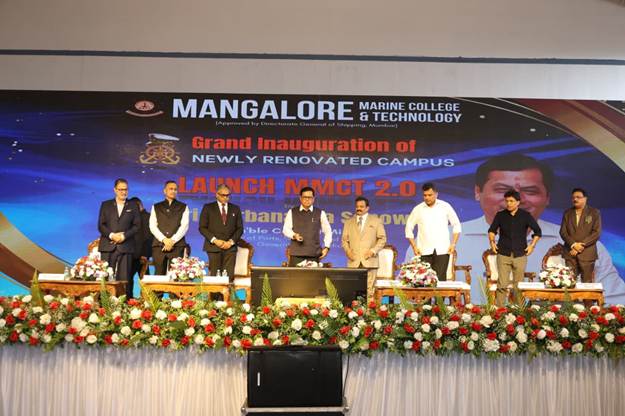
Union Minister for Ports, Shipping and Waterways Sarbananda Sonowal, who presided over the celebration, described the milestone as a reaffirmation of India’s growing maritime strength and self-reliance. The announcement formed the opening plank of the day’s programme and set out investments and welfare measures intended to strengthen the port’s role as a regional economic hub.
The projects include a 150-bed multi-specialty hospital delivered under a public-private partnership, intended to provide healthcare to port employees and adjacent communities with coverage under Ayushman Bharat; the renovated campus of Mangalore Marine College and Technology (MMCT); and a new ₹9.51 crore office building for the Mercantile Marine Department (MMD), Mangalore, constructed on land allotted by NMPA to streamline seafarer competency examinations and certification for Karnataka and neighbouring states. Taken together, the infrastructure and CSR portfolio reflects an emphasis on social infrastructure alongside cargo and logistics enhancements.
The package complements recent memorandum-level commitments: during India Maritime Week 2025, NMPA signed memoranda of understanding worth ₹52,000 crore as part of broader sectoral MoUs exceeding ₹12 lakh crore. These commitments are presented as a demonstration of investor confidence in the port’s transformed ecosystem and as inputs to the NMPA master planning, which targets increased cargo throughput and integrated logistics development.
“This is a strong signal of the rising confidence of investors in the transformed maritime ecosystem of our nation,” Sonowal said. He added that the NMPA Master Plan 2047 envisions doubling cargo handling capacity, achieving carbon neutrality and positioning Mangaluru as a major logistics and cruise hub for South India.
Tracing its five-decade trajectory, NMPA began in 1975 with four berths and an annual throughput of about 90,000 tonnes. The port now operates 16 berths, a Single Point Mooring facility, and handles in excess of 46 million tonnes annually with a usable capacity of 74 million tonnes. The authority has set an aspirational target of 100 million tonnes by 2047 and is pursuing capacity expansion, deep-draft terminals and specialised infrastructure, including LNG and cruise-related facilities, to realise that objective.
Mechanisation and green transition are central to the port’s recent evolution. NMPA reports 92 per cent mechanisation of cargo operations and has moved to 100 per cent solar power for its energy needs while adopting digital systems to reduce environmental impact. The port has also launched the Harit Cargo Concession Policy to incentivise low-carbon logistics practices and to position itself as a green logistics hub for South India.
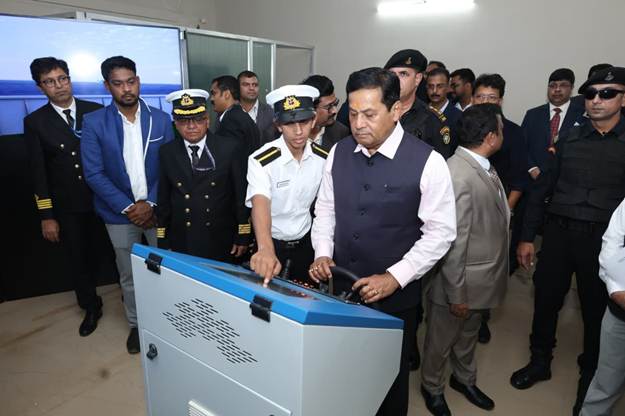
The campus upgrade at MMCT emphasises maritime education and practical training, with modern simulators and a ship-in-campus training model aimed at raising the quality and employability of cadets. The port highlighted a corporate partnership with a global shipping operator to expand shipboard training opportunities; the collaboration is intended to give cadets exposure to global standards and to create a pipeline for careers at sea and in shore-based maritime services.
NMPA’s plan for regional economic integration includes road upgrades, truck terminal expansion, preparation for deep-draft operations and release of port land for port-led industries. Under the Sagarmala Programme in Karnataka, 32 projects valued at ₹6,526 crore are being implemented alongside eight additional projects worth ₹420.89 crore; over 960 acres of port land have been earmarked for industry, with projected annual revenue generation of about ₹7,500 crore and an expected investment inflow of roughly ₹68,000 crore over the planning horizon. The port’s growing cruise activities are also cited as reviving local hospitality and small enterprises.
The broader national maritime strategy that frames these initiatives includes the Maritime India Vision 2030 and the Maritime Amrit Kaal Vision 2047, which set out a multi-decadal blueprint of port modernisation, green transition, logistics efficiency and skill development. National scale measures referenced at the event include flagship investments and projects such as the Vadhvan Port Project and policy frameworks to promote green shipping and port competitiveness.
Statistical points advanced at the ceremony placed India’s maritime progress in stark terms: the number of Indian seafarers rising from about 108,000 in 2014 to over 320,000 today, India’s position as a leading source of seafaring labour globally, and an ambition that by 2030, one in every five seafarers worldwide will be Indian. Wider indicators cited included significant increases in inland and coastal cargo movement, faster vessel turnaround times, and expanded port capacity and flagged tonnage — all presented as evidence of structural change in maritime logistics and trade facilitation.
The Golden Jubilee event brought together national and local dignitaries, senior ministry officials, port management and industry stakeholders. Among those present were the Director General of Shipping, the Chairman and Deputy Chairman of NMPA, members of Parliament, state legislators and representatives of maritime training and crewing organisations. The attendance underlined the port’s cross-sectoral importance and the multi-stakeholder interest in its future trajectory.
Beyond infrastructure and investment, the ministerial message also stressed the human dimension: skill development, job creation and livelihood support for coastal communities under programmes that link maritime growth to inclusive outcomes. The announced projects thus combine hard infrastructure with social measures designed to broaden the benefits of port expansion across adjoining districts.
By launching the ₹1,500 crore package at the fiftieth year mark, NMPA signals an intent to consolidate its recent gains and to accelerate a planned transition to higher capacity, greener operations and closer integration with regional industry clusters. The combination of capital projects, CSR measures and training investments is presented as an integrated approach to making Mangaluru a major maritime, logistics and cruise hub for South India.
– global bihari bureau