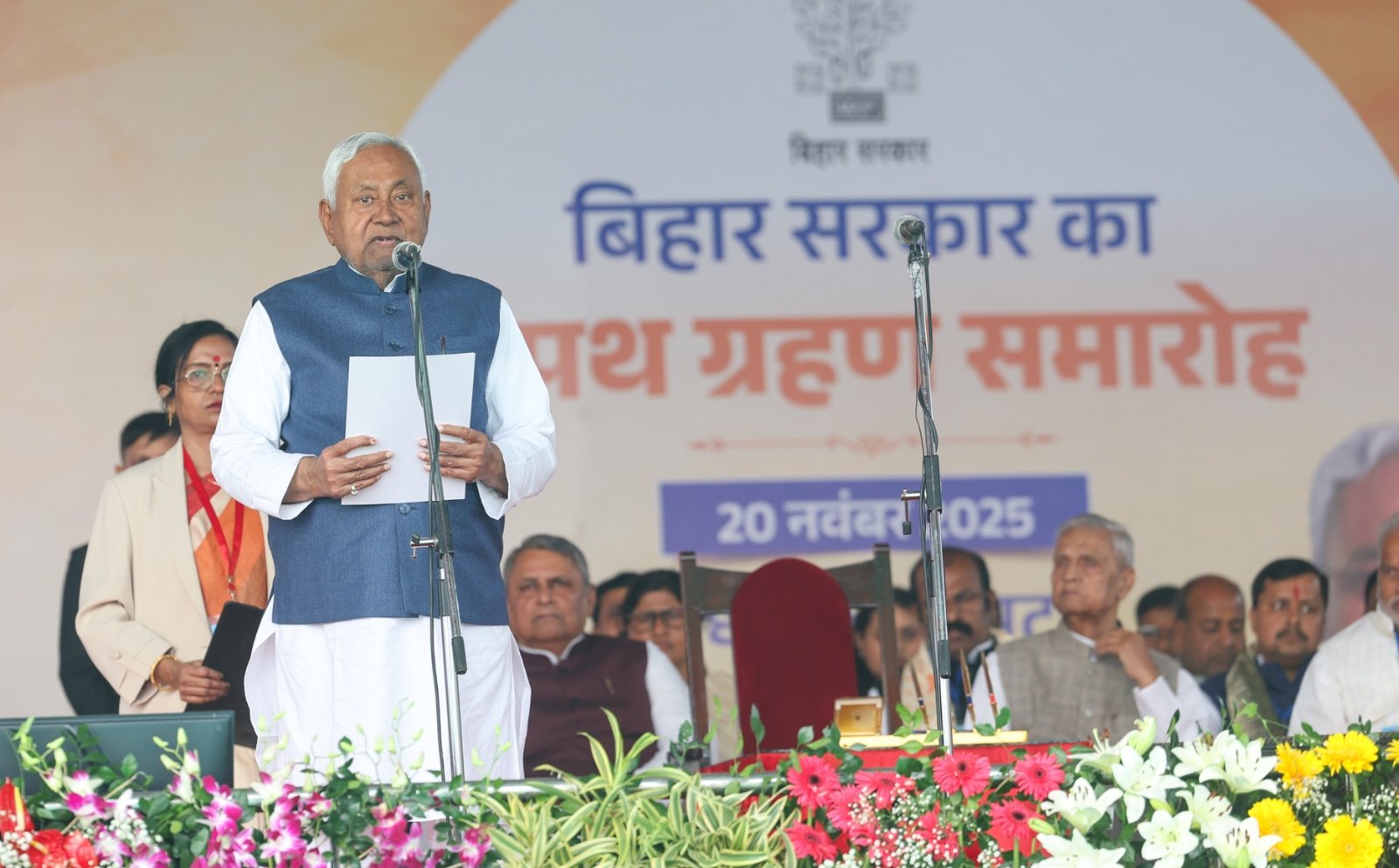
Nitish Kumar swears in as Chief Minister of Bihar for the 10 time today.
Nitish X: Strongest mandate, quietest transition
Patna: Nitish Kumar was sworn in as the Chief Minister of Bihar for the tenth time at noon today, ending the shortest interregnum the state has ever experienced and marking the beginning of what is already being called his strongest term.
The National Democratic Alliance (NDA)’s 202-seat sweep—eighty-nine for the Bharatiya Janata Party (BJP), eighty-five for the Janata Dal (United) (JD(U)), nineteen for Chirag Paswan’s Lok Janshakti Party (Ram Vilas) (LJP(RV)), five for Jitan Ram Manjhi’s Hindustani Awam Morcha (Secular) (HAM(S)), four for Upendra Kushwaha’s Rashtriya Lok Morcha (RLM)—had made the outcome inevitable. Prime Minister Narendra Modi, present on the dais alongside Union Home Minister Amit Shah and a dozen NDA chief ministers, called Kumar “an experienced administrator with a proven track record” and described the 27-member council as “a wonderful team that will take Bihar to new heights.”
The arithmetic—one berth for roughly every six Members of the Legislative Assembly (MLAs)—was agreed upon weeks before polling and executed without revision. Caste supplies the deeper logic, adhering almost exactly to the 2023 survey numbers: eight upper-caste ministers (four Rajputs, two Bhumihars, and two Brahmins), thirteen from the Other Backward Classes–Extremely Backward Classes (OBC-EBC) combine, which forms forty-eight per cent of the council, five Scheduled Caste (SC) representatives, and one Muslim.
The balance—veterans for stability, qualified hands for delivery, fresh mandates for legitimacy—mirrors Kumar’s governance ethos: reward loyalty and competence, but never at the expense of alliance optics. Names tell their own sub-stories. From the JD(U) come old retainers like Vijay Kumar Chaudhary, Shravan Kumar, Vijendra Prasad Yadav, and Leshi Singh; from the BJP, Mangal Pandey, Nitin Nabin, Ram Kripal Yadav, Shreyasi Singh, Sanjay Singh Tiger, and Rama Nishad; from the smaller allies, Santosh Kumar Suman and Deepak Prakash.
Over a dozen from the prior cabinet were dropped, including high-performers like Nitish Mishra (industries), whose investment hauls in Muzaffarpur factories clashed with BJP quota claims. Other omissions are equally instructive: Jiwesh Mishra and several others who had nursed hopes find themselves on the outside, a reminder that even a 202-seat majority leaves little room for sentiment. This churn, at thirty per cent, signals renewal without rupture, prioritising those with proven administrative runs—seventeen have held portfolios before—over pure electoral stars. In Bihar, where MLAs often double as de facto district collectors, such experience trumps Ivy League gloss; it is the engineer’s blueprint for a state long defined by improvisation.
The full list of ministers who took oath yesterday, in the exact order administered by Governor Arif Mohammad Khan, is as follows: Nitish Kumar (CM), Samrat Choudhary (Deputy CM), Vijay Kumar Sinha (Deputy CM), Vijay Kumar Chaudhary, Shravan Kumar, Vijendra Prasad Yadav, Leshi Singh, Madan Sahni, Santosh Kumar Suman, Sunil Kumar, Md Zama Khan, Arun Shankar Prasad (all JD(U)); Mangal Pandey, Nitin Nabin, Ram Kripal Yadav, Shreyasi Singh, Sanjay Singh Tiger, Pramod Kumar Chandravanshi, Dilip Jaiswal, Lakhendra Paswan, Deepak Prakash, Surendra Mehta, Narayan Prasad, Rama Nishad, Santosh Kumar Singh, and one more whose name was inaudible in the live feed (all BJP); Sanjay Kumar Singh and one more (LJP(RV)); Santosh Kumar Suman (HAM(S)); Deepak Prakash (RLM).
The council that took shape today is the most deliberate distillation yet of Bihar’s post-Mandal, post-caste-survey reality. Fourteen ministers belong to the BJP, nine to the JD(U), including the chief minister, two to Chirag Paswan’s party, and one each to Manjhi and Kushwaha. Caste supplies the deeper logic, adhering almost exactly to the 2023 survey numbers: eight upper-caste ministers (four Rajputs — Shreyasi Singh, Leshi Singh, Sanjay Singh Tiger, one more; two Bhumihars including Vijay Kumar Sinha; two Brahmins — Mangal Pandey and Dilip Jaiswal); thirteen from the OBC-EBC combine forming forty-eight per cent of the council (Kurmis: Nitish Kumar, Shravan Kumar, Vijay Kumar Chaudhary; Kushwahas: Samrat Choudhary, Deepak Prakash; Yadavs: Vijendra Prasad Yadav, Ram Kripal Yadav; others from Kanu, Teli, Nonia, Mallah clusters); five Scheduled Caste representatives (Santosh Kumar Suman, Rama Nishad, Lakhendra Paswan, two more from Paswan sub-caste); and one Muslim (Md Zama Khan).
Rajputs emerge as the single largest caste bloc in the cabinet for the first time in two decades. The five Dalit ministers, drawn from Paswan and Manjhi factions, mark the highest Scheduled Caste representation in any Kumar ministry and reward the NDA’s successful reclamation of reserved seats lost in 2020. The two Yadavs—one each from the BJP and JD(U)—are the most discussed inclusions, quiet feelers toward a fourteen per cent community whose younger, urbanising sections showed visible cracks in the Rashtriya Janata Dal (RJD) loyalty. Kurmis and Kushwahas hold the commanding heights of the backward segment, while the ninety-eight smaller EBC sub-castes settle for junior roles and the promise of downstream patronage. Md Zama Khan remains the lone Muslim face, a continuity gesture rather than an expansion in a state where Muslims form seventeen per cent of the population.
Beyond caste and coalition math, the selections reveal a layered calculus of seniority and qualification, where political longevity often trumps formal credentials in a state where governance experience is the true diploma. Roughly two-thirds of the council—eighteen ministers—qualify as veterans with three or more prior assembly terms or equivalent administrative stints, ensuring continuity in a bureaucracy still scarred by the 1990s’ neglect. Shravan Kumar, a nine-term MLA from Lakhisarai and a Kurmi mainstay since 1990, exemplifies this: his retention underscores Kumar’s reliance on battle-tested loyalists who navigated the Lalu-Rabri era’s chaos and delivered on rural electrification drives in the 2005-2010 term. Vijendra Prasad Yadav, another nine-termer from Hasanpur, brings similar heft, his Yadav roots paired with decades steering public health engineering amid floods and famines. Vijay Kumar Chaudhary, a seven-term legislator; Leshi Singh, five; Madan Sahni, four. Among the BJP group, Nitin Nabin brings prior experience as Union Minister of State for Home and Environment; Mangal Pandey ran health through the pandemic; Vijay Kumar Sinha managed the House as Speaker 2020–2024.
Qualifications, when they surface, tilt toward practical expertise over academic pedigree, reflecting Bihar’s needs for hands-on administrators rather than theorists. Nitish Kumar, the council’s anchor, holds a B.Tech in electrical engineering from the National Institute of Technology Patna (NIT Patna) (then Bihar College of Engineering), where he honed skills in power grids before a brief stint at the Bihar State Electricity Board; his formal training informs the NDA’s infrastructure vows, from seven expressways to district medical colleges. Samrat Choudhary, the Kushwaha deputy CM, boasts a Doctor of Letters from California Public University, a credential that, while unconventional for Indian politics, signals his grassroots evolution from a Patna University alumnus to a party organiser who mobilised EBC voters through student unions in the 1980s. Vijay Kumar Sinha, the other deputy and a Bhumihar, earned a civil engineering diploma from Government Polytechnic, Barauni, in 1989, lending technical credibility to anticipated agriculture or land reforms roles; his prior speakership honed legislative savvy, managing stormy sessions on reservation bills. Mangal Pandey, BJP’s Brahmin face and a returning health minister, pairs an MBBS from Patna Medical College with pandemic-era experience, positioning him for education or IT, where his prior revamps of medical colleges align with the Rs 5,000-crore sector overhaul pledge.
Gender and region follow the same measured script. Three women took oath — Shreyasi Singh (Rajput, BJP), Leshi Singh (Rajput, JD(U)), Rama Nishad (Nishad-Dalit, BJP). North and south Bihar split almost evenly: Kosi-Seemanchal sent Zama Khan, Sunil Kumar, Deepak Prakash; Tirhut and Mithila contributed Shravan Kumar, Leshi Singh, Vijendra Prasad Yadav; Magadh and Shahabad gave Vijay Kumar Sinha, Ram Kripal Yadav, Pramod Kumar Chandravanshi; Bhojpur-Ara belt returned Nitish Kumar himself and Nitin Nabin.
Newer entrants, comprising about one-third or nine ministers, inject dynamism but are rarely novices without moorings. Shreyasi Singh, the Rajput shooter and Jamui MP-turned-MLA, enters cabinet for the first time at 35, her international accolades in trap shooting (bronze at the 2018 Commonwealth Games) and family legacy (daughter of late MLA Shailesh Singh) compensating for limited legislative tenure; her youth appeals to the NDA’s job-creation pitch for migrants’ kin. Sanjay Kumar Singh of LJP(RV), a first-time MLA who ousted Tej Pratap Yadav in Mahua, brings no formal degree on record but electoral grit from Paswan strongholds, rewarding Chirag Paswan’s youth mobilisation. Rama Nishad, BJP’s Dalit from Sonbarsa, is another debutant, her community organising background in fisheries cooperatives suiting niche welfare roles despite modest schooling.
This assembly is the NDA’s institutional echo of its poll math: upper-caste reliability fused with non-Yadav backward resurgence, Dalit flanks broadened by Paswan and Manjhi, all under Kumar’s enduring social-justice banner. The 2010 sweep, with 206 seats, leaned on a kindred OBC pivot; 2025 refines it, fragmenting the old Muslim-Yadav edifice through welfare nets like scholarships and reservations. Yet the weave frays at edges—the EBCs’ elite capture by Kurmi-Kushwaha clusters, the Muslims’ tokenism amid Owaisi’s gains, the women’s upper-caste skew. Dynastic threads run through ten ministers, from Shreyasi to Suman, prompting RJD barbs on nepotism even in opposition exile.
Portfolios remain unannounced tonight, but the broad contours are already clear from closed-door talks. JD(U) will retain Home, General Administration, Vigilance, Cabinet Secretariat, Election, and a large slice of Finance — the levers Kumar has never surrendered in any alliance. The BJP is expected to take Road Construction, Health & Family Welfare, Education, Energy, Urban Development, Industries, and Information Technology — the departments that carry maximum contractor interest and national visibility. Smaller allies will settle for Rural Development, Animal Husbandry & Fisheries, SC/ST Welfare, Backward & Extremely Backward Class Welfare, and Minority Welfare — portfolios that resonate with their core voters without threatening the big two.
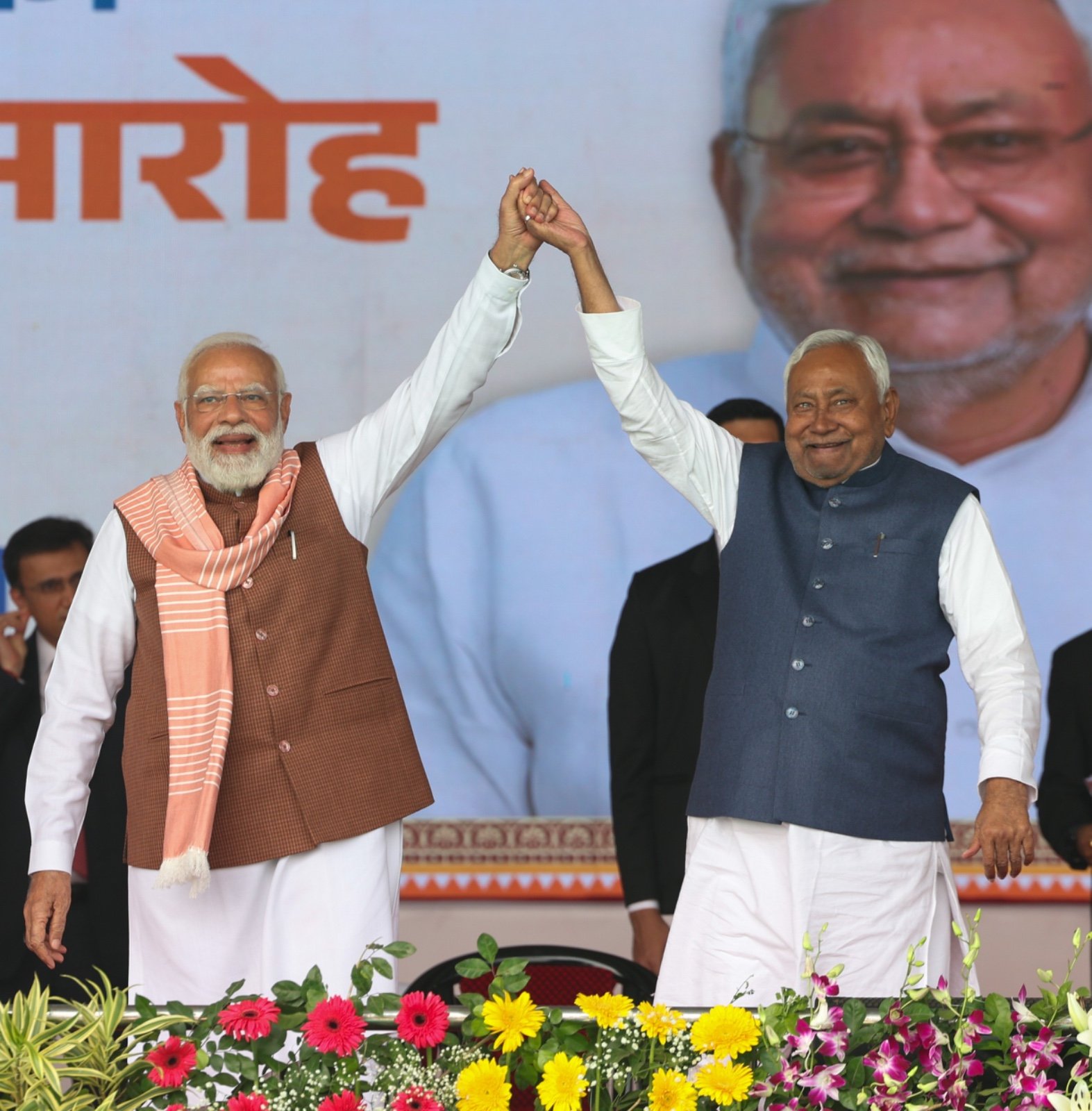
For the BJP and Narendra Modi, Kumar’s indispensability extends far beyond this latest victory, rooted in a partnership that has weathered more storms than most alliances endure. Bihar, with its forty seats in the Lok Sabha and seventy-five in the Rajya Sabha, remains the fulcrum of Hindi-belt politics, and Kumar’s JD(U) provides the twelve MPs that propped up Modi’s third term after the BJP fell nine short of a majority in 2024. Without those votes, the NDA’s national arithmetic would have teetered, forcing concessions to larger regional players like the Telugu Desam Party (TDP) or JD(U)’s own leverage in a hung Parliament. In Bihar itself, the BJP has never crossed the 100-seat mark alone; its eighty-nine seats this time, while impressive, still hinge on Kumar’s eighty-five to secure the 122 needed for stability. No BJP leader—neither the state president nor central heavyweights like Ravi Shankar Prasad—matches Kumar’s stature as a local “Sushasan Babu,” the engineer-turned-politician who ended Lalu Prasad’s jungle raj and rebuilt roads, schools, and electricity grids. Modi’s national charisma, amplified by Rashtriya Swayamsevak Sangh (RSS) groundwork, delivers upper-caste and urban votes, but it is Kumar’s quiet rewriting of social lines—through EBC quotas, Mahadalit scholarships, and women’s reservation hikes—that consolidates the sixty-three per cent OBC-EBC-Dalit base the BJP cannot touch alone. His appeal to women, who turned out in record numbers for initiatives like the 35 per cent reservation in jobs and the prohibition experiment (flawed as it was), added the swing that buried the Mahagathbandhan. Kumar’s volatility—six alliance switches since 1999, from breaking with Modi in 2013 over his Gujarat elevation to rejoining in 2017 and 2024—has earned him the “Paltu Ram” tag, yet it underscores his survival instinct: he always lands on the winning side, pulling the BJP with him. For Modi, who has publicly credited Kumar’s “good governance” in victory speeches, the alliance is less a gamble than a necessity; sidelining him risks fracturing the non-Yadav backward vote, alienating EBCs who see Kumar as their authentic voice against Yadav dominance. In a state where caste trumps ideology, Kumar is the hinge—the indispensable moderate who tempers Hindutva with social justice, ensuring Bihar remains an NDA fortress without the backlash of overreach. As the Prime Minister noted yesterday, this “wonderful team” elevates the state, but beneath the praise lies an unspoken truth: without Nitish Kumar at the helm, the double-engine sarkar in Bihar stalls.
After the celebrations die down — after the fireworks over Gandhi Maidan, the victory processions in every district, and the selfies with Modi — will the full historical footnote become audible? This time, unlike literally every government formation since 1990, there was no midnight resignation, no Sunday-morning flight to Delhi, no leaked letter of discontent, no parallel claim to Raj Bhavan, no 3 a.m. press conference. August 2022, January 2024, November 2020, and July 2017 — each had its own dose of high drama. This time, the script ran quietly from resignation on 17 November to legislature party meetings on 18 November to oaths on 20 November.
And unlike many past verdicts, there were no post-poll disturbances either. In the 48 hours after counting, a handful of viral videos purporting to show angry protests in Patna, Begusarai and Seemanchal spread like wildfire on RJD and Congress handles. Within hours every clip was traced to old footage from Chhattisgarh, Jharkhand, Uttar Pradesh — repurposed with new hashtags. No barricade was broken, no counting centre besieged, no lathi-charge ordered anywhere in Bihar. The Election Commission of India (ECI) logged zero repolls, zero deaths, zero major law-and-order incidents. Tejashwi Yadav’s allegations of manipulated voter lists found no echo on the ground. Even Rohini Acharya’s dramatic exit from politics on 16 November unfolded in press statements, not on the streets. The state that once turned every close verdict into a tinderbox simply watched the results, absorbed the shock, and moved on to Chhath preparations.
For now, Bihar has traded its habitual suspense for the unfamiliar comfort of certainty. The opposition, reduced to forty-one seats and grappling with succession questions inside the RJD, offers no immediate counter-pull. Prashant Kishor’s Jan Suraaj, scoreless despite the noise, has retreated into introspection. In the old secretariat tonight, files for the inaugural cabinet meeting are stacking up under fluorescent lights while the winter fog settles over the river. The tenth Nitish Kumar ministry has begun not with the creak of strained alliances but with the quiet hum of a machine that, for the moment, runs smoothly.
– global bihari bureau