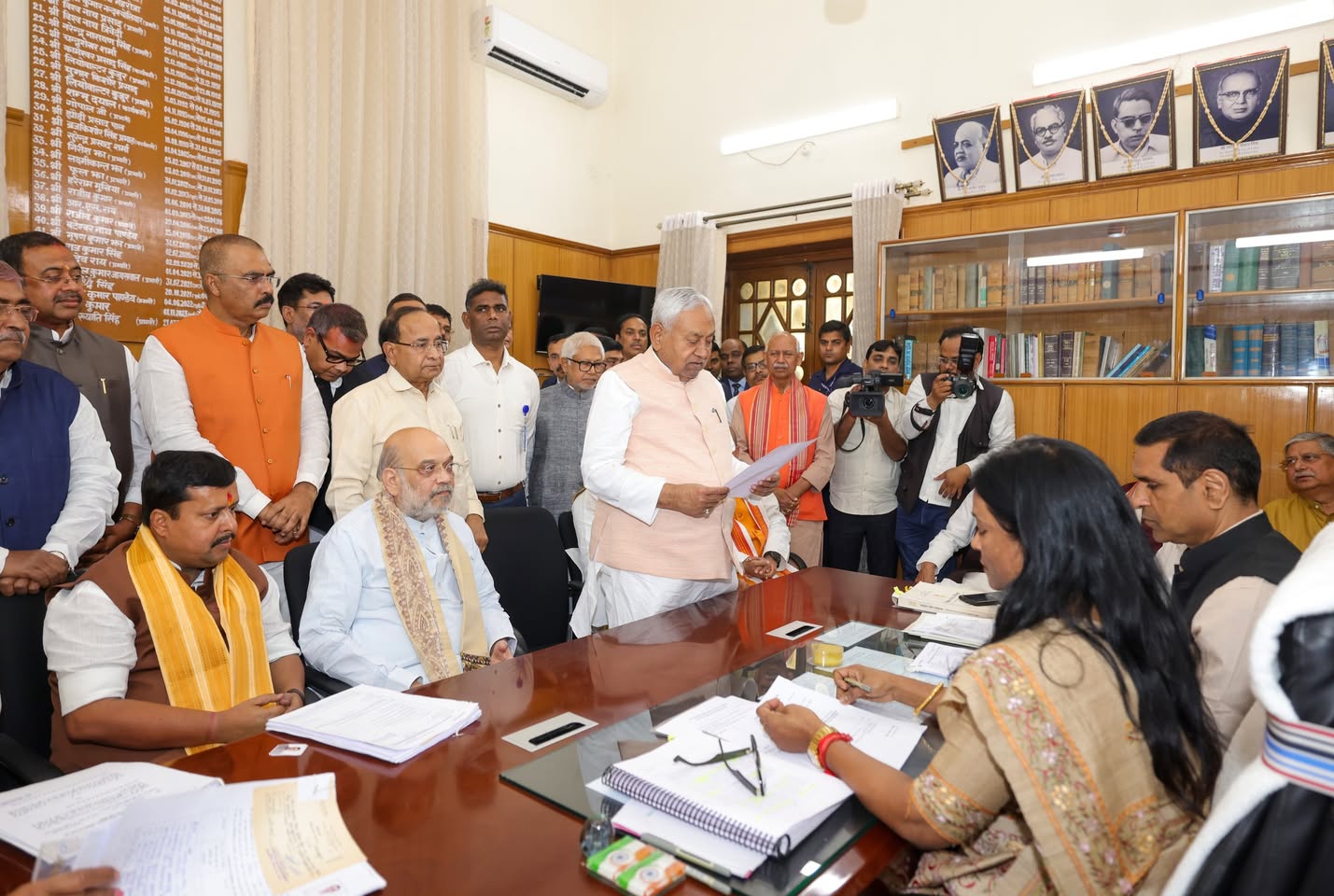
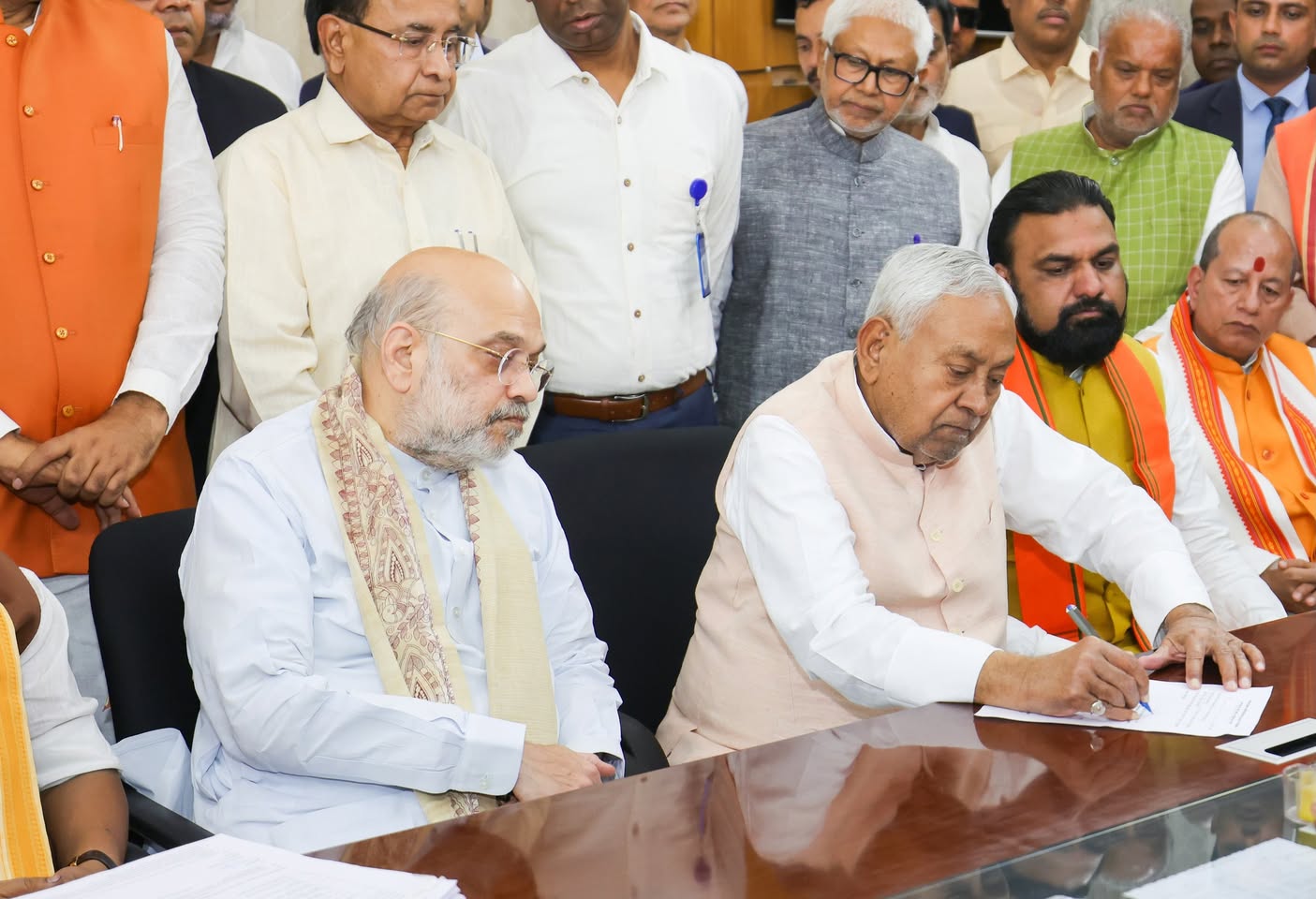
Left to Right: Bharatiya Janata Party president Nitin Nabin, Union Home Minister Amit Shah and Bihar Chief Minister Nitish Kumar
Nitish’s Rajya Sabha Bid Redraws NDA Balance
Patna/New Delhi: Bihar Chief Minister Nitish Kumar formally filed his nomination on March 5 for the upcoming Rajya Sabha elections scheduled for March 16, confirming weeks of speculation that the state’s longest-serving contemporary political figure is preparing to move from the executive centre of power in Patna to a legislative role in New Delhi. The move effectively signals the approaching end of his prolonged tenure as chief minister, a position he has held for most of the period since 2005 and through which he emerged as one of India’s most durable regional leaders.
The decision by Kumar to enter the Rajya Sabha has triggered one of the most consequential political transitions in Bihar in nearly two decades, reshaping the balance of power within the National Democratic Alliance while simultaneously opening a new chapter in the veteran leader’s long public career. The development has triggered intense speculation about the future leadership of the state government and the evolving balance of power between his party, the Janata Dal (United), and its alliance partner, the Bharatiya Janata Party.
For Bihar’s political landscape, the implications are profound. Kumar has dominated the state’s governance narrative for nearly twenty years, presiding over periods of coalition with both the Bharatiya Janata Party and the Rashtriya Janata Dal at different points. His tenure began after the defeat of the Rashtriya Janata Dal-led regime, which had ruled Bihar through the 1990s and early 2000s under Lalu Prasad Yadav and later Rabri Devi. Kumar’s rise to power was widely associated with a promise to restore governance and administrative stability after what critics described as a period of institutional decline.
During his early years as chief minister, his administration focused heavily on rebuilding roads, improving law and order, expanding school enrolment and implementing welfare programmes aimed particularly at women and marginalised communities. These policies helped shape a political identity centred on governance and development, enabling him to maintain electoral relevance across shifting alliances.
The move to the Rajya Sabha now suggests a transition from state-level executive leadership to a broader national role. Supporters within the National Democratic Alliance argue that Kumar’s experience in coalition management and public administration could contribute meaningfully to parliamentary deliberations, particularly at a time when the government often requires careful floor coordination in the upper house.
Reacting to the development, Union Home Minister Amit Shah publicly welcomed Kumar’s nomination, describing his political experience as an asset to national policymaking. In a message posted on social media, Shah said Kumar’s commitment to Bihar’s welfare over the past two decades had helped move the state away from what he termed an era of “jungle raj” toward development and governance. He added that Kumar’s experience in public service and policymaking would make the proceedings of the Rajya Sabha more effective and strengthen the alliance’s broader commitment to inclusive development.
At the same time, the Rajya Sabha election process in Bihar also saw another prominent nomination from the ruling alliance. Bharatiya Janata Party president Nitin Nabin filed his nomination for the Rajya Sabha as well. Party leaders noted that after a long and active political career in the state, Nabin is expected to contribute significantly to parliamentary debates and legislative work in the Upper House.
The parallel nominations underline the broader political transition underway within the National Democratic Alliance in Bihar, where the Bharatiya Janata Party has steadily expanded its organisational strength and electoral influence over the past decade. While Kumar remains the most recognisable political face of governance in the state, the Bharatiya Janata Party has emerged as the largest partner within the alliance, altering the internal power balance that defined the coalition during its earlier years.
Opposition parties, particularly the Rashtriya Janata Dal led by Tejashwi Yadav, have portrayed Kumar’s shift to Parliament as evidence that the Bharatiya Janata Party is consolidating its dominance in Bihar’s politics. Critics argue that his transition could pave the way for the Bharatiya Janata Party to assume the chief minister’s position in the state for the first time since the alliance first came to power in 2005.
Beyond Bihar, the development also carries implications for national politics. Kumar’s political career began in the 1970s amid the anti-corruption movement led by Jayaprakash Narayan, a movement that produced several influential leaders of northern Indian politics. Over the decades, he cultivated a reputation as a pragmatic coalition manager capable of navigating complex alliances.
He served earlier as a member of the Lok Sabha and held key portfolios in the government led by Atal Bihari Vajpayee, including the ministries of Railways and Agriculture. That national administrative experience, combined with his long record as chief minister, positions him as one of the few regional leaders with both state and Union-level governing credentials.
Within the Rajya Sabha, such experience could prove valuable to the National Democratic Alliance leadership, particularly as the chamber continues to play a critical role in the legislative process. While the alliance has strengthened its numbers in recent years, the upper house often requires careful negotiation and coordination to secure the passage of legislation.
At the same time, Kumar’s shift inevitably raises questions about the future leadership of the Janata Dal (United). The party has long been closely associated with his personal leadership, and the absence of a clearly established successor introduces an element of uncertainty about its organisational trajectory. Whether the transition leads to generational change within the party or deeper integration with the Bharatiya Janata Party’s political framework remains an open question.
For Bihar, the moment marks the likely end of an era defined by Kumar’s style of consensus-oriented governance. His political career has been characterised by multiple alliance realignments, pragmatic decision-making and a reputation for administrative focus rather than rhetorical politics. Supporters credit him with stabilising governance in the state, while critics often highlight the frequent shifts in political alliances that punctuated his career.
Yet few dispute the scale of his influence over Bihar’s political trajectory since the mid-2000s. The state’s political narrative over the past two decades has largely revolved around the contest between Kumar’s governance-focused politics and the social justice mobilisation represented by the Rashtriya Janata Dal.
Whether his move to the Rajya Sabha represents the beginning of a gradual political retirement or the start of a new national role within the National Democratic Alliance remains uncertain. Much will depend on how actively he participates in parliamentary debates, internal alliance consultations and broader policy discussions in New Delhi.
For now, however, the symbolism of the transition is unmistakable. A leader who shaped Bihar’s politics for a generation is preparing to step onto a different stage in India’s parliamentary arena, leaving behind a political landscape that will inevitably evolve in his absence while continuing to bear the imprint of his long tenure.
– global bihari bureau