
AI Roadmap Seeks to Lift 490 Million Informal Workers
Mission Digital ShramSetu to Bridge India’s Workforce Gap
 New Delhi: India’s growth story, NITI Aayog warned today, will falter unless its 490 million informal workers are placed at the centre of the nation’s technological transformation. This is the core message of AI for Inclusive Societal Development, a new roadmap released by the government’s policy think tank that argues Artificial Intelligence (AI) and frontier technologies can only deliver on their promise when they empower the workers who form the backbone of India’s economy.
The pioneering study is a first-of-its-kind effort to systematically explore how Artificial Intelligence (AI) and frontier technologies can be harnessed to transform the lives and livelihoods of India’s 490 million informal workers – the backbone of the nation’s economy.
While global debates on AI have largely focused on white-collar jobs and formal employment, the study, developed in partnership with Deloitte under NITI Aayog’s Frontier Tech Hub, shifts attention to the informal sector. Contributing nearly half of India’s Gross Domestic Product (GDP), these workers continue to face structural barriers, including financial insecurity, limited market access, low productivity, inadequate skilling, and insufficient social protection. The report highlights that these challenges are underpinned by four systemic barriers: low trust, poor access and usability of services, limited awareness and skills, and outdated tools and processes.
The study underscores that AI and other frontier technologies alone cannot dismantle these barriers. Without deliberate human intent, targeted investment, and coordinated action across government, industry, academia, and civil society, the promise of technology risks remaining out of reach for those who need it most.
To address these gaps, NITI Aayog has proposed ‘Mission Digital ShramSetu’, a national initiative to build a technology-driven ecosystem that empowers informal workers. The mission will leverage AI, blockchain, Internet of Things (IoT), robotics, and immersive learning to expand access to skilling, financial instruments, verified work outcomes, and real-time market information, enabling workers to enhance productivity, opportunity, and dignity in work.
Distribution of India’s informal trade workforce by sector and corresponding work profiles
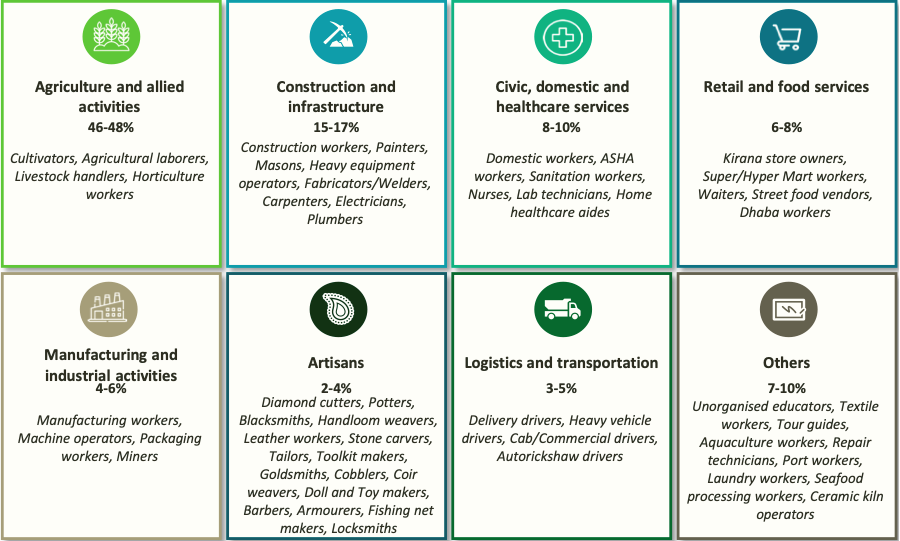
The roadmap draws on extensive field-level insights and sectoral analysis, highlighting the diversity of the informal workforce across construction, textiles, handicrafts, food services, agriculture, and healthcare. It identifies priority sector targets, estimating that AI-enabled platforms could initially reach 60 million workers in construction, 50 million in agriculture, 25 million in textiles and handicrafts, and 30 million in healthcare and allied services.
In construction, AI-powered tools can optimise task allocation and material management, while robotics and IoT devices monitor safety and productivity. In textiles and handicrafts, blockchain-enabled supply chains and AI-assisted design platforms can help artisans access formal markets and receive transparent pricing. Agriculture workers are projected to benefit from AI-driven crop advisory systems, remote sensing, and IoT-enabled farm monitoring, potentially improving yields by 15–20% for smallholders. Healthcare aides can leverage immersive learning platforms and AI-assisted patient monitoring, supporting skill development for over 30 million workers. Across sectors, digital platforms aim to deliver verified credentials, smart contracts for timely payments, and on-demand learning modules.
By 2035, the roadmap envisions a digitally-enabled ecosystem in which voice-first AI interfaces overcome literacy and language barriers, micro-credentials and demand-driven learning enable rapid upskilling, and AI-driven platforms connect workers with jobs, markets, and entitlements designed around the realities of the informal sector. Cost reduction in frontier technologies and accessible, resilient digital infrastructure are central to achieving scale.
Economic projections underline the urgency of action: at the current trajectory, informal workers’ average annual income may stagnate at approximately USD 6,000 by 2047, significantly below the USD 14,500 threshold required for India to achieve high-income status. The roadmap projects that full adoption of frontier technologies and skilling interventions could raise incomes by 50–70% in targeted sectors by 2040, accelerating India’s path to a Viksit Bharat 2047.
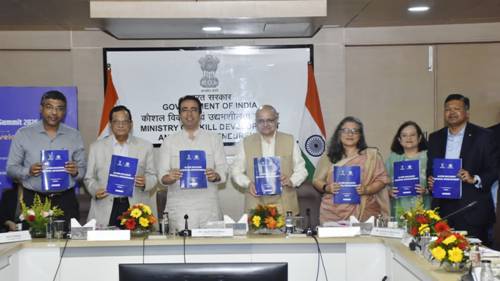
At the launch in New Delhi, Minister of State (Independent Charge) for Skill Development and Entrepreneurship Jayant Chaudhary described empowering informal workers as both an economic and moral imperative. “By bringing together government, industry, and civil society, this mission will ensure that every worker—whether a farmer, artisan, or healthcare aide—has the skills, tools, and opportunities needed to thrive in the digital economy of tomorrow,” he said, highlighting the alignment of Digital Skilling in AI with India’s broader national skilling agenda.
NITI Aayog CEO B. V. R. Subrahmanyam stressed the non-negotiable need for collaboration. “Transforming the lives of India’s 490 million informal workers demands cross-functional action—from focused R&D that reduces the cost of frontier technologies, to building a sustainable ecosystem of innovation tailored to the informal sector, to skilling and reskilling at scale,” he said. Distinguished Fellow Debjani Ghosh, Chief Architect of the Frontier Tech Hub, noted that the roadmap is unique in placing informal workers’ voices, challenges, and aspirations at the centre of the AI conversation, providing a mission-mode framework to turn the promise of frontier technologies into real, measurable empowerment.
The study details implementation strategies, including sector- and persona-led prioritisation, state-driven rollout, regulatory enablement, strategic partnerships, and multi-level impact evaluation mechanisms. Pilot clusters across eight states have been recommended to test the model, with each cluster expected to reach 2–5 million workers in the first phase. The evaluation framework includes metrics on productivity improvement, income enhancement, market access, and skill acquisition, allowing for real-time course correction.
The roadmap identifies specific technological interventions, such as AI-enabled workforce planning, predictive analytics for market linkages, blockchain-based verification of work and payments, immersive learning for skill acquisition, IoT-based productivity monitoring, and robotics solutions in selected trades. The report emphasises that these interventions are expected to improve productivity, provide secure incomes, and enhance access to markets and social protections across sectors.
The study draws lessons from India’s earlier successes in building inclusive digital public infrastructure, including Aadhaar, the Unified Payments Interface (UPI), and the Jan Dhan financial inclusion programme, demonstrating the country’s capacity to implement large-scale digital solutions with measurable societal impact.
With the study now public, the government and its partners are expected to translate the roadmap into concrete programmes. The next phase will focus on identifying pilot states and worker segments for Mission Digital ShramSetu ahead of its proposed rollout in 2026. NITI Aayog’s Frontier Tech Hub will coordinate with the Ministries of Skill Development and Entrepreneurship, Labour and Employment, and Electronics and Information Technology to begin groundwork for implementation, marking the first formal step in building a coordinated national framework to apply AI and frontier technologies for the empowerment of India’s 490 million informal workers.
– global bihari bureau