GSTAT Targets GST 2.0 Dispute Resolution
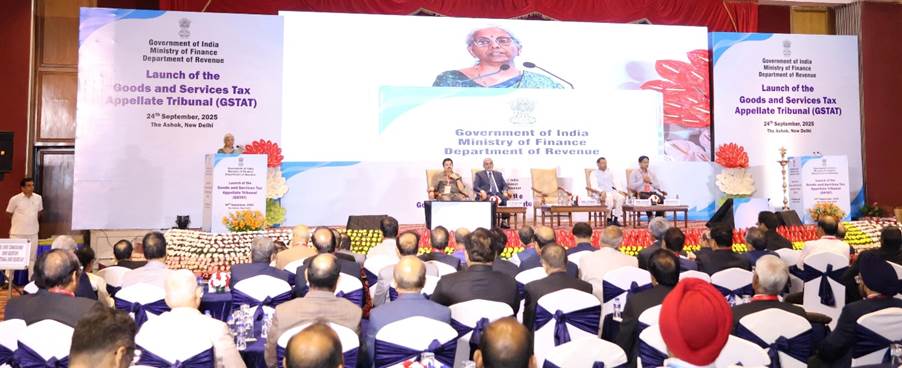
New Delhi: Finance Minister Nirmala Sitharaman launched the Goods and Services Tax Appellate Tribunal (GSTAT) here today, addressing a critical gap in resolving tax disputes as India rolls out the Next Generation of Goods and Services Tax (GST 2.0) reforms, effective September 22, 2025.
A key feature unveiled during the launch was the GSTAT e-Courts Portal, developed by Goods and Services Tax Network (GSTN) in collaboration with National Informatics Centre (NIC). This digital platform enables taxpayers to file appeals online, track cases, and join hearings virtually. The portal builds on NIC’s e-courts success in other tribunals, aiming to boost GSTAT’s efficiency. Staggered filing until June 30, 2026, ensures a smooth transition, with FAQs, explanatory notes, and videos on the GSTAT Portal (https://efiling.gstat.gov.in) to guide users, including MSMEs, on registration, filing, and hearings.
GSTAT tackles a backlog of over 1 lakh GST cases, critical as monthly collections hit Rs 1.8 lakh crore in 2025, up 10% from 2024, and 1.4 crore businesses have formalised since 2017, per Ministry of Finance data. By easing high court burdens, GSTAT could free MSME funds—vital for their 30% GDP share—though uniform enforcement across 45 locations will test coordination. Trade bodies welcome the move for investor confidence, but rural MSMEs may need support to access digital tools.
With new rate slabs and anti-profiteering rules to lower prices, GST 2.0 has spurred the need for a dedicated tribunal to handle appeals, a void unfilled since GST’s 2017 debut due to legal and administrative delays. GSTAT aims to clear over 1 lakh pending cases, ensure compliance with GST 2.0’s provisions, and boost trust for businesses, especially Micro, Small and Medium Enterprises (MSMEs). The launch drew Minister of State for Finance Pankaj Chaudhary, GSTAT President Justice Sanjaya Kumar Mishra, Haryana Minister Rao Narbir Singh, Revenue Department officers, GST officials, legal experts, and trade representatives.
Why was GSTAT absent earlier? The Central Goods and Services Tax Act of 2017 mandated a tribunal under Section 109 to hear second-level appeals, but legal challenges over member qualifications and debates on merging with the Customs, Excise and Service Tax Appellate Tribunal stalled progress. This left taxpayers, including 1.4 crore formalised businesses, reliant on overburdened high courts, delaying justice and tying up funds. “The launch of the GST Appellate Tribunal is a step in this journey so that the resolution of disputes can be simple and accessible,” Pankaj Chaudhary said, emphasising its role in providing a “uniform, transparent, and reliable platform.”
Why now? GST 2.0’s simplified 5% and 18% slabs, expanded e-invoicing, and revived anti-profiteering measures to ensure price reductions—part of the GST Bachat Utsav festive campaign—could trigger disputes if businesses fail to comply. GSTAT, with its 31 State Benches across 45 locations, is designed to handle these appeals swiftly.
The tribunal’s purpose is to streamline second-level appeals from Central or State GST authorities, ensuring uniformity and predictability. It will enforce GST 2.0 compliance, including passing on rate cuts (e.g., 5% for unpacked food), with penalties for non-compliance. Its e-Courts Portal, built by Goods and Services Tax Network (GSTN) and National Informatics Centre (NIC), enables online filing and virtual hearings, with staggered appeals until June 30, 2026. With monthly GST collections reaching Rs 1.8 lakh crore in 2025, a 10% increase from 2024, GSTAT could unlock MSME cash flows—crucial for their 30% contribution to GDP—though uniform implementation across 45 locations remains a challenge.
Revenue Secretary Arvind Shrivastava said that GSTAT will allow equal opportunity to all sides to present their standpoint and enable the settlement of such issues in a fair and stable manner.
The Tribunal will provide a specialised, nationwide forum that can bring consistency in interpretation, predictability in outcomes, and credibility to the appellate process. This is vital for strengthening trust between taxpayers and tax administration, the Revenue Secretary underlined. Highlighting the three core dimensions in the design of the GSTAT, the Revenue Secretary emphasised the 3 S’s: structure, scale, and synergy. Its structure combines judicial and technical expertise to deliver balanced decisions. Its scale, with state benches and the possibility of single-member benches for simpler matters, ensures reach and efficiency. And its synergy — between technology, process, and human expertise — will allow it to deliver justice with both speed and depth. Concluding his remarks, Shrivastava said that the Department of Revenue, in partnership with Goods and Services Tax Network (GSTN) and National Informatics Centre (NIC), has developed a digital platform that will anchor the work of GSTAT from the very start. e-Filing, case management tools, and electronic court modules will make proceedings smoother and transparent, setting new benchmarks for the functioning of a Tribunal in our country.
“The outcome we seek is straightforward: reduced legal frictions, greater simplicity, and delays in litigation addressed proactively, so cash flows move faster, Micro, Small and Medium Enterprises (MSMEs) and exporters invest with confidence and citizens feel the benefits of the system,” the Finance Minister said.
Pankaj Chaudhary underlined that a strong appellate mechanism instils the trust that justice will be swift and fair. With the introduction of the GST Appellate Mechanism, he sought to assure every taxpayer that their appeal will be heard, their rights will be protected, and there will be no delay in justice.
Justice Sanjaya Kumar Mishra underlined the pivotal role the Tribunal will play in clearing the backlog of appeals under GST while also laying down jurisprudence for future disputes. He also underscored that the cooperation of both Central and State Governments has been instrumental in enabling the timely establishment of the Tribunal and expressed confidence that such support will continue in the future.
– global bihari bureau