New Bhopal–Dhanbad, Bhopal–Chopan trains launched
New Delhi: Bihar and Jharkhand have received new direct rail connectivity with Madhya Pradesh with the launch of two new express trains linking coalfields, industrial centres and regional hubs with Bhopal and central India.
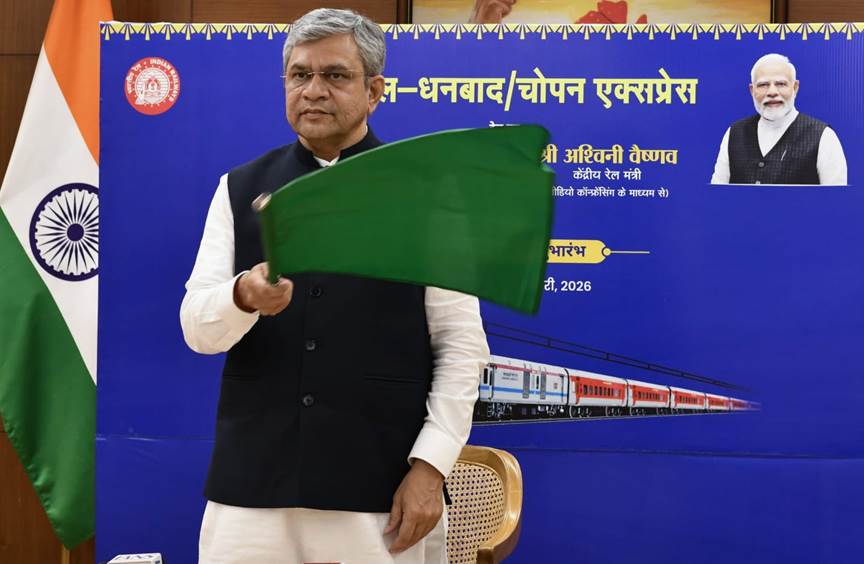
The two new long-distance express trains linking Madhya Pradesh with Jharkhand and Uttar Pradesh were flagged off virtually from Rail Bhawan in New Delhi today, expanding direct rail connectivity between central India and key coal and industrial regions in the east. Train No. 11631/32 Bhopal–Dhanbad–Bhop Tri-Weekly Express and Train No. 11633/34 Bhopal–Chopan–Bhop Weekly Express were inaugurated by Union Railway Minister Ashwini Vaishnaw.
The launch ceremony took place at Bhopal railway station in the presence of Madhya Pradesh Chief Minister Mohan Yadav, deputy chief ministers Jagdish Devda and Rajendra Shukla, MPs Alok Sharma and Rajesh Mishra, and MLAs Radha Singh and Riti Pathak.
The two new services have been introduced in response to rising demand for direct rail links from Madhya Pradesh to Uttar Pradesh and Jharkhand. Vaishnaw said railway expansion in the state had accelerated sharply during the third term of Prime Minister Narendra Modi, with projects worth around ₹48,000 crore sanctioned that directly connect with Madhya Pradesh.
Among the major approvals cited were the Indore–Manmad new railway line at an estimated cost of ₹18,000 crore, the Bhusawal–Khandwa third and fourth line project costing ₹3,500 crore, the Prayagraj–Manikpur third line at ₹1,640 crore, and the Ratlam–Nagda third and fourth line project at ₹1,000 crore. The Itarsi–Nagpur fourth line has been sanctioned at ₹5,400 crore, while the Itarsi–Bhopal–Bina fourth line corridor, one of the busiest routes in the region, has been approved at ₹4,300 crore. The Vadodara–Ratlam third and fourth line project has received clearance at ₹8,800 crore. The Cabinet has also approved the Gondia–Jabalpur doubling project at a cost of ₹5,200 crore.
Ongoing projects include Ramganj Mandi–Bhopal, Lalitpur–Singrauli, Indore–Budni, the Bina–Katni third line, Satna–Rewa and Katni–Singrauli doubling, the Katni grade separator and gauge conversion works, all aimed at easing congestion and improving punctuality and freight movement.
Vaishnaw said the Union Budget has proposed a new Dedicated Freight Corridor from Dankuni in West Bengal to Surat in Gujarat, passing through Odisha, Chhattisgarh, Madhya Pradesh and Maharashtra. The 2,052-km east–west corridor will link with the existing Western Dedicated Freight Corridor and is expected to provide a logistics backbone for industrial expansion in Madhya Pradesh by enabling faster movement of goods to western ports. He said the corridor would connect the state efficiently with ports in Gujarat and Maharashtra, including the upcoming Vadhvan Port, and existing ports such as Hazira Port and Mundra Port. This connectivity is expected to benefit both containerised cargo and bulk commodities and support export-oriented industries.
Mohan Yadav said the new train services would ensure regular rail connectivity to Singrauli and described them as particularly beneficial for people travelling between Singrauli and Dhanbad, where many residents are engaged in trade, business and employment. He noted that the services establish direct rail links with Jharkhand and Bihar and would serve as a catalyst for wider regional development.
The Bhopal–Dhanbad–Bhop Tri-Weekly Express (Train No. 11631/32) will halt at 30 stations between Bhopal and Dhanbad. Under its regular schedule, it will depart from Bhopal at 20:55 and reach Dhanbad at 20:30 the following day. On the return journey, it will leave Dhanbad at 07:20 and arrive in Bhopal at 07:00 the next day. The train will operate with 24 coaches, including AC, sleeper and general class coaches.
The Bhopal–Chopan–Bhop Weekly Express (Train No. 11633/34) will stop at 15 stations between Bhopal and Chopan. It will depart from Bhopal at 20:55 and reach Chopan at 10:50 the next day, while the return service will leave Chopan at 17:10 and reach Bhopal at 07:00 the following morning. This train will also have 24 coaches comprising AC, sleeper and general categories.
The new services will provide direct connectivity to Vidisha, Ganj Basoda, Bina, Sagar, Damoh, Katni Murwara, Khanna Banjari, Beohari, Singrauli, Chopan, Chandrapura and Dhanbad, among other stations. Railway officials said the routes would strengthen links between Madhya Pradesh, Uttar Pradesh and Jharkhand and integrate the Singrauli coalfields and industrial belt with the state capital Bhopal, benefiting trade, energy and mining sectors.
Passenger traffic is also expected to rise with safer and more reliable services, supporting tourism, education, local trade and daily commuting. The introduction of the two trains forms part of a broader push to expand rail capacity and services across Madhya Pradesh.
Under the Union Budget 2026–27, Indian Railways has received a record capital allocation of ₹2.93 lakh crore and ₹1.20 lakh crore for safety. Madhya Pradesh alone has been allocated ₹15,188 crore for railway development, about 24 times higher than the annual average during 2009–2014. Railway projects worth ₹1.18 lakh crore are currently underway in the state, and full electrification of its railway network has been completed.
Under the Amrit Bharat Station Scheme, 80 stations in Madhya Pradesh are being redeveloped, some of which were inaugurated in 2025. Safety upgrades include plans to implement the Kavach automatic train protection system over 4,591 route kilometres. The state currently operates five pairs of Vande Bharat Express and four pairs of Amrit Bharat Express trains, with more such services and additional new trains scheduled to be introduced during the year.
Railway officials said the launch of the two new express trains reflects a broader effort to link infrastructure expansion with passenger convenience and freight efficiency, as Madhya Pradesh’s rail network is positioned as a central corridor for trade, industry and mobility across central and eastern India.
– global bihari bureau