©FAO/ David Blacker
Global Lessons from Sri Lanka’s Fruit Farmers
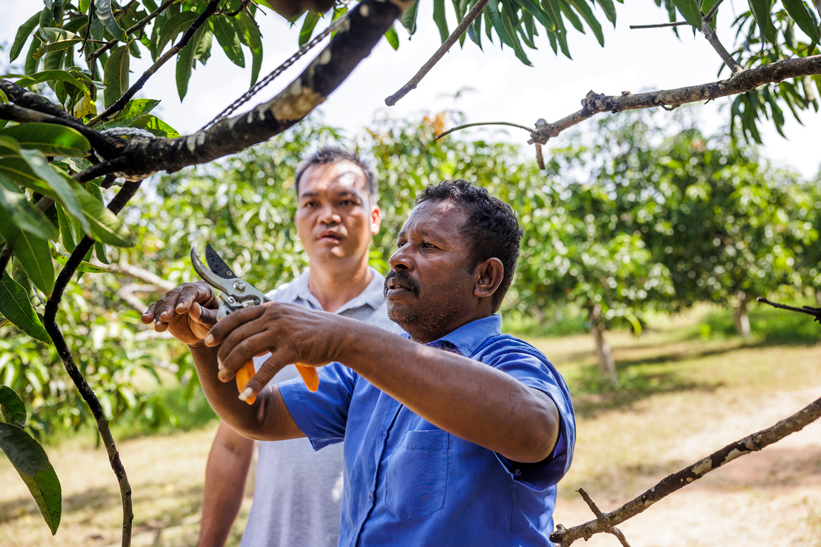
In Sri Lanka’s sun-baked Anuradhapura district, mango farmer Shantha Dissanayake, 53, has long battled wild elephants trampling his orchards, a persistent worry in the region’s sparse, dry landscape. But his heart sank when Chinese agricultural expert Zengxian Zhao arrived and slashed his towering mango trees to stubs.
“These outsiders came and hacked down all my trees to stubs with only a few leaves left. They looked close to dead,” Shantha recalled, gesturing toward his now-thriving orchard. The pruned trees, designed to maximise sunlight and nutrients, have boosted his marketable yield by 50 per cent, producing premium mangoes over 500 grams each, a technique that could transform mango farming far beyond Sri Lanka. “This experiment has turned out to be a complete success,” he said, grinning as he tinkered with his rusty old tractor, a relic from his days growing squash and maize.
Shantha’s journey is at the heart of a Food and Agriculture Organization of the United Nations and China South-South Cooperation project, a $1.5 million effort launched in 2023 to revitalise Sri Lanka’s mango, pineapple, and banana farms. As the island recovers from its 2022 economic collapse, these low-cost innovations, adaptable to tropical regions worldwide, are helping farmers like Shantha increase yields and eye global markets.
Zengxian, from China’s Ministry of Agriculture and Rural Affairs, laughed at Shantha’s initial shock. “He was initially shocked, but he’s been convinced and is spreading the word,” he said, standing in Shantha’s orchard, now a hub where neighbours learn techniques applicable to mango farms from India to Mexico.
Zengxian’s pruning method – which he has demonstrated to hundreds of Sri Lankan farmers at more than 30 sites around the dry and sparsely-populated North-Central Province – is manually simple. It follows a fractal logic wherein the crown of each mango tree is hollowed out and the number of spindles per branch is reduced by half. In essence, he serially splices the tree, starting at about 70 centimetres up the trunk, replicating the pattern of leaving four rather than the typical seven branches at each point to open the canopy in a way that enhances fruit productivity.
Ultimately, the ideal is to have one tree with about 87 branches, each producing one or two ovoid-shaped mangoes, ideally weighing just over 500 grams. Shorter mango trees make it easier to bag and pick the fruit at harvest, which is done by hand. Greater exposure to sunlight additionally reduces opportunities for invasive pests, lowering both labour requirements and agrichemical costs.
Shantha says that while gross yield per pruned tree has dipped somewhat, his net marketable yield has jumped by 50 per cent, as he now obtains mostly prime-grade fruit, whereas before the majority of his fruit was too small or irregular and had to be sold at giveaway prices.
Shantha describes himself as a convert to the new techniques he has learned and now plans to adopt them for the rest of his trees. He is convincing his brother-in-law, Jayasekara, to do the same on his nearby farm, where mango trees tower up to three times higher but with only marginal economic yields. At the moment, Jayasekara uses a long bamboo pole to knock down fruits from the upper branches, which usually bruises them to the point where they have to be turned into chutney on the same day or perish. With shorter trees, this wouldn’t be the case.
The pineapple predicament
In the humid, flood-prone towns of Makandura and Horana, pineapple farmer Suneth Lakmal adopted methods from Chinese expert Yangyang Liu, whose Sinhala fluency and poetic musings about “buffaloes in paddy fields with herons standing nearby” endeared him to locals. Using raised soil beds, mulching, and crown propagation, Suneth tripled his yield to 20,000 pineapples per acre. “I don’t feel any limits to how much I can cultivate,” he said, planning to double his land and pursue exports to the $11 billion global fruit market, a goal mango farmers elsewhere could share with similar cost-saving techniques.
Dharshini Erangika Jayamanne, Director of Agriculture at Makandura’s Research and Development Centre, established a model pineapple farm yielding three times the norm, innovating disease-resistant propagation for pineapples and bananas. “The key to this project was guidance and the scientist-to-scientist rapport,” she said, having trained over 1,000 farmers and students. The methods, recoverable in one to three seasons, are sustainable without long-term subsidies, offering a model for smallholder farmers globally.
Transportation, a universal challenge for fresh fruits, saw a 50 per cent reduction in losses through plastic crates and upside-down pineapple packing, as explained by Chandana Wasala, Deputy Director of the National Institute of Post-Harvest Management. “Transforming Sri Lanka’s tropical fruit sector is a systemic enterprise,” he said, inspired by China’s market efficiencies after training there. His team’s 80 “training of trainers” sessions have reached hundreds, a model replicable in other fruit-growing nations.
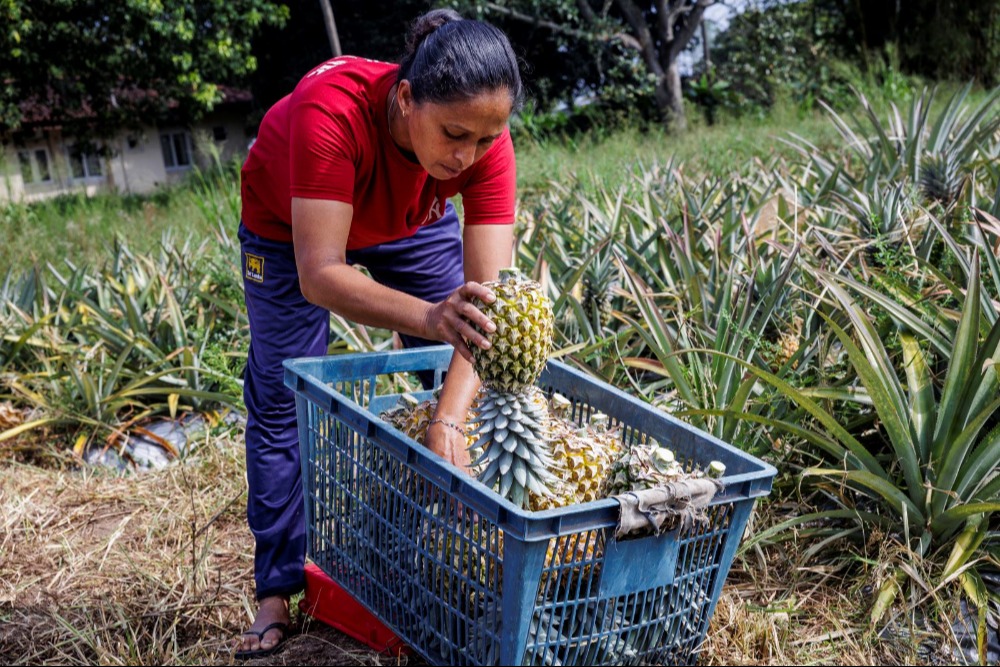
Seela Wickrama, converting her family’s betel farm to pineapples and bananas, fields curious glances from neighbours. “They’ll look over the wall and ask why I am planting so densely, and I tell them about the FAO project,” she said, now investing her own funds after initial grants. Provincial instructor Bandara Abeysinghe highlighted returns: “If done well, farmers get a higher return on investment,” with 50 annual pruning courses planned to sustain impact.
Sri Lanka’s Agriculture Minister, Kuragamage Don Lalkantha, sees the project as a lifeline for the nation’s fruit diversity. “We need investments from abroad… and must focus on increasing production and boosting exports,” he said, subsidising equipment to reach the poorest and enhance food security. The Food and Agriculture Organization’s Vimlendra Sharan called it a “pilot and a proof of concept,” noting, “Farmers are amazingly instinctive at understanding each other,” a sentiment that resonates with mango farmers facing similar challenges worldwide.
Shantha, dodging elephants and embracing new methods, summed up the hope: “We have a saying that the way to get rich is to grow mangoes out of season. With these new technologies, there’s now another viable path.” For mango farmers from Asia to Africa, these lessons could mean richer harvests and new markets.
Source: The Media Office at the Food and Agriculture Organization of the United Nations (FAO).
– global bihari bureau