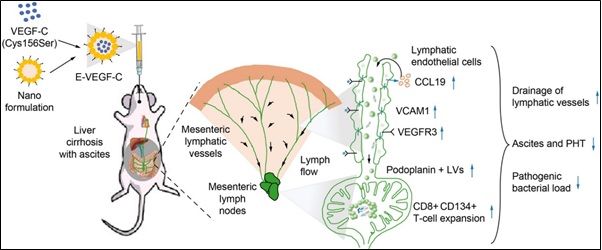
This illustration highlights that vascular endothelial growth factor-C (VEGF-C) is a key pro-lymphangiogenic factor, offering improved mesenteric lymphatic drainage & gut immune response, making them promising candidates for the treatment of cirrhosis.
New Delhi: A team of Indian scientists may have discovered a new approach to treating liver cirrhosis by enhancing lymphatic drainage in the liver and intestine using nanocarriers loaded with vascular endothelial growth factor-C (VEGF-C), according to an announcement by the Ministry of Science and Technology. The preliminary findings offer potential hope for patients with advanced cirrhosis, where current treatments for complications like abdominal fluid accumulation, known as ascites, remain limited.
Cirrhosis, the advanced stage of chronic liver disease, disrupts blood and lymphatic vessels, leading to increased lymph production and impaired drainage, which contributes to ascites in decompensated cirrhosis. Lymphatic vessels, which drain interstitial fluid, proteins, and immune cells back to the bloodstream, become dilated and dysfunctional in this condition. Researchers from the Institute of Liver and Biliary Sciences (ILBS) in New Delhi and the National Institute of Pharmaceutical Education and Research (NIPER) in Guwahati have explored VEGF-C, a protein that promotes lymphangiogenesis, the formation of new lymphatic vessels, as a potential therapeutic agent.
Dr. Subham Banerjee’s team at NIPER Guwahati developed reverse micelle-based nanocarriers to deliver VEGF-C, overcoming its short half-life and systemic side effects by targeting VEGFR-3 receptors critical for lymphatic vessel growth. Dr. Savneet Kaur’s team at ILBS tested these nanocarriers in animal models of advanced cirrhosis and portal hypertension, administering them orally to facilitate uptake by gut lymphatic vessels. The study found that the nanocarriers potentially increased mesenteric lymphatic drainage, reduced ascites, lowered portal pressures, improved immune responses in lymph nodes, and decreased bacterial load locally and systemically.
Funded by the Department of Science and Technology’s Nano Mission and published in JHEP Reports, this research is the first to suggest that therapeutic lymphangiogenesis using VEGF-C could help restore damaged lymphatic networks in advanced cirrhosis. The scientists emphasise that further preclinical studies in larger animals, followed by human trials to evaluate safety, dosage, and efficacy, are needed to confirm the approach’s potential as an alternative treatment for decompensated cirrhosis.
– global bihari bureau