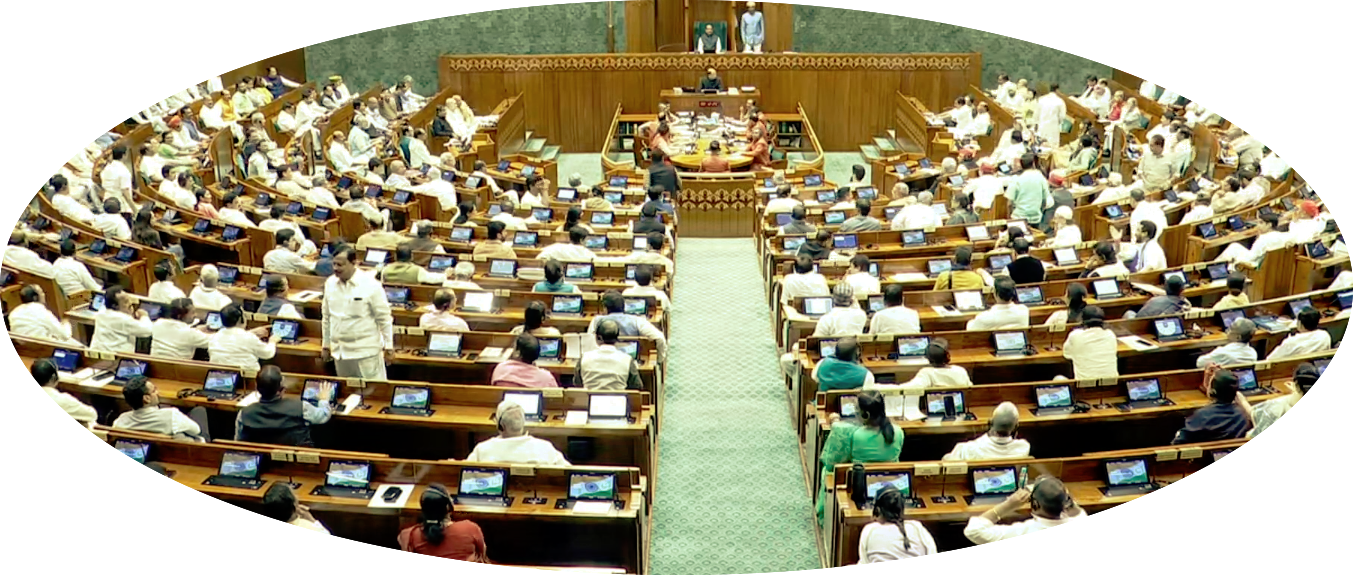
File photo of Lok Sabha proceedings. Source Sansad TV
Constitutional Bills Spark Lok Sabha Protests
New Delhi: Three bills—the Constitution (One Hundred and Thirtieth Amendment) Bill, 2025, the Government of Union Territories (Amendment) Bill, 2025, and the Jammu and Kashmir Reorganisation (Amendment) Bill, 2025—were introduced in the Lok Sabha amid protests from opposition MPs and referred to a Joint Parliamentary Committee (JPC) for further examination following a voice vote, today. The JPC, comprising 21 Lok Sabha and 10 Rajya Sabha members, will review the bills, with further details expected as the process continues.
Union Home Minister Amit Shah presented these three bills in the Lok Sabha today, proposing a framework to disqualify elected officials, including the Prime Minister, Chief Ministers, and Ministers, from holding office if detained for 30 consecutive days on charges punishable by five years or more of imprisonment. The provisions granting authority to Governors and Lieutenant Governors have prompted discussions about their implications for federalism, particularly in Union Territories. The Opposition has indicated it will scrutinise the bills, while the government maintains their necessity for ensuring accountability in governance.
The introduction of the bills led to protests in the Lok Sabha, with opposition MPs from the Congress and the All India Majlis-e-Ittehad Muslimeen (AIMIM) expressing dissent, some tearing copies of the bills, resulting in multiple adjournments. AIMIM MP Asaduddin Owaisi stated that the bills infringe on the separation of powers and the public’s right to elect their government, arguing that they allow executive agencies to act based on allegations, which could lead to misuse against opposition leaders. Congress MPs Manish Tewari and KC Venugopal described the bills as a challenge to the Constitution’s basic structure, expressing concerns that they could be used to target opposition-led state governments. Congress MP Gaurav Gogoi suggested the bills were introduced amid protests over electoral roll revisions in Bihar.
The Opposition noted that disqualification based on detention rather than conviction could enable politically motivated arrests, highlighting the absence of judicial oversight or clear definitions for “serious criminal charges.” They raised concerns about the bills’ impact on federalism, particularly in Union Territories, where the central government holds significant authority.
The government stated that the bills aim to uphold constitutional morality and public trust, with Shah asserting that the ruling National Democratic Alliance (NDA) prioritises ethical governance. Despite speculation that the Jammu and Kashmir bill might address statehood restoration, it focuses solely on ministerial disqualification.
The Constitution (One Hundred and Thirtieth Amendment) Bill, 2025, seeks to amend Articles 75, 164, and 239AA of the Constitution. It introduces a clause (5A) in Article 75, requiring any Union Minister, including the Prime Minister, detained for 30 days on specified charges, to resign or be removed. If the Prime Minister does not resign, the President must withdraw their appointment on the 31st day, even without the Prime Minister’s advice. Similar provisions apply to Chief Ministers and Ministers in States and the National Capital Territory of Delhi under Articles 164 and 239AA. Detained officials may seek bail within 30 days and, if granted bail, may resume their positions.
The Government of Union Territories (Amendment) Bill, 2025, amends the Government of Union Territories Act, 1963, to extend these disqualification rules to Ministers in Union Territories with legislative assemblies, such as Delhi and Puducherry, authorising Governors or Lieutenant Governors to enforce resignations or removals.
The Jammu and Kashmir Reorganisation (Amendment) Bill, 2025, amends Section 54 of the 2019 Act by adding sub-section (5A), requiring the resignation or removal of the Chief Minister or Ministers in Jammu and Kashmir if detained for 30 days, with the Lieutenant Governor authorised to act, subject to the Chief Minister’s advice if the detained official is not the Chief Minister. The bill permits reappointment of such officials upon release, at the Lieutenant Governor’s discretion.
The government claimed that the bills address public concerns about elected officials continuing to govern while detained, referencing instances where Chief Ministers and Ministers have remained in office during detention. Amit Shah described the bills as part of the Union government’s efforts to combat political corruption and uphold integrity in public life. He noted that the Constitution’s framers did not foresee leaders refusing to resign before arrest, and the bills ensure that no Prime Minister, Chief Minister, or Minister can govern while detained.
Shah outlined a provision allowing accused officials to seek bail within 30 days, with automatic disqualification on the 31st day if bail is not secured, enforced by the President, Governors, or Lieutenant Governors. He stated that the bills were intended for JPC review to facilitate thorough discussion. Responding to a remark by an opposition leader about his past arrest, Shah clarified that he resigned before his arrest in a case later dismissed by a court as politically motivated and did not hold office until acquitted. He contrasted the government’s approach with the Opposition’s, citing the 39th Constitutional Amendment during the Emergency, which granted special privileges to the Prime Minister, as an example of differing approaches to accountability.
– global bihari bureau