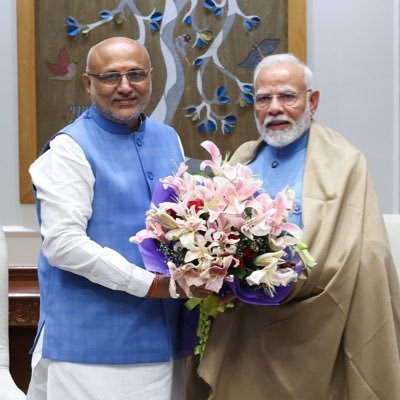
CP Radhakrishnan with Narendra Modi
India Elects New Vice President
New Delhi: Chandrapuram Ponnusamy Radhakrishnan, the 68-year-old seasoned Bharatiya Janata Party (BJP) leader and former Maharashtra Governor, won India’s vice-presidential election on September 9, 2025, defeating former Supreme Court Justice B. Sudershan Reddy with 452 first-preference votes to 300, as announced by Rajya Sabha Secretary-General Pramod Chandra Mody in New Delhi. He becomes the country’s 15th Vice President.
Radhakrishnan, backed by the National Democratic Alliance (NDA)’s 425 MPs, outpaced Reddy, supported by the Indian National Developmental Inclusive Alliance (INDIA bloc)’s 324 MPs. Three regional parties—Biju Janata Dal (BJD) with 20 MPs, Bharat Rashtra Samithi (BRS) with 9 MPs, and Shiromani Akali Dal (SAD) with 2 MPs—abstained, citing state-specific priorities, but their 31 votes did not shift the NDA’s lead.
Earlier, Union Minister Jyotiraditya Scindia voiced confidence, stating, “We are confident that the NDA candidate CP Radhakrishnan will win the elections”, while Union Minister Gajendra Singh Shekhawat predicted a “huge margin”. BJP MP Ananta Nayak declared, “NDA has more numbers… CP Radhakrishnan will definitely become the Vice President”, and BJP MP Pradeep Purohit anticipated, “Several INDI Alliance MPs will vote for the NDA candidate”.
Radhakrishnan’s victory bolsters the NDA’s influence over the Rajya Sabha, where the Vice President serves as Chairperson, amid ongoing legislative battles over economic reforms and federal policies. The Opposition’s defeat highlights their numerical shortfall, with 324 MPs against the NDA’s 425, though their focus on principles signals strategies for future contests, including the 2027 general elections.
Prime Minister Narendra Modi praised the victory, stating, “Congratulations to Thiru CP Radhakrishnan Ji on winning the 2025 Vice Presidential election. His life has always been devoted to serving society and empowering the poor and marginalised. I am confident that he will be an outstanding VP, who will strengthen our Constitutional values and enhance Parliamentary discourse”.
The election, triggered by Jagdeep Dhankhar’s resignation on July 21, 2025, due to health concerns, marked the first early vice-presidential poll since 1987.
Voting unfolded from 10:00 AM to 5:00 PM Indian Standard Time (IST) in Room No. F-101, Vasudha, Parliament House, drawing a 98.21 per cent turnout among 781 eligible Members of Parliament (MPs) from the Lok Sabha and Rajya Sabha, per the Election Commission of India (ECI).
Conducted under Article 68(2) of the Constitution of India, which mandates filling a vacancy promptly, the poll used a secret ballot free from party whips, allowing potential cross-voting. The ECI set the schedule on August 1, 2025, with results declared by 7:30 PM IST.
The NDA held mock polls on September 8 to ensure ballot accuracy. The Opposition conducted mock polls to prevent invalid ballots, directing MPs to mark only a first preference.
The opposition INDIA bloc framed the contest as a clash of principles, with Congress President Mallikarjun Kharge stating, “Sudershan Reddy ji has all the chances of winning”. Reddy told the Press Trust of India (PTI), “I have received love from the people and a positive response from civil society”. Karnataka Deputy Chief Minister DK Shivakumar urged MPs to vote their conscience, citing Radhakrishnan’s “controversial history”.
The ECI streamed results on YouTube for transparency, and no tie necessitated second-preference counts. Notable voters included Modi, External Affairs Minister S. Jaishankar, Congress MPs Sonia Gandhi, Priyanka Gandhi, and BJP MP Kangana Ranaut.
The high turnout and orderly process reflect strong parliamentary engagement, but abstentions by regional parties underscore competing state priorities, such as Odisha’s development focus for BJD and Telangana’s regional issues for BRS.
The election’s smooth execution, with no reported irregularities, reinforces India’s democratic framework, though cross-voting claims by the NDA suggest underlying tensions in coalition dynamics.
– global bihari bureau