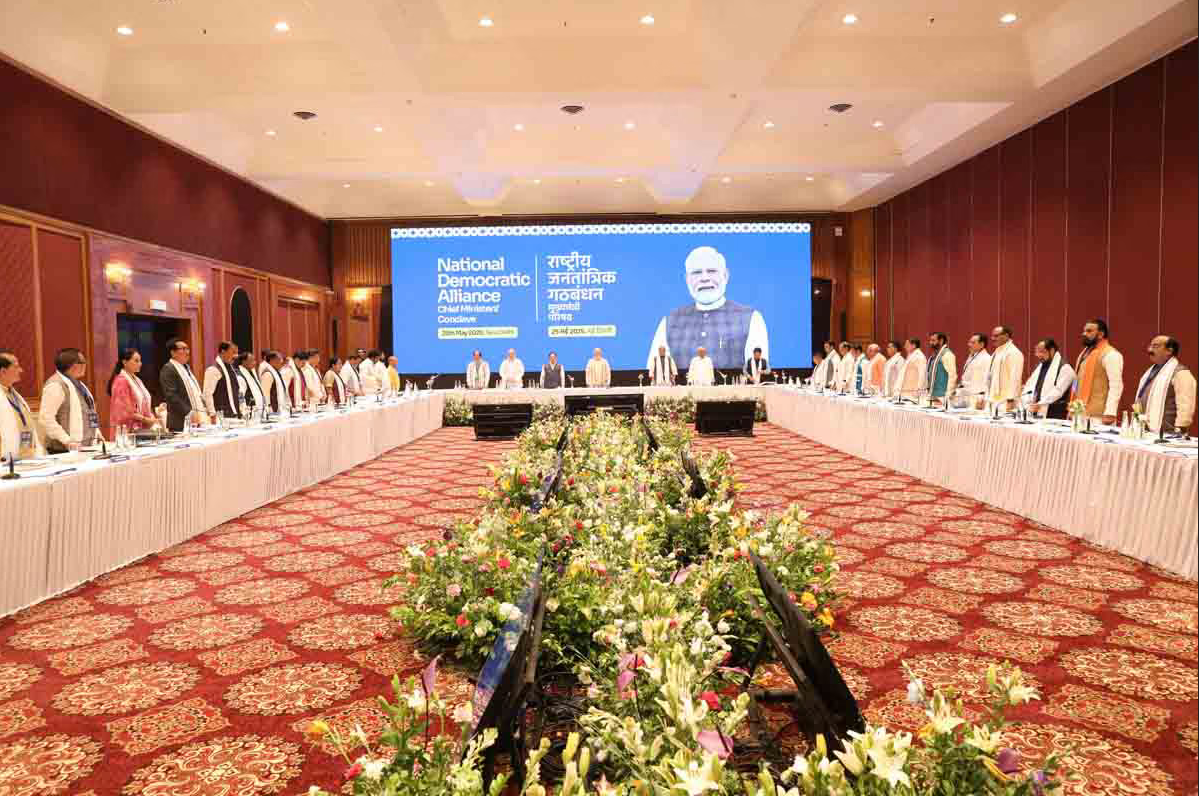
New Delhi: Prime Minister Narendra Modi chaired the National Democratic Alliance (NDA) Chief Ministers’ Conclave at The Ashok Hotel in New Delhi, uniting 20 chief ministers and 18 deputy chief ministers from NDA-ruled states to discuss governance, national security, and social inclusion, with a focus on accelerating India’s development and ensuring effective governance through double-engine administration. The meeting, attended by senior Union ministers, including BJP National President and Union Minister J.P. Nadda, Defence Minister Rajnath Singh, and Home Minister Amit Shah, passed resolutions commending Operation Sindoor and supporting the caste-based census, while planning for key national milestones like the 50th anniversary of the Emergency and the 10th International Yoga Day.
The conclave featured presentations on state initiatives in water conservation, grievance redressal, education, women empowerment, sports, and administrative reforms. Modi emphasised building synergies in cleanliness, sanitation, healthcare, youth empowerment, agriculture, and technology to advance Viksit Bharat @2047, a vision for a developed India by 2047. He proposed forming study groups to analyse best practices for adoption across states, urging that self-reliance become a people’s movement with active citizen participation. Modi also stressed environmental conservation, calling for sustained monitoring of Amrit Sarovars and revitalisation of traditional water sources like wells and stepwells, alongside innovative programs for World Environment Day on June 5.
Two resolutions were passed unanimously. The first, moved by Rajasthan Chief Minister Bhajan Lal Sharma and seconded by Maharashtra Deputy Chief Minister Eknath Shinde, praised the armed forces and Modi’s leadership in Operation Sindoor, a military operation launched on May 7, 2025, targeting terror infrastructure in Pakistan and Pakistan-Occupied Kashmir following the April 22 Pahalgam attack. J.P. Nadda, addressing the media post-conclave, highlighted the operation’s precision and the army’s courage, noting its contribution to a strong, capable, and self-reliant India. The second resolution, moved by Haryana Chief Minister Nayab Singh Saini and seconded by Andhra Pradesh Deputy Chief Minister Pawan Kalyan, endorsed the Union Cabinet’s approval of a caste-based census, pioneered by Bihar under Chief Minister Nitish Kumar. Nadda clarified that the NDA avoids caste-based politics but aims to integrate deprived, oppressed, marginalised, and Dalit communities into mainstream development.
Seven best practices were discussed, including Chhattisgarh’s fight against Naxalism and the Bastar Olympics, which incorporated tribal culture, sports, and traditions. Bihar’s Jal Jeevan Hariyali project for water conservation in drought-affected areas, presented by Deputy Chief Minister Samrat Choudhary, was reviewed. Assam Chief Minister Himanta Biswa Sarma detailed measures to combat child marriage, proposing a study team to evaluate outcomes. Gujarat’s success with the PM Surya Ghar Yojana, providing free electricity and income generation, was shared by Chief Minister Bhupendra Patel. Meghalaya Chief Minister Conrad Sangma presented the CM Connect initiative for accountable governance in remote areas, while Uttarakhand Chief Minister Pushkar Singh Dhami outlined the implementation of the Uniform Civil Code. Uttar Pradesh Chief Minister Yogi Adityanath discussed Project Alankar, aimed at enhancing school and college infrastructure. Maharashtra showcased administrative reforms, with suggestions for states to study its model.
The conclave planned for upcoming events, including the NDA government’s 11th anniversary on June 9, the 10th International Yoga Day on June 21, and the 50th anniversary of the Emergency on June 25–26, to highlight democratic values and counter narratives of suppression. Modi urged state governments to organise programs showcasing India’s progress. Home Minister Amit Shah briefed attendees on anti-Naxal strategies, while Chhattisgarh Chief Minister Vishnu Deo Sai and Home Minister Vijay Sharma detailed rehabilitation efforts in Naxal-affected areas. A committee will be formed to plan these programs, ensuring public engagement.
On the same day, Madhya Pradesh Chief Minister Dr. Mohan Yadav met Modi to discuss state development priorities, as shared by the Prime Minister’s Office on X. The conclave, attended by leaders from states like Andhra Pradesh, Nagaland, and Bihar, reinforced NDA unity, with Nitish Kumar’s presence signalling coordination despite his absence from the prior NITI Aayog meeting. The deliberations underscored the NDA’s commitment to national security, social justice, and inclusive growth, aligning state and central policies for a unified development agenda.
– global bihari bureau