Naval Conference Releases Five Policy Guides
NIPUN Portal, GeM Handbook Launched at Meet
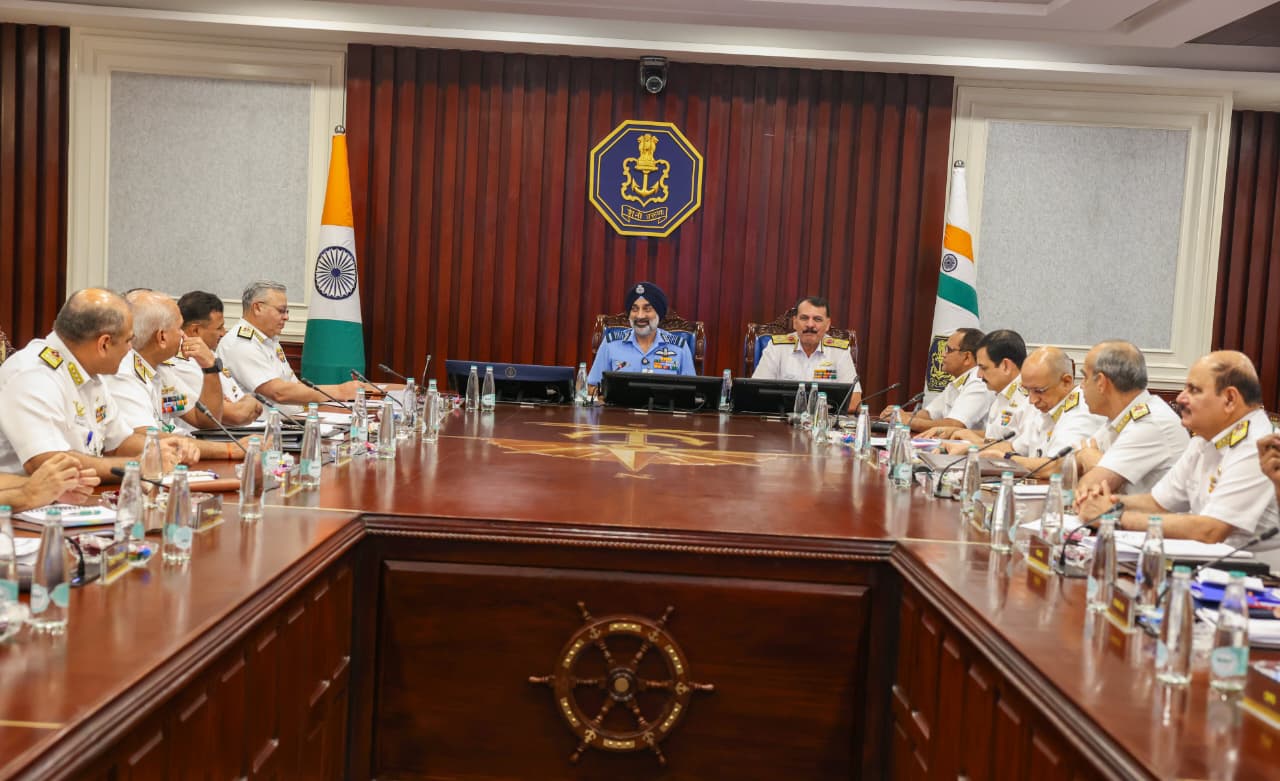
New Delhi: A series of interconnected decisions to advance the Indian Navy’s operational framework has emerged from the second biannual Naval Commanders’ Conference 2025, conducted from October 22 to 24, 2025, at Nausena Bhawan, here.
The forum opened with the Chief of the Naval Staff assessing recent deployments and joint missions before laying out a clear roadmap for a fully Aatmanirbhar Navy by 2047 through indigenous technology integration. Driving this ambition is the Innovations for Defence Excellence (iDEX), the Ministry of Defence’s flagship programme launched in 2018 to channel structured, milestone-based funding into defence innovation. With a committed corpus of ₹498.78 crore over 2023–28 — roughly ₹100 crore annually — iDEX operates under the Defence Innovation Organisation (DIO), a Section 8 company formed by Hindustan Aeronautics Limited (HAL) and Bharat Electronics Limited (BEL).
The funding is split strategically: approximately 60 per cent for prototype development under the Support for Prototype and Research Kick-start (SPARK) framework, 25 per cent for incubation, mentorship, and testing infrastructure, 10 per cent for outreach and international collaborations such as INDUS-X with the US Department of Defense, and 5 per cent for administrative overheads.
Also read:
Under the standard iDEX stream, projects receive up to ₹1.5 crore, disbursed in milestone-based tranches: an initial tranche on contract signing, a tranche on proof-of-concept submission, a tranche on delivery of a functional prototype validated by a Technical Evaluation Committee (TEC) comprising service officers, Defence Research and Development Organisation (DRDO) scientists, and industry experts, and a final tranche when the system is ready for field trials. For larger-scale ambitions, iDEX Prime offers up to ₹10 crore to take prototypes into pre-production, while the ADITI 2.0 scheme — focused on deep-tech domains like Artificial Intelligence (AI), quantum computing, hypersonics, and biotechnology — provides up to ₹25 crore for 24-month projects. Successful systems bypass traditional tenders and qualify for direct procurement up to ₹500 crore under the Defence Acquisition Procedure 2020, with innovators retaining intellectual property and the government securing a non-exclusive, royalty-free licence for defence use.
This funding architecture is not merely financial support — it is a deliberate de-risking mechanism that allows startups and MSMEs to compete in a domain historically dominated by Defence Public Sector Undertakings in India (DPSUs). By offering free access to DRDO labs, naval test ranges, and air bases, iDEX compresses development cycles from years to months, ensuring that solutions like anti-drone swarm systems, AI-based sonar anomaly detection, torpedo decoys, or underwater swarm drones reach operational units swiftly. Exact funding figures are approximate, reflecting typical SPARK, iDEX Prime, or ADITI grants. The initiative has already generated over ₹1,000 crore in procurement orders and engaged more than 1,000 innovators, with over 200 projects funded to date, positioning it as a cornerstone for the Navy’s 194 ongoing innovation efforts across iDEX, Technology Development Fund (TDF), Supporting Pole of Research and Innovation for Naval Technology (SPRINT), and Make-in-India schemes.
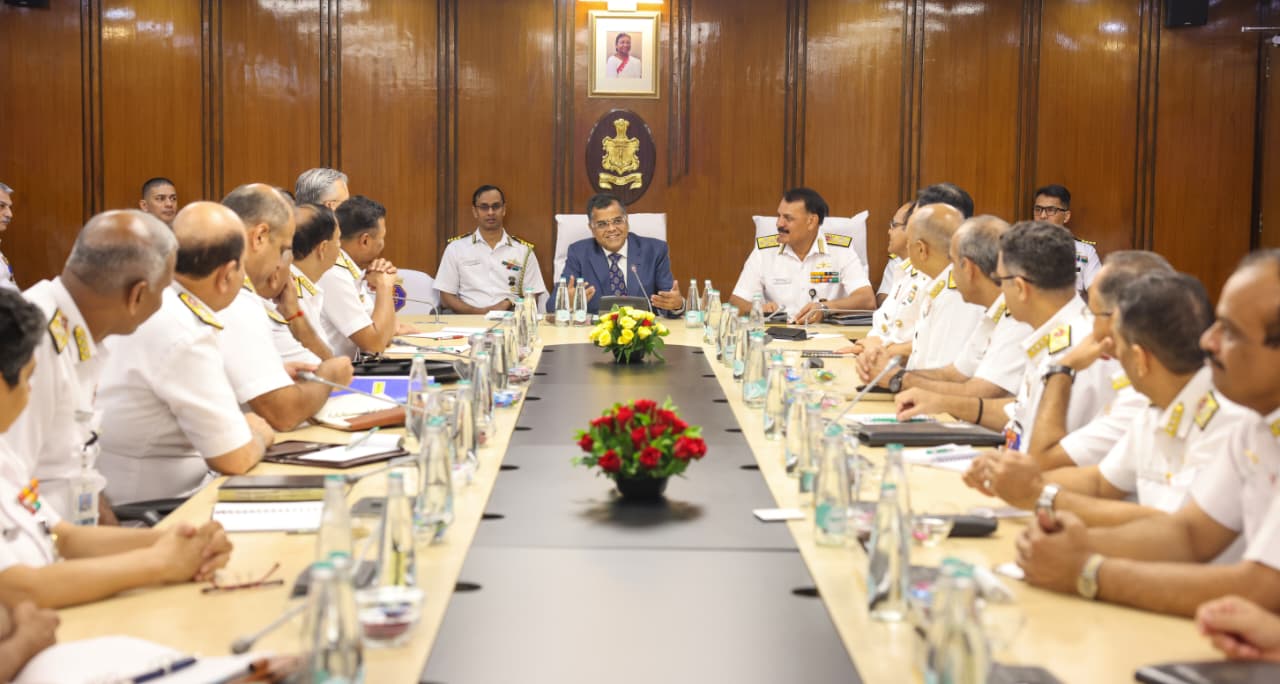
This strategic foundation was enriched by the Sagar Manthan session on October 22, which convened commanders with external experts and strategic thinkers to evaluate emerging maritime threats in real time, feeding actionable insights into the conference’s evolving agenda. Building on this, Defence Minister Rajnath Singh addressed the gathering on October 23, commending the Navy’s high operational readiness and its deterrent presence in the Indian Ocean Region (IOR) — a force that reassures partner nations while countering destabilising elements. He positioned indigenous warship and equipment development as the bedrock of maritime self-reliance and directed immediate integration of advanced tactics, especially uncrewed and autonomous platforms, to secure strategic superiority. These instructions, now set to shape doctrine, procurement, and planning, rely heavily on iDEX as the primary channel for sourcing and scaling such technologies — whether lightweight torpedo decoys, underwater swarm drones, AI sonar systems, or anti-drone swarms.
This directive reflects a shift towards network-centric warfare, where uncrewed systems reduce human risk in high-threat environments and enable cost-effective scaling of naval operations, aligning with global trends seen in conflicts like Ukraine, where drones have disrupted traditional naval paradigms. The Minister’s emphasis on Operation Sindoor as a symbol of India’s resolve — creating a deterrent that confined Pakistani forces to their coast — highlights how such capabilities amplify India’s role in the IOR, sending a message of readiness amid rising tensions with actors like China in the Indo-Pacific.
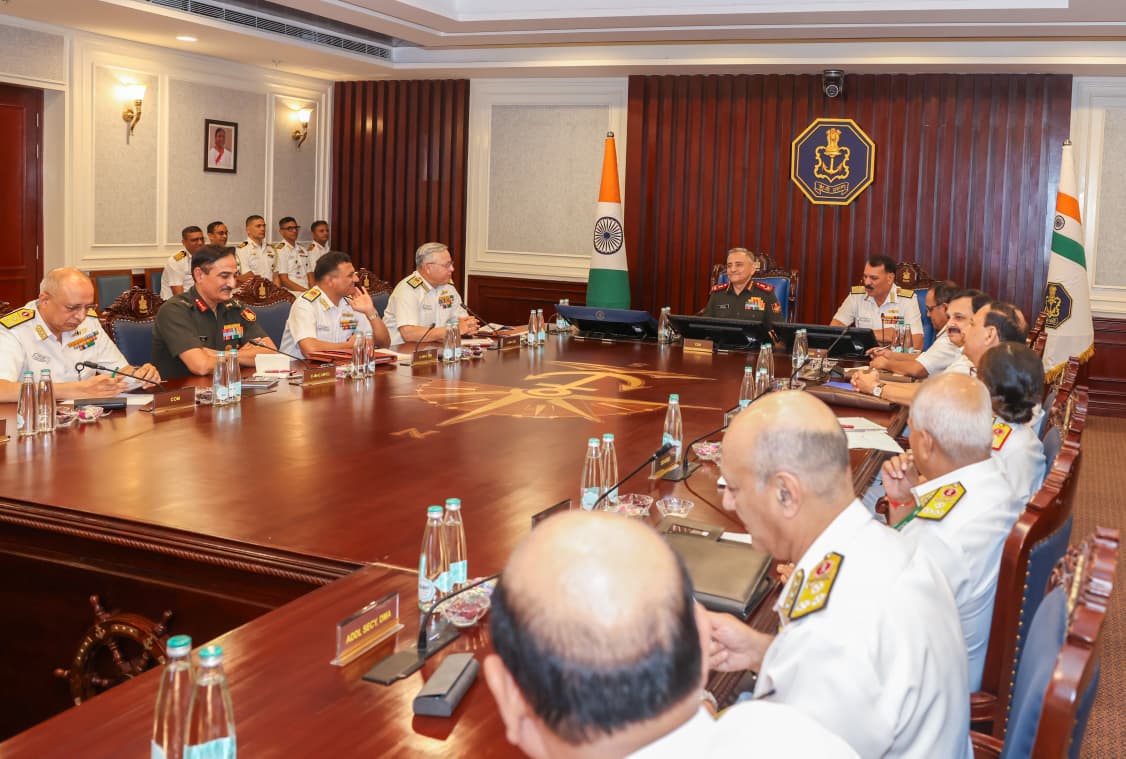
Inter-service cohesion was further strengthened when the Chief of the Defence Staff emphasised jointness and resource optimisation, with inputs from the Chief of the Air Staff and Cabinet Secretary aligning frameworks for multi-domain operations. This focus on synergy addresses a historical silo in Indian defence planning, fostering integrated theatre commands that could enhance response times in hybrid scenarios, such as anti-access/area denial (A2/AD) threats in the Malacca Strait or Andaman Sea.
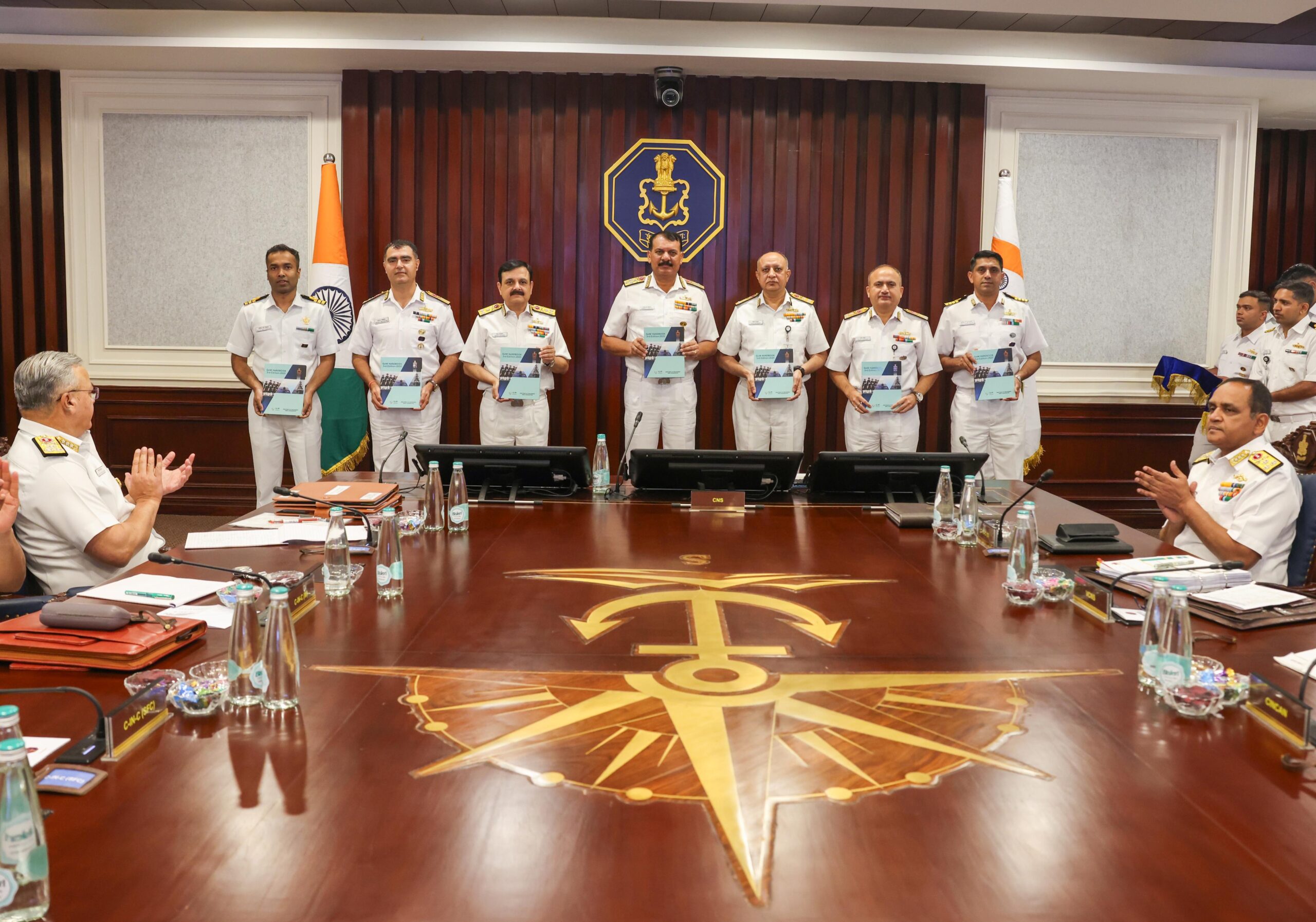
The conference then translated these discussions into concrete tools by releasing five publications — including the Regulations for Naval Armament Service, Government e-Marketplace (GeM) Handbook, and Foreign Cooperation Roadmap — standardising critical functions from armament management to international partnerships. Notably, over the last decade, 67 per cent of the Navy’s capital acquisitions have come from Indian industries, reducing import dependency and generating significant economic multipliers. For instance, Project 17A frigates, with over 75 per cent indigenous content, have created tens of thousands of jobs in shipyards like Mazagon Dock Limited (MDL) and Garden Reach Shipbuilders & Engineers (GRSE), while recent ₹315 crore contracts to MSMEs underscore the Navy’s role in linking security with socioeconomic development. Extending this, iDEX’s engagement of over 300 startups and MSMEs has contributed to a broader defence production surge, reaching ₹1.27 lakh crore in FY 2023–24 — a 174 per cent rise since 2014–15 — driving GDP growth through backward linkages in supply chains, skill development, and regional industrial clusters.
Defence exports, fuelled by indigenisation, have skyrocketed from ₹686 crore in FY2014 to ₹23,622 crore in FY2024–25 (a 34-fold increase), with FY2025–26 projections at ₹9,131 crore for April–September alone, positioning India as an emerging exporter in the $25 billion global market and creating indirect jobs in ancillary sectors like electronics (reducing import bills by 20–30 per cent) and manufacturing. Analytically, this economic ripple effect not only cushions fiscal pressures from the ₹6.81 lakh crore defence budget (up 9.53 per cent in 2025–26) but also aligns with Viksit Bharat 2047 by generating employment for over 1 million in the sector, boosting MSME revenues, and fostering a $119 million venture capital ecosystem for deep-tech, ultimately transforming defence from a cost centre to a growth engine.
Capping the process, the Naval Intellectual Portal for Unified Knowledge (NIPUN) portal was launched as a centralised digital repository to aggregate research, analyses, and domain expertise from across the naval community, including iDEX-funded prototypes and operational lessons. This platform will serve as a living archive, enabling faster learning loops and data-driven decision-making at the fleet level, potentially revolutionising how lessons from operations — like the Navy’s escort of over 230 merchant vessels carrying approximately $4 billion in cargo over the past year — are institutionalised.
This seamless progression — from threat assessment and political direction to policy standardisation and knowledge consolidation — positions the conference as a closed-loop mechanism that identifies gaps, sets targets, issues enforceable guidelines, and equips the force with implementation tools. Through iDEX-driven innovation, binding publications, and digital infrastructure, it strengthens combat effectiveness, accelerates self-reliance, and ensures the Indian Navy remains a technologically advanced, operationally agile, and strategically decisive pillar of national defence amid evolving global security dynamics. Analytically, these steps not only mitigate vulnerabilities in supply chains exposed by global disruptions but also amplify India’s SAGAR (Security and Growth for All in the Region) vision, countering assertive postures from actors like China through enhanced partnerships and deterrence, while contributing to Viksit Bharat 2047 by intertwining military modernisation with industrial growth, job creation, and export potential in the $25 billion defence market.
– global bihari bureau