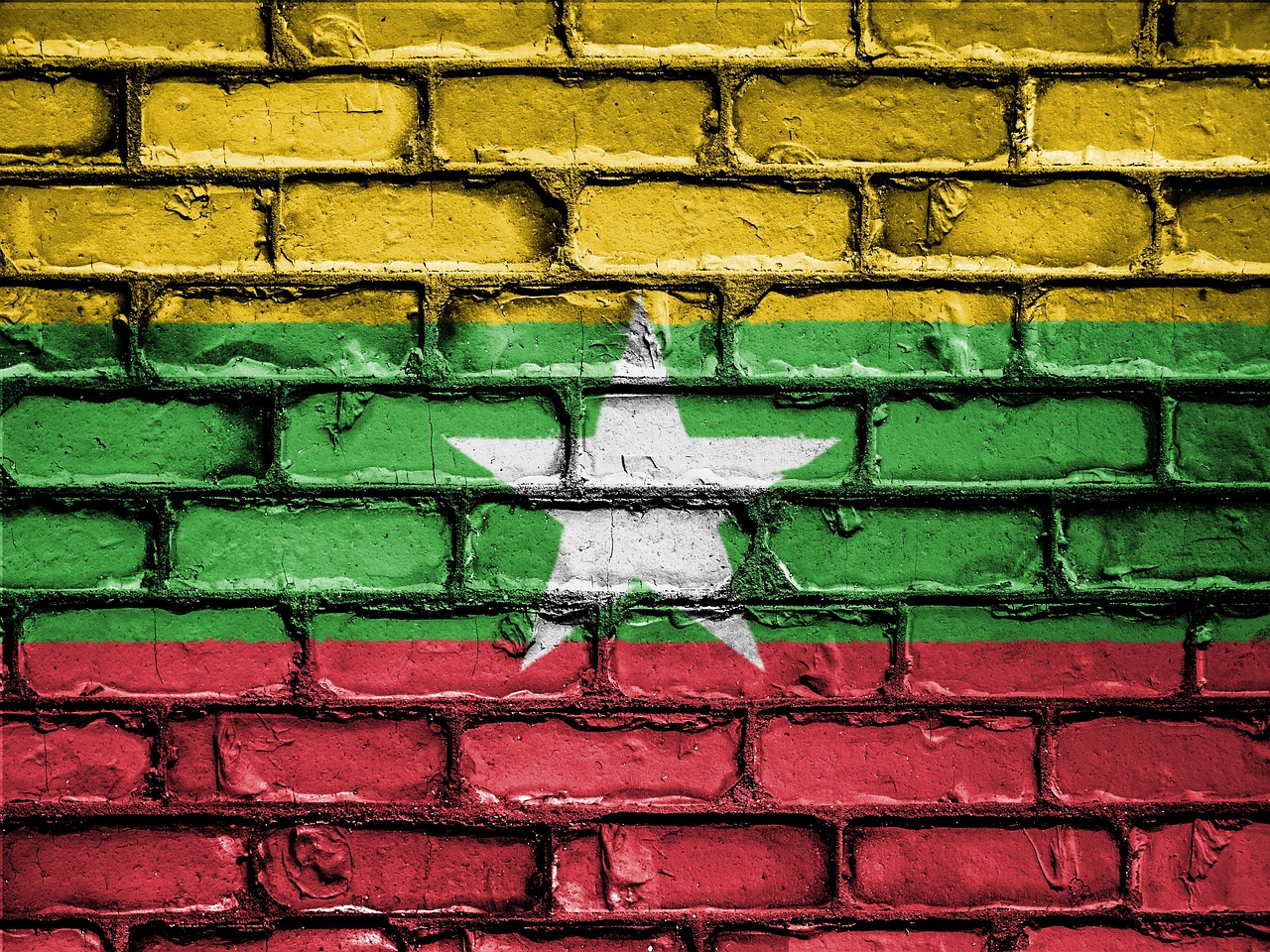
Mayanmar's flag painted on a wall.
 By Nava Thakuria*
As Elections Shrink, Myanmar Expands Energy Diplomacy
Junta Narrows Ballot, Widens Business Ties
As Myanmar’s military rulers push ahead with a tightly circumscribed electoral process at home, they are simultaneously projecting continuity and confidence abroad by expanding economic and energy cooperation with neighbouring countries. Even as much of the global community has dismissed the ongoing three-phase general election as lacking credibility, the junta has sought to underline stability by strengthening business ties with China, India, Thailand, Russia and several Middle Eastern nations, particularly in the oil and natural gas sector.
The military-run daily Global New Light of Myanmar reported on January 1, 2026, quoting Energy Minister Ko Ko Lwin, that the country of around 55 million people is deepening cooperation with foreign partners across a range of offshore oil and gas projects. According to the report, Myanmar and Thailand are jointly expanding investments in oil and natural gas projects in the Ayeyawady and Mottama sedimentary basins as well as in offshore areas. India, it added, has been carrying out exploration and drilling activities in areas near the Andaman Islands, signalling continued regional engagement despite Myanmar’s political isolation.
This economic outreach has unfolded against the backdrop of a sharply narrowed electoral landscape. The military, known locally as the Tatmadaw, completed the first phase of the general election on December 28, 2025, even as a civil war–like situation continues across large parts of the country. Voting was held in only 102 of Myanmar’s 330 townships, with many areas excluded because they remain outside the control of the regime led by Senior General Min Aung Hlaing. Anti-military ethnic armed groups, people’s defence forces and other resistance organisations, which currently control roughly one-third of the country’s territory, strongly opposed the polls.
The junta-appointed Union Election Commission (UEC) had initially planned elections in 274 townships, declaring the remainder disturbed or unstable, particularly in Rakhine, Sagaing and Shan provinces. Polling ultimately took place under heavy security in major cities such as Naypyitaw, Yangon and Mandalay, as well as in parts of the Bago and Ayeyarwady regions. In these areas, the pro-military Union Solidarity and Development Party (USDP) has already been declared the winner in 89 constituencies for the 330-member Pyithu Hluttaw, the lower house of parliament.
Participation in the vote reflected the constrained political environment. Observers noted that turnout was dominated by elderly voters, many of whom appeared to cast ballots out of fear rather than political conviction. Younger voters, particularly those not from military families, largely boycotted the exercise. A junta spokesperson claimed that 52 per cent of more than 11.5 million registered voters participated in the first phase. By contrast, Myanmar’s national elections in 2015 and 2020 recorded a turnout of around 70 per cent and resulted in landslide victories for the National League for Democracy (NLD) led by Nobel laureate Daw Aung San Suu Kyi.
The narrowing of political space has been reinforced by the exclusion of much of the Opposition. The UEC cancelled the registration of numerous mainstream political parties, with more than 40 entities, including the NLD, failing to re-register. Only six parties—the USDP, National Unity Party, People’s Pioneer Party, Myanmar Farmers Development Party, Shan and Nationalities Democratic Party, and People’s Party—are permitted to contest nationwide, while 51 smaller parties are confined to regional assemblies.
Since the military coup of February 1, 2021, which overthrew the elected civilian government in Naypyitaw, Myanmar has experienced widespread violence and repression. More than 7,500 people have been killed in anti-military unrest as security forces carried out crackdowns that included airstrikes on crowded areas, hospitals and schools. Thousands have been arrested, more than 3.6 million people displaced, and an estimated 20 million now require urgent humanitarian assistance. Around 540,000 children are feared to be suffering from acute malnutrition, while many pro-democracy leaders have fled to neighbouring Thailand, China, India and Bangladesh.
The election process has drawn criticism from the United Nations, Western governments, Japan, Australia and global human rights organisations, all of which have questioned its credibility. Anti-junta activists have described the polls as a sham intended to legitimise military rule and ease international pressure, arguing that they will not result in a genuinely independent civilian government. The National Unity Government, Myanmar’s parallel administration in exile, has also rejected the vote, citing the junta’s continued airstrikes against civilian populations.
Military chief Min Aung Hlaing, who cast his ballot in Naypyitaw, has nonetheless insisted that the election will advance Myanmar’s democratic transition. Even as political participation narrows at home, the junta appears intent on maintaining economic engagement abroad, particularly in the strategic energy sector, as it seeks to project normalcy and resilience amid deepening internal conflict and sustained international scrutiny.
*Senior journalist