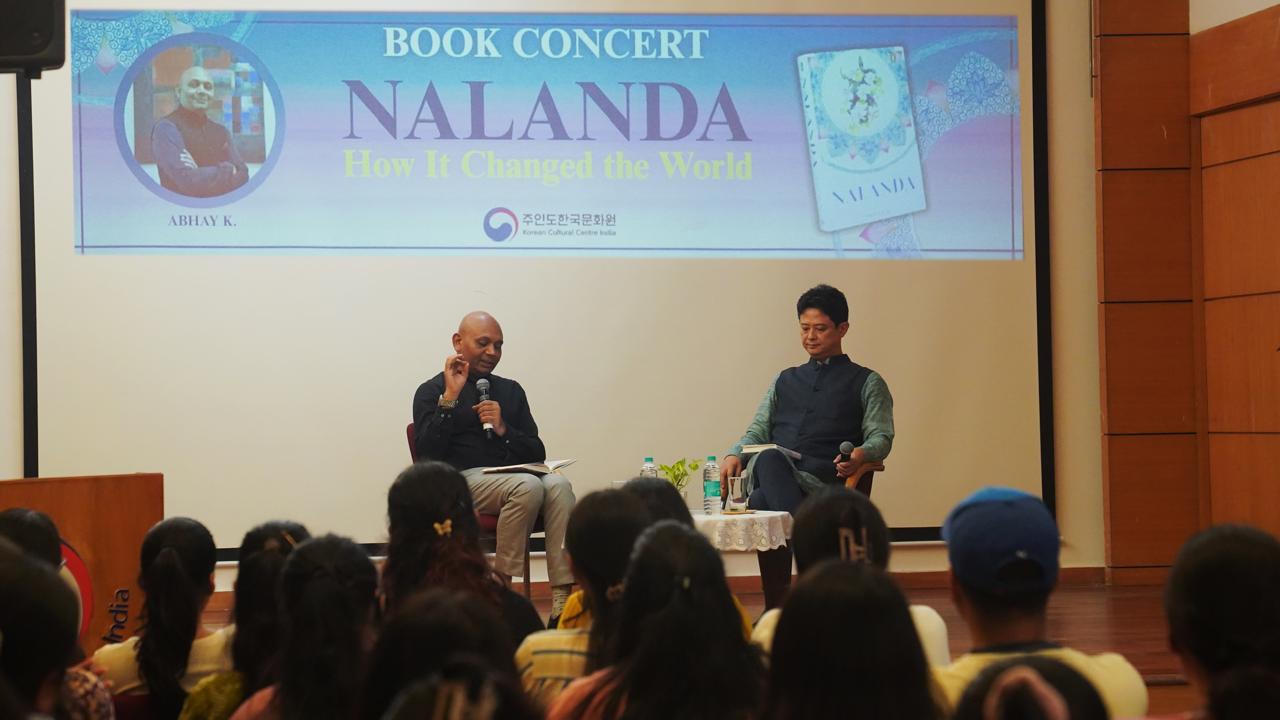
New Delhi: The Korean Cultural Centre in New Delhi pulsed with intellectual energy as the Embassy of the Republic of Korea hosted a book talk on Nalanda: How It Changed the World by Abhay K., the pen name of diplomat and author Abhay Kumar, Deputy Director General of the Indian Council for Cultural Relations. Scholars, students, and literature enthusiasts filled the venue, drawn to explore Nalanda’s ancient legacy, a vibrant thread linking India and Korea through centuries of shared history.
The discussion unfolded in a dynamic exchange, with Lim Sang Woo, Deputy Chief of Mission at the Korean Embassy, guiding Abhay K. through incisive questions. They traced the book’s genesis, revealing the inspiration behind chronicling Nalanda’s rise as a global beacon of knowledge. The conversation brought to life the university’s role in shaping education, philosophy, and spiritual thought, conjuring images of monks and scholars whose ideas reverberated across continents.
A pivotal moment came when Kumar highlighted Nalanda’s deep ties with Korea. He recounted the journey of Hyecho, a Silla Kingdom monk who, in 723 CE, ventured to Nalanda to immerse himself in the language and culture of Buddha’s homeland. Hyecho’s travelogue, Wang Ocheonchukguk Jeon, or A Memoir of the Pilgrimage to the Five Kingdoms of India, vividly details his experiences in Magadh, Kushinagar, and Varanasi. Attendees leaned forward, captivated by this account of a centuries-old bond between India and Korea, rooted in a shared quest for wisdom.
Abhay K.’s book, a meticulously researched work, weaves a compelling narrative of Nalanda’s evolution into a renowned seat of learning, its influence shaping intellectual and spiritual currents, including Korea’s Buddhist traditions. It offers readers a rare window into Nalanda’s historical and cultural significance, inviting them to explore its global impact. The text stands as both a scholarly tribute and an accessible journey through time.
The event highlighted India and Korea’s shared commitment to strengthening their multifaceted ties. Both nations, through such dialogues, celebrate Nalanda’s legacy as a living symbol of their cultural and historical connection, fostering collaboration that bridges past and present.
– global bihari bureau