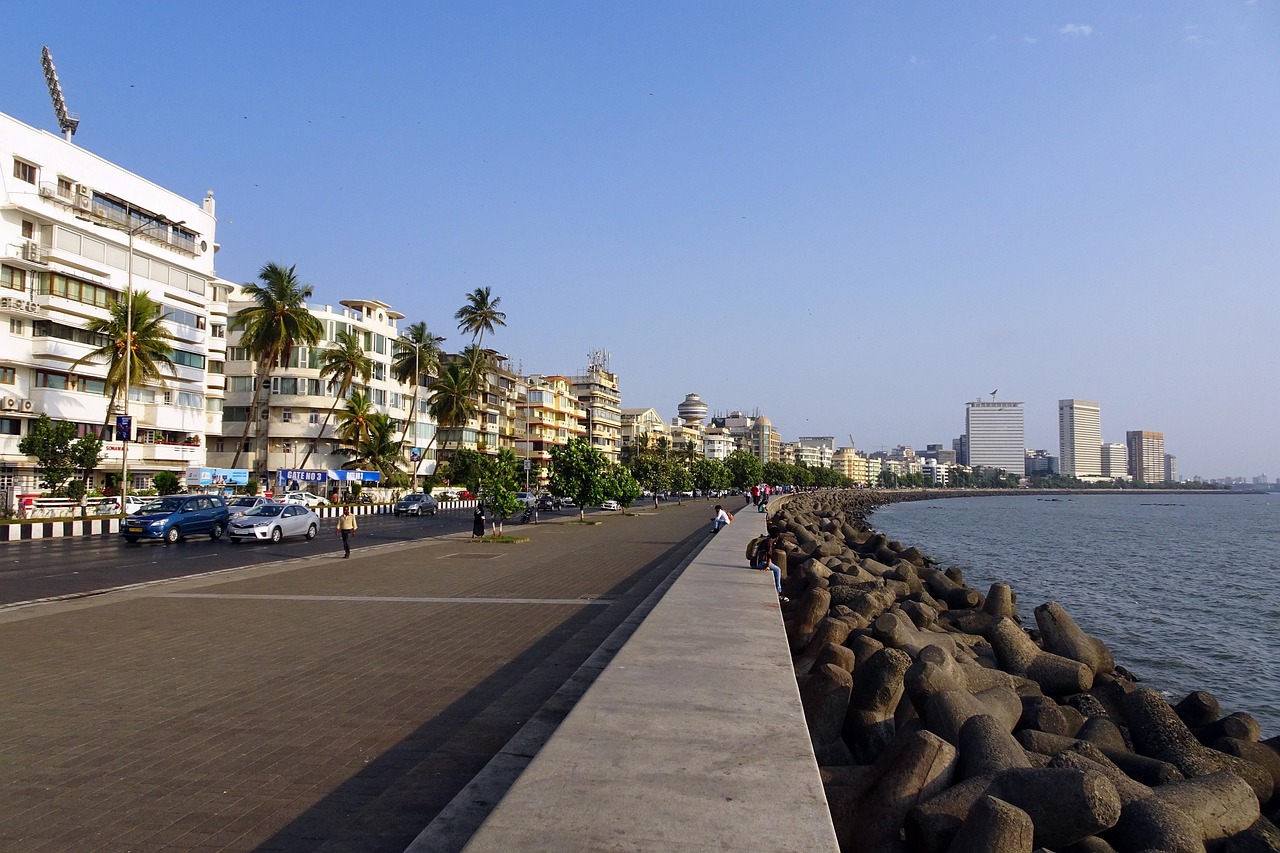
Marine Drive, Mumbai
 By Dr Samar Verma*
Cities Hold Key to Credible Climate Action
The inaugural Mumbai Climate Week (held February 17–19, 2026, organised by Project Mumbai with Maharashtra government partnership) offered a familiar but newly sharpened conviction: India’s clean-growth transition will not be decided in national targets or global communiqués, but in the quieter, harder work of state and city delivery- where plans become projects, projects become pipelines, and pipelines become outcomes people can actually live with.
Across the sessions, a common theme surfaced again and again: the transition is no longer primarily a problem of declaring ambition. It is a problem of execution under stress- stress created by climate volatility, fiscal constraints, institutional thinness, and the sheer complexity of coordinating multiple sectors and agencies at speed.
What follows in this write-up is my synthesis of the shared ideas that kept converging across those rooms: the practical conditions that must be met if India’s climate action is to become credible, investible, and equitable at scale.
To be clear, these reflections draw from only a small slice of Mumbai Climate Week. The agenda made evident how much broader the climate-action canvas was: discussions spanned the energy transition and green industrial growth, clean mobility and transport systems, food systems and nature-linked resilience, urban liveability and integrated resilience planning (including cooling and healthier air), and innovation-led pathways- alongside persistent questions of financing, governance, and just transitions. Many parallel sessions were certainly engaging with these and other issues, often more deeply and from specialised perspectives. Here are my takeaways on the common cross-cutting themes that surfaced repeatedly in the sessions I participated in.
The real theatre of transition is sub-national- and it is already under strain
The most resonant message was straightforward: India’s transition will be won or lost in sub-national delivery- in states, cities, districts, utilities, and the “last-mile” institutions that convert intent into implementable projects. This is not an ideological argument about decentralisation. It is a recognition of where the bottlenecks sit, where the political economy bites, and where citizens experience success or failure.
We are now in a phase where climate volatility is no longer a rare disruption; it is becoming a planning baseline. Urban flooding, heat stress, water scarcity, and changing rainfall patterns are forcing governments and firms to confront a new reality: infrastructure designed for yesterday’s climate will increasingly underperform in tomorrow’s climate. In that context, resilience is not a decorative add-on appended to a “main” development plan; it is becoming the core of what development means.
That shift changes the definition of clean growth. It is not only about deploying renewables, electrifying transport, or greening industry- though all of that remains essential. It is also about governance capacity: can state and city systems plan for uncertainty, coordinate across departments, manage contracts, and course-correct when conditions change? The transition, in practice, becomes a test of public administration and institutional coherence.
This is where cooperative federalism stops being a slogan and becomes a delivery strategy. States can compete and collaborate simultaneously. Competition can push speed and ambition; collaboration can accelerate replication of working prototypes- whether institutional models, financing structures, regulatory approaches, or implementation toolkits. The real currency here is the demonstrator: proof points that are credible enough to travel across contexts and scale.
Climate finance must move from “how much” to “how it flows”
The next theme followed naturally. Public budgets matter- but they cannot, on their own, finance the full arc of the transition, especially in a world of rising capital costs, volatile geopolitics, and competing development priorities. The response cannot be to simply repeat the mantra of “more climate finance” as if naming the need solves the mechanics.
Climate finance is, at heart, a plumbing problem. Capital may exist, but it does not reliably flow into the segments that matter most for sub-national delivery- distribution utilities, urban systems, resilience infrastructure- without deliberate structuring. These are precisely the sectors where impact is high, but risk is perceived as complex: regulatory risk, procurement risk, project preparation gaps, data gaps, and institutional fragmentation.
That creates an uncomfortable paradox. The places where outcomes are won or lost are often the places where finance is hardest. Urban resilience projects are multi-agency, politically sensitive, and often harder to package as conventional revenue-generating assets. Distribution utilities sit at the heart of the power transition but carry legacy stresses. Nature-based or blue-green infrastructure may be essential, yet often struggles to fit standard financing templates.
What emerged across discussions was not one silver bullet, but a pragmatic repertoire. Some segments need a lower cost of capital. Some need risks to be reallocated, so private investors are not exposed to governance or procurement uncertainty that they cannot price. Some need blended finance that uses concessional capital strategically, not as a blanket subsidy, but as a lever to unlock larger pools of commercial capital. And increasingly, there is a case for performance-linked approaches- where financing is tied to measurable progress and implementation milestones, rather than disbursed upfront in ways that weaken accountability.
The deeper point is worth stating plainly: finance is not merely “raised”; it is engineered. If the engineering is weak- if project preparation is thin, if governance is unclear, if measurement is absent- then even well-meaning finance announcements can become symbolic rather than catalytic.
The binding constraint is not ambition; it is the capacity to absorb and deliver
This leads to what I would call the central bottleneck: absorptive capacity. Even where policy intent exists and money is available, states and cities can struggle to convert resources into results. The gap appears in predictable places: weak project conceptualisation, thin project preparation, uncertain procurement, fragile contract management, and monitoring systems too weak to enforce performance discipline.
If the first decade of climate action was dominated by debates about targets, the next decade will be dominated by debates about institutions- about the quality of the machinery that turns targets into outcomes. The question is no longer only “what should we build?” but “who will design, procure, manage, and measure it- with competence and accountability that capital providers and citizens both require?”
Coordination is central here, but coordination is also famously difficult. Climate action cuts across line departments, agencies, and levels of government. Coordination structures and nodal officers can help, but only if mandates are clear, skills are adequate, and decisions are enforceable. Otherwise, coordination becomes performative- committees exist, meetings happen, but delivery remains slow and fragmented.
There is also a practical warning embedded in implementation: outsourcing does not eliminate accountability. Public authorities need to retain strategic control over climate integrity- particularly design standards, resilience requirements, and monitoring frameworks.
In short, a financing strategy without institutional architecture is an empty vessel.
Cities are where risk, liveability, and emissions converge
If there is one arena where these themes collide most visibly, it is the city. Urban systems concentrate assets, populations, and economic activity- and therefore concentrate both emissions and climate risk. If cities are planned poorly, climate stress becomes chronic: heat, flooding, pollution, and mobility breakdown become everyday governance failures rather than episodic shocks.
A striking feature of the urban discussions was the repeated return to systems thinking. Climate outcomes are embedded in land use decisions, density, transport connectivity, and the quality of public space. Planning for efficient density, transit-oriented development, and walkability is not merely an aesthetic preference; it is a long-run climate and public-health strategy. It shapes energy demand, air quality, public health burdens, and the affordability of mobility for millions.
Alongside this came the argument for blue-green infrastructure- integrated water management, restored ecological buffers, and urban greening that moderates microclimates and reduces heat stress. These interventions are sometimes treated as “nice to have,” but in a warming world, they begin to look like essential public infrastructure. The cost of inaction is paid not only in disaster losses, but in degraded livability and diminished productivity.
There is also a material dimension that cities cannot ignore. The built environment is not only about operational energy use; it is also about embodied emissions and waste. Construction and demolition waste, if treated as a resource rather than a burden, can move cities toward circularity while reducing pressure on raw materials. This is where climate action intersects with resource efficiency and municipal services- again reinforcing the point that climate outcomes are not contained within a single “climate department.”
Importantly, these interventions can become credibility anchors because their gains are tangible. When communities can see ecological improvements- through greener neighbourhoods, restored water systems, cooler microclimates- climate action stops being abstract. It becomes a lived experience, strengthening legitimacy and social buy-in.
Metrics are not bureaucracy; they are the bridge from declarations to credibility
A transition this complex cannot be governed by slogans. It must be governed by measurement. Transparent baselines, monitoring, and evidence-based planning are not bureaucratic rituals; they are the foundation of credibility- both for citizens and for investors.
Measurement does at least four things. It clarifies priorities by revealing which sectors or geographies carry the highest risk or mitigation potential. It improves sequencing by showing what must be done first to unlock later gains. It enables performance-linked financing by defining what “progress” means in measurable terms. And it supports course correction- vital in a world where assumptions can break quickly.
There is also a strategic caution here: the risk of locking into the wrong pathways. Over-committing to fragile assumptions- about technology costs, climate baselines, or regulatory conditions- can produce expensive lock-ins. The practical answer is scenario thinking and adaptability: designing plans that can evolve as conditions change, while still maintaining direction and accountability.
In this sense, data is not just information; it is governance infrastructure.
Equity is operational: without legitimacy, implementation speed collapses
Perhaps the most important theme- because it determines the political viability of everything else- is equity. Climate justice is not merely a moral frame; it is an operational necessity. The transition must protect livelihoods, manage distributional impacts, and include community voices in planning- otherwise legitimacy erodes and implementation slows.
This is not theoretical. When people experience climate action as something done to them rather than with them, projects face resistance, delays, and distrust. Conversely, when individual behavioural change, community-level solutions, and state-led investments reinforce one another, delivery accelerates. Climate action becomes a shared project rather than a contested imposition.
There is also a sober recognition that some regions and sectors will face hard economic transitions. “Green growth” must be explicit about the growth and opportunity needed to offset transition impacts. Emissions reduction alone is not a sufficient social contract. Economic dignity, stable livelihoods, and credible pathways for reskilling and transition support are not optional; they are part of the design challenge.
Equity, in other words, is not a chapter at the end of a climate plan. It is a condition for the plan to work.
A simple test for seriousness: can we build investible pipelines where delivery is hardest?
Put together, the sessions I attended offered a realistic, action-oriented picture. India’s climate transition is not constrained by a lack of ideas or a lack of intent. It is constrained by the mechanics of delivery: how states and cities plan under rising volatility; how they build institutional capacity; and how they engineer finance so capital moves into the hardest segments while rewarding performance.
If I had to propose a single “seriousness test” after Mumbai Climate Week, it would be this: can we build investible pipelines at the sub-national level- especially in the sectors that are hardest to finance and hardest to implement- while pairing finance with governance architecture, measurement discipline, and equity-by-design?
Because if we can, clean growth becomes more than a climate response. It becomes an economic and institutional upgrade- one that strengthens resilience, improves liveability, and positions India’s states and cities as credible engines of the next growth model. If we cannot, we will keep producing declarations that the climate will not wait for, while delivery continues to lag behind the urgency of the moment.
And that, ultimately, is the choice that sits beneath all the climate-week conversations: whether we treat the transition as a series of announcements, or as the painstaking, institutional craft of building capability- state by state, city by city- until ambition finally becomes reality.
*Samar Verma, PhD, is a senior economist, public policy professional and an institution-builder, with 28 years of experience in economic policy research, international development, grant management, and philanthropic leadership. Views are personal.