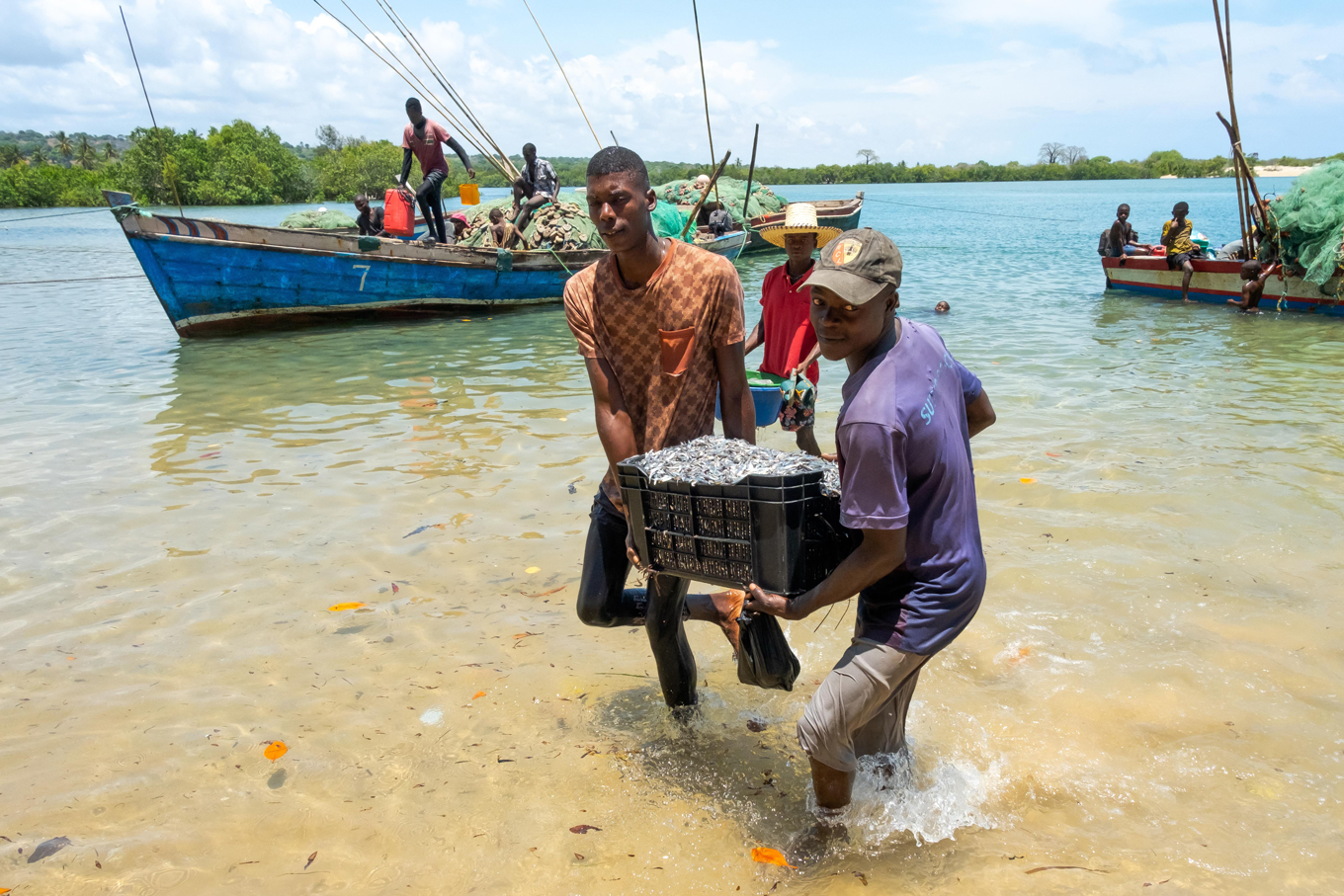
Fishers who regularly work around the anchored FADs have reported significantly improved catches. ©FAO/ Isilda Mabasso
Pemba: In the shimmering blue waters off northern Mozambique’s Cabo Delgado province, where the ocean meets pristine beaches, the sea is both a lifeline and a formidable challenge for local fishers. For Mário Sadique, a 52-year-old fisher from the Mecufi coastal district, the struggle to provide for his twelve children—six of whom, aged three to eight, live with him—has defined his daily life. Divorced and the sole breadwinner, Mário has long depended on the sea for food and income, supplementing his fishing with small-scale farming. Yet, the unpredictable waters, dwindling fish stocks near the shore, and inadequate gear often made his efforts feel like a gamble. Paddling his traditional canoe for two hours to reach deeper waters, he would spend the night fishing for tuna and other species, only to return the next afternoon with as little as a kilo of fish—barely enough to feed his family, let alone sell.
The gruelling routine of shifting locations, guided by instinct and luck, yielded inconsistent results. Bad weather could keep him ashore, and poor catches left him with little to show for his labour. The coastal waters, strained by overfishing, offered slim pickings, making each trip uncertain. However, a pilot project launched by the Food and Agriculture Organization of the United Nations (FAO), in close collaboration with Mozambique’s Ministry of Agriculture, Environment and Fisheries, has introduced a transformative solution for Mário and his community. The initiative deployed eight anchored Fish Aggregating Devices (aFADs) across four communities in Cabo Delgado, designed to attract fish and simplify the search for a reliable catch.
These aFADs, constructed with concrete blocks, chains, buoys, and sustainable organic materials like coconut fronds and rope, work by drawing marine life to a fixed location. Microorganisms and algae cling to the aggregating materials, attracting smaller fish, which in turn lure larger species like tuna. In tropical waters, the shade provided by the devices further entices fish. “The idea of installing aFADs was to enable small-scale fishers to access the abundant tuna stocks offshore, as there is a lot of fishing pressure on the nearshore waters,” said Jon Lansley, a fishery industry officer at FAO. With financial support from the Norwegian Agency for Development Cooperation (NORAD), the project trained sixteen fishers, including Mário, alongside national technicians in constructing and deploying aFADs, as well as new fishing techniques. Basic gear, including lines, hooks, and lures, was distributed to support their efforts.
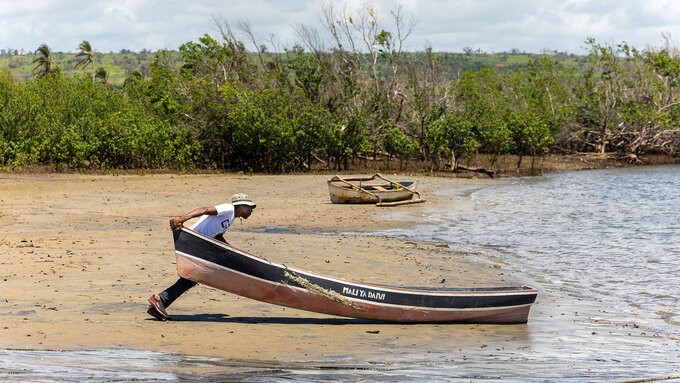
For fisher Mário Sadique, the sea has long been both vitally important and relentlessly challenging. Despite his hard work, his catches were often poor. Anchored Fish Aggregating Devices (aFADs), implemented by FAO and the Government of Mozambique, have helped attract fish, making them easier to catch. ©FAO/ María Legaristi Royo
For Mário, the impact has been life-changing. The aFADs have stabilised his fishing grounds, shortening his trips and boosting his catch from a meagre one to five kilos per outing to an average of 20 kilos. On a good day, he can earn up to MZN 3,000 (USD 47), a significant increase that ensures food on the table and allows him to invest in his children’s education. “With the anchored FADs, I finally knew I wouldn’t return home empty-handed,” Mário said, his voice reflecting relief and gratitude. The larger, more dependable catches—particularly of prized tuna valued by restaurants and hotels in Pemba, the provincial capital—have brought economic stability and improved nutrition not only to Mário’s family but also to over 100 fishers across the four communities who regularly use the aFADs.
The project’s success owes much to the partnership between FAO and the Mozambican Ministry, which has prioritised sustainable fishing to bolster coastal livelihoods. Catch levels remain sustainable, as fishers use small canoes and limit fishing frequency. Despite challenges like extreme weather, such as Cyclone Chido in December 2024, the aFADs have enhanced resilience, helping fishers recover more quickly from such shocks. The initiative’s impact extends beyond individual households, fostering economic stability for fishing communities and contributing to better nutrition across the region. Building on this success, FAO and the Ministry are preparing to deploy more aFADs and distribute 100 additional gear kits to local fishers in 2025. For Mário and his fellow fishers, these simple devices have turned the unpredictable sea into a source of hope, offering not just fish but a brighter future for their families and communities.
Source: The FAO News And Media Office, Rome
– global bihari bureau