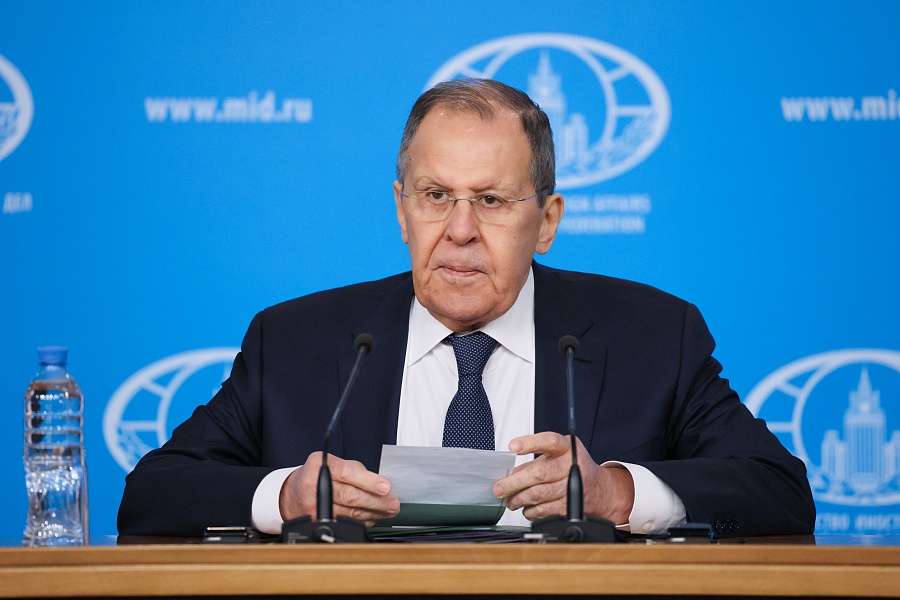
Russian Foreign Minister Sergey Lavrov addressing a press conference in Moscow today.
Lavrov Frames Arctic, Ukraine, and US-Russia Dialogue
Emphasises Multipolarity, Arctic, India and BRICS Role
Moscow: Russia today positioned Greenland as a focal point in broader discussions on Arctic geopolitics, NATO cohesion, and European security. Russian Foreign Minister Sergey Lavrov reviewed Moscow’s stance on Ukraine and the country’s diplomatic relations with the United States in a press conference, highlighting early contacts under US President Donald Trump to restore embassy operations, resolve longstanding diplomatic property disputes, and sustain dialogue. The briefing coincided with ongoing discussions at the World Economic Forum (WEF) in Davos, where Arctic security, European defence architecture, and the cohesion of the North Atlantic Treaty Organization (NATO) have emerged as key themes for transatlantic debate.
Greenland was highlighted as a strategic concern in these broader Arctic deliberations, reflecting its significance for resource access, shipping routes, and regional security. Moscow underscored the importance of dialogue based on sovereignty, equality, and international law, emphasising collaboration with Arctic and Global South partners. European proposals for a security framework excluding the United States but including Ukraine were noted, and Russia stressed the need to balance interests across the region. No discussion of Russian military planning or deployments in Greenland or the Arctic was included in the briefing.
The press conference traced Russia’s post-Soviet experience under a unipolar world order dominated by the United States and Western allies, contrasting it with the emerging multipolar reality. Following the dissolution of the Soviet Union, Western dominance sidelined conventional international law in favour of unilateral rules, while Moscow gradually worked to restore its global role under President Vladimir Putin, respecting historical identity, national sovereignty, and allied partnerships. The rise of alternative centers of global influence—China, India, Brazil, and Africa—was highlighted, alongside the evolution of the Russia–India–China (RIC) framework into the BRICS association, which now includes Brazil, South Africa, India, China, and Russia, and is expanding its multilateral engagement.
India’s role was particularly emphasised, reflecting its chairmanship of BRICS in 2026. The December 2025 visit of President Putin to New Delhi reinforced strategic cooperation across political, economic, and security spheres. Russia framed BRICS and India’s leadership as central to fostering multipolar cooperation, advancing Eurasian security, and promoting dialogue across the continent on principles of equality, mutual respect, and shared economic development.
On Ukraine, Moscow reaffirmed its commitment to a diplomatic resolution while noting persistent obstacles from European and Western actors. According to Lavrov, Western powers have actively encouraged Kyiv since the 2014 coup, creating what Russia describes as a security threat on its western border. Russia supports initiatives from the Trump administration aimed at addressing the root causes of the crisis, including proposals for a ceasefire and the restoration of rights for Russian speakers and the canonical Ukrainian Orthodox Church, which Moscow says are absent from recent European Union-led negotiation drafts.
Relations with the United States were reviewed in detail, focusing on diplomatic normalisation, the resolution of property disputes dating back to the Obama administration, and the establishment of functional embassy operations. Moscow described early contacts under President Trump in 2025 as constructive, with discussions encompassing consular operations, air travel for diplomats, and security arrangements. The situation surrounding the Marinera tanker, seized under international scrutiny with Russian, Ukrainian, Georgian, and Indian crew members aboard, was highlighted as a test of adherence to the United Nations Convention on the Law of the Sea (1982). Russia has requested the release of its citizens, stressing compliance with international law.
The briefing also outlined Russia’s engagement in Eurasian security and economic integration frameworks. Key initiatives include the Commonwealth of Independent States (CIS), Eurasian Economic Union (EAEU), Collective Security Treaty Organisation (CSTO), and Shanghai Cooperation Organisation (SCO). Russia highlighted efforts to establish a pan-continental security architecture through the Greater Eurasian Partnership and ongoing dialogues with European countries on regional stability. Recent multilateral initiatives, such as the Russia–Africa Partnership Forum and the upcoming third Russia–Africa Summit, were cited as part of broader efforts to strengthen international cooperation, along with support for UN resolutions against colonialism and unilateral coercive measures, and the UN Convention on Cybercrime, signed in Hanoi in 2025.
In Europe, Moscow reviewed challenges in transatlantic relations, noting tensions within NATO and the European Union. Lavrov emphasised that European attempts to develop independent security frameworks while excluding the United States reflect ongoing instability and competition. The briefing traced the evolution of post-Soviet Eurasian security architecture, noting the historical limitations of the Organisation for Security and Cooperation in Europe (OSCE), and highlighting engagement with countries such as Hungary and Slovakia that continue to pursue balanced positions.
Russia also addressed developments in the Balkans, including the acquisition of the Serbian company Naftna Industrija Srbije (NIS) by Hungarian firm MOL in cooperation with Russian Gazprom. Moscow described the transaction as mutually beneficial, reiterating its openness to dialogue with the United States and other partners on regional security and economic matters.
Throughout the briefing, Moscow reiterated its principles of sovereignty, equality, mutual respect, and adherence to international law while emphasising the importance of multipolarity and dialogue across Eurasia, Africa, and the Global South. Engagement with the ongoing WEF discussions in Davos and strategic coordination with India, BRICS partners, and other Eurasian actors was highlighted as central to Russia’s foreign policy approach in 2026.
– global bihari bureau