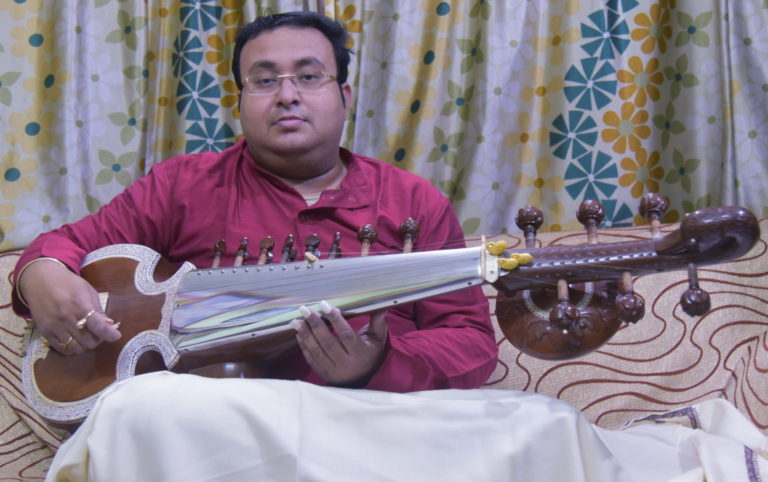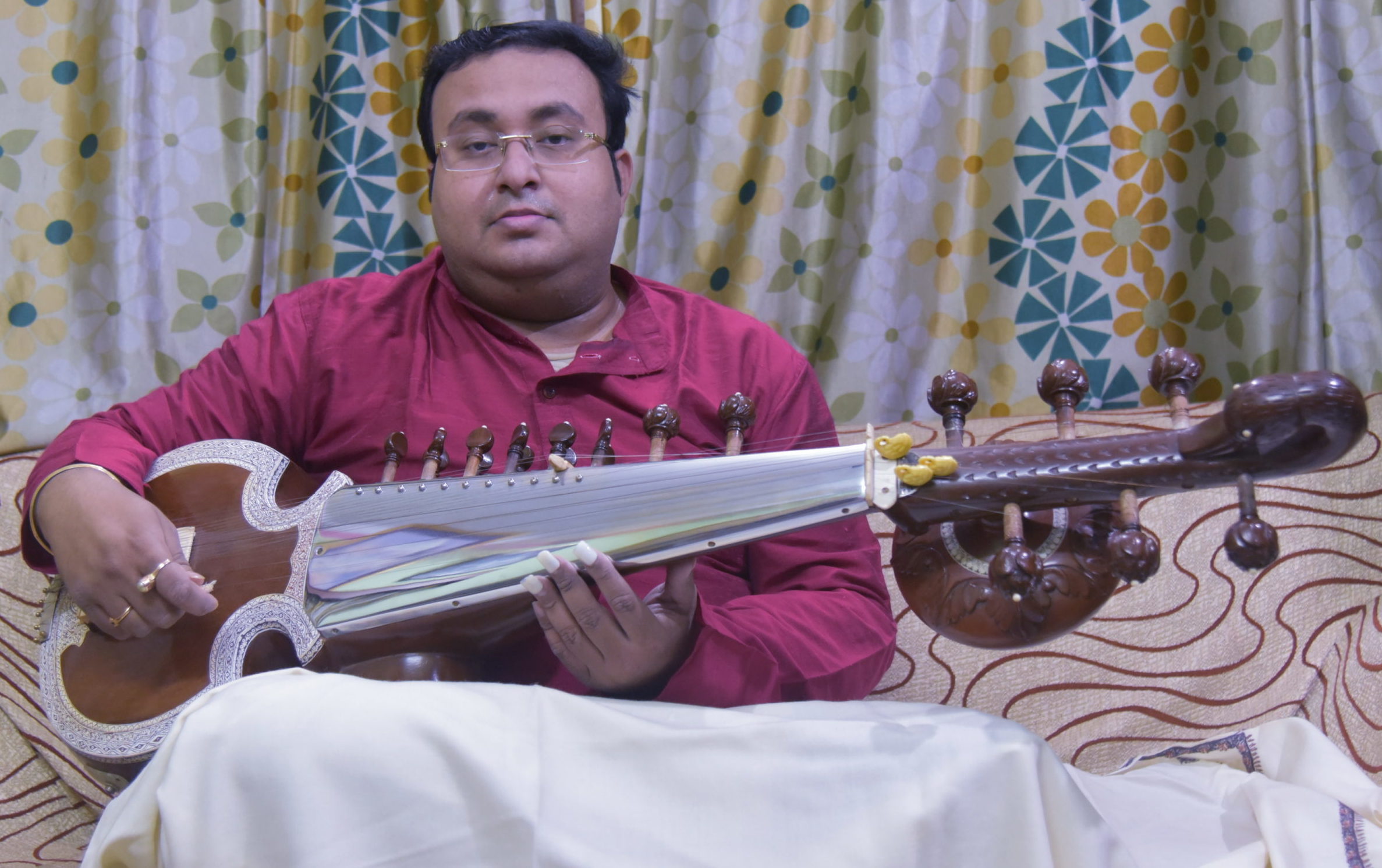
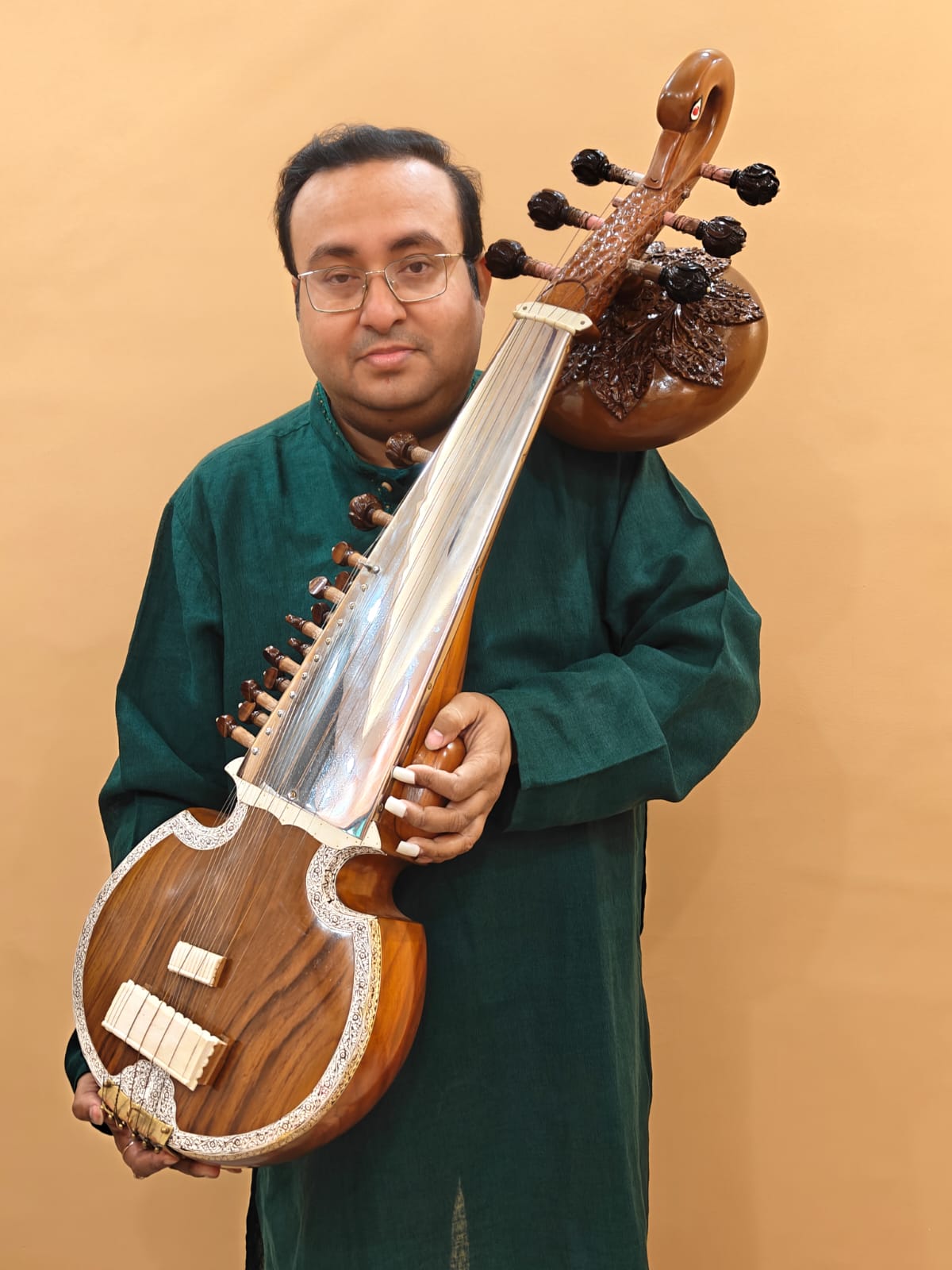
Pandit Joydeep Mukherjee performing with Mohanveena.
 By Sudipta Dey
A 1948 Sound Finally Finds Its Patent
Patent Secures Mohanveena’s Place in History
Kolkata: In June 1948, listeners across India tuned in to a broadcast from All India Radio in New Delhi and heard a sound they had never encountered before. It carried the clarity of the sarod, yet lingered with a deep, contemplative resonance that seemed to echo from a much older musical past. The instrument producing it had been born only weeks earlier, in April of that year, in the hands of the eminent sarod maestro Sangeetacharya Pandit Radhika Mohan Maitra.
Seventy-eight years later, that same instrument—the Mohanveena—has finally received formal recognition in the form of a patent granted in March 2026. The moment marks far more than a legal milestone. It brings into the official record the story of the first musical instrument created in independent India. It closes a long chapter in which an important innovation of Indian classical music existed largely without documentation.
The achievement is the result of a sustained effort led by the acclaimed multi-instrumentalist Pandit Joydeep Mukherjee, a distinguished exponent and torchbearer of the Senia Shahjehanpur Gharana. By securing the patent, Mukherjee has ensured that the instrument conceived by his guru’s lineage now stands protected not only in the concert tradition of Indian music but also in the legal history of innovation.
“This is not just a patent for an instrument,” Pandit Joydeep Mukherjee said while announcing the development. “It is an absolute victory of India’s musical identity.”
The origins of the Mohanveena lie in a musical puzzle that occupied Maitra during the years leading up to India’s independence. Between 1943 and 1948, the sarod maestro began reflecting on a limitation within the instrument he had mastered. The sarod was admired for its tonal precision and rhythmic brilliance, but it did not possess the long, meditative sustain associated with older instruments such as the veena or the sursingar.
Maitra began to ask whether a new instrument could combine the sarod’s expressive agility with the contemplative depth of the ancient “been-baaj” tradition. The search led to years of experimentation, refinement and craftsmanship.
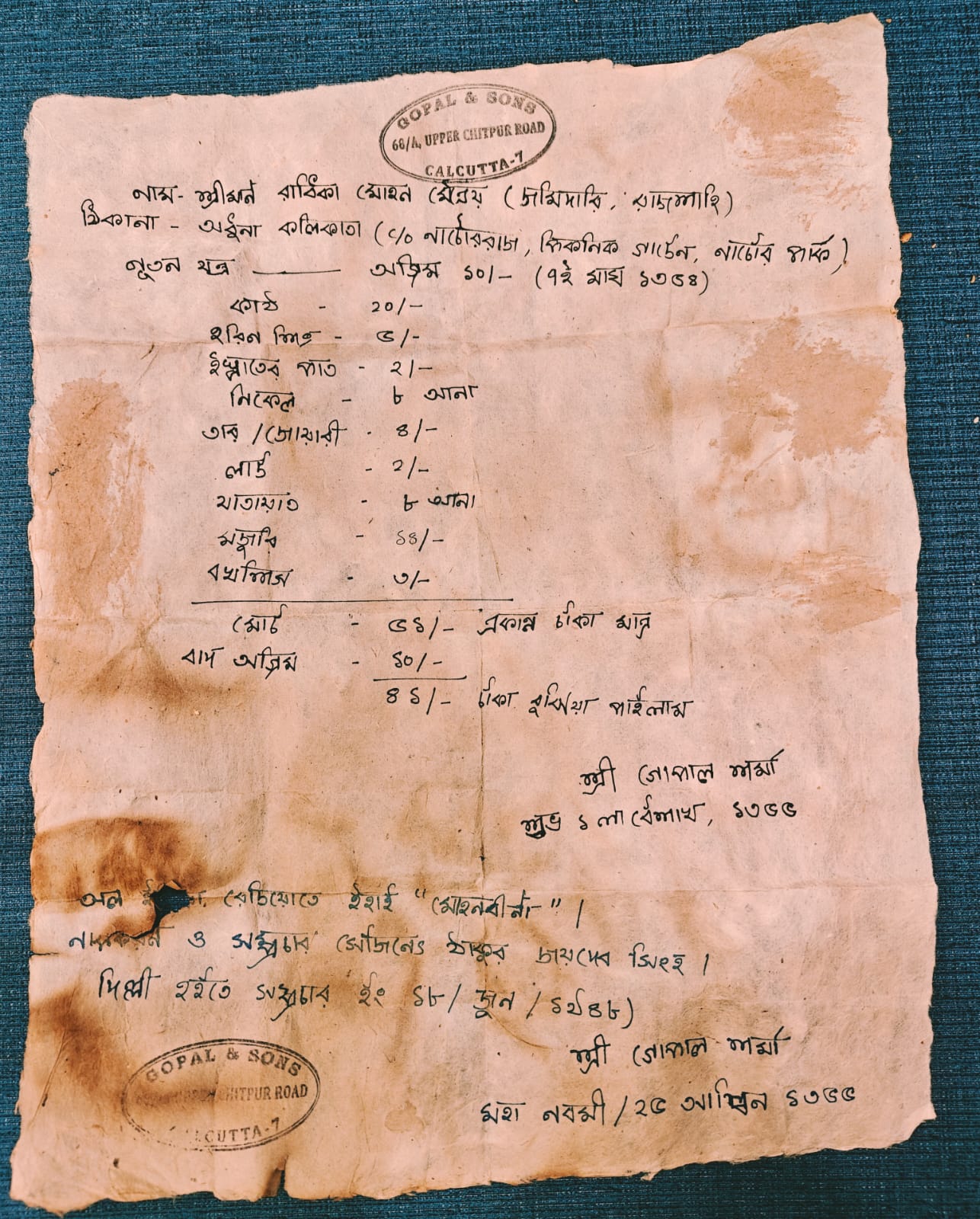
By April 1948, the idea had taken physical form. The instrument that emerged retained the structural logic of the sarod but introduced crucial changes that altered its entire sonic character. In a traditional sarod, the resonating chamber is covered with goat skin, producing the instrument’s characteristic bright metallic tone. Maitra replaced this with a wooden top, softening the attack and allowing the sound to bloom more gradually.
He also adopted a flat bridge design associated with the sursingar and the surbahar, enabling the strings to sustain their vibrations for longer durations. The result was an instrument capable of producing a deep, resonant tone suited to the introspective aesthetics of the veena tradition while retaining the expressive possibilities of the sarod.
When the instrument was introduced to the public through the All India Radio broadcast in June 1948, it immediately stood apart. Thakur Jaidev Singh, then Chief Producer of All India Radio, named it the Mohanveena, drawing from Maitra’s middle name, Radhika Mohan.
Over time, however, the name began to acquire a different association in popular imagination. During the last two to three decades, “Mohanveena” became widely linked with modified slide guitars used in contemporary and fusion music. The original 1948 instrument created by Maitra was something entirely different—a fretless instrument rooted wholly in Indian design, with no structural dependence on Western models.
Despite its originality, the Mohanveena existed for decades without formal intellectual property protection. Within the traditional guru–shishya ecosystem of Indian classical music, innovations have historically been transmitted through lineage rather than documentation. Instruments, techniques and compositions were preserved through performance and pedagogy rather than through patents or legal registration.
Yet as global awareness of intellectual property grew, the absence of formal recognition began to carry risks. Without documentation, the origins of innovations could easily blur, leaving significant contributions vulnerable to misattribution or gradual disappearance from the historical record.
Nearly twenty years ago, this realisation set Pandit Joydeep Mukherjee on a long and meticulous path.
A grand-disciple of Pandit Radhika Mohan Maitra and an accomplished performer on several instruments, Mukherjee recognised that preserving his guru’s legacy demanded more than continuing the musical tradition. It required reconstructing the historical and technical foundations of the instruments themselves.
The work involved extensive archival research, detailed documentation of structural features and careful translation of decades of artistic practice into the precise language required for patent law. The process was slow and exacting, but it gradually began to yield results.
Along the way, Mukherjee’s efforts also drew attention to several rare instruments associated with the Senia Shahjehanpur lineage that had nearly vanished from contemporary performance. Instruments such as the Seni Rabab, the Sursingar and the Sur-Rabab began to reappear in discussions about India’s musical heritage, reminding musicians and scholars alike of the richness of forgotten sonic traditions.
The revival of these instruments also received national attention. In 2023, Prime Minister Narendra Modi publicly appreciated the work being done to restore rare classical instruments, recognising the broader cultural importance of such initiatives.
Formal legal recognition soon followed. In December 2025, two other instruments created by Maitra—the Dil Bahar and the Nabadeepa—were granted patents. Those milestones prepared the ground for the most significant recognition yet.
In March 2026, the Mohanveena itself was finally granted a patent, formally acknowledging it as an original instrument conceived in the earliest years of independent India.
“This is not just a patent for an instrument,” Pandit Joydeep Mukherjee said while announcing the development. “It is an absolute victory of India’s musical identity.”
The statement reflects the deeper meaning of the moment. The Mohanveena’s journey—from a creative experiment in the 1940s to a formally recognised instrument in the twenty-first century—illustrates how tradition and innovation have always coexisted within Indian classical music.
For seventy-eight years, the instrument’s voice travelled through performances, students and recordings, sustained by memory rather than documentation. With the patent now secured, that sound has also entered the official archive of India’s creative history.
In doing so, Mohanveena’s long echo has finally found its signature.