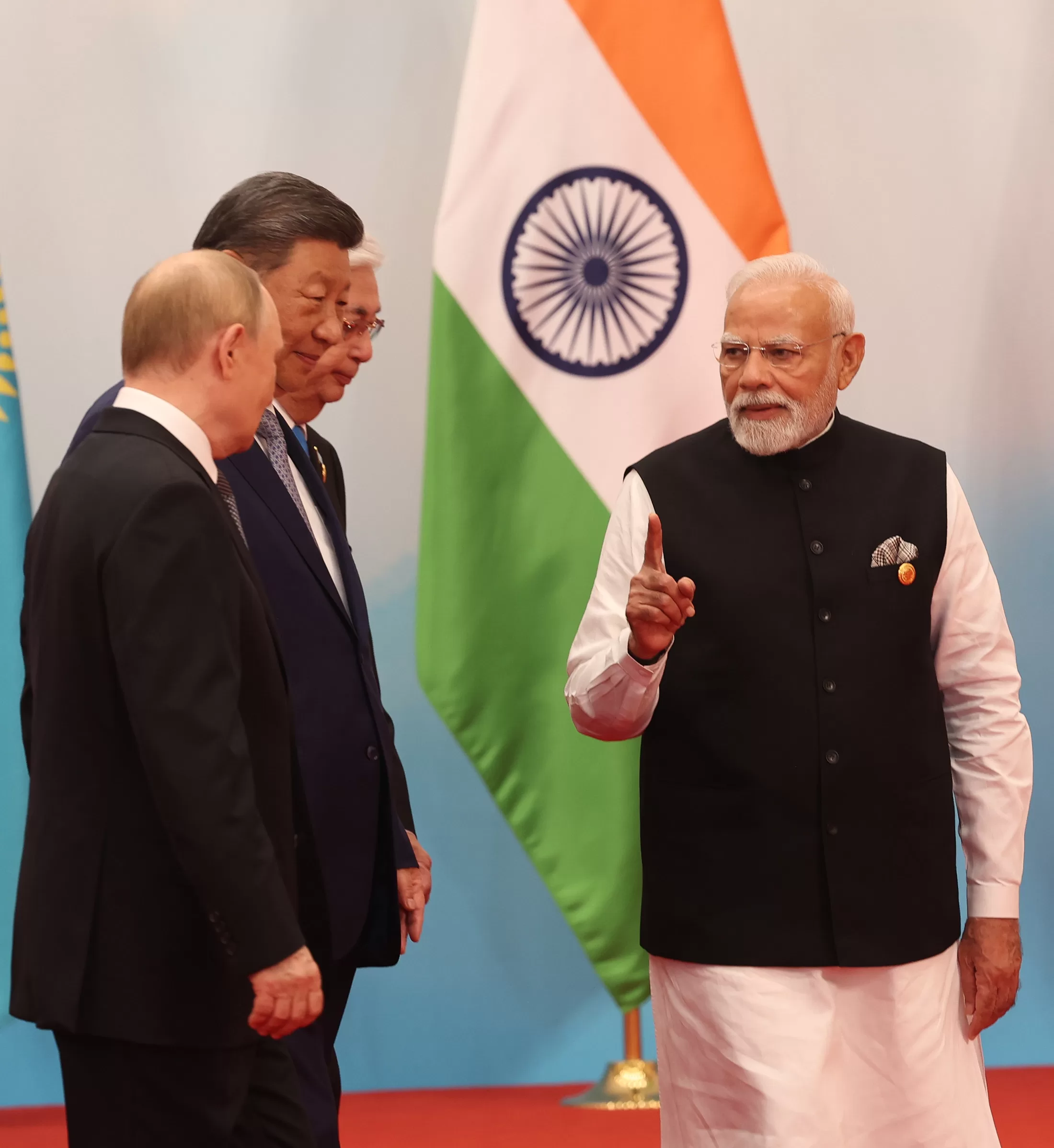
Indian Prime Minister Narendra Modi with Presidents Kassym-Jomart Tokayev of Kazakhstan, Xi Jinping of China and Vladimir Putin of Russia at the SCO Summit 2025 in Tianjin, China on September 01, 2025.
Tianjin Pact Backs India’s Terror Fight
Tianjin: India scored a diplomatic triumph at the Tianjin SCO Summit, ending September 1, 2025, as the Tianjin Declaration condemned the April 22, 2025, Pahalgam terror attack—attributed to Pakistan-based groups—overcoming the Qingdao meeting’s failure to acknowledge it.
This condemnation, achieved despite Pakistan’s presence, contrasts with the June 2025 Qingdao Defence Ministers’ Meeting, where India’s rejection of a draft omitting Pahalgam exposed challenges to the SCO’s commitment to countering terrorism, separatism, and extremism, as seen in the 2017 Astana Summit’s SCO Convention on Countering Extremism, the 2022 Samarkand Summit’s resolution on emerging threats, and the Tashkent-based Regional Anti-Terrorist Structure (RATS) coordinating intelligence and operations.
At Qingdao, aimed at bolstering SCO security cooperation, India’s Defence Minister Rajnath Singh refused to endorse a draft statement that ignored the Pahalgam attack while citing terrorist activities in Pakistan’s Balochistan, highlighting difficulties in aligning on terrorism. The Tianjin Declaration’s explicit mention of Pahalgam marks a correction, securing consensus among all members, including Pakistan. Yet, India-Pakistan geopolitical tensions suggest aligning on terrorism remains complex.
At Tianjin, Indian Prime Minister Narendra Modi declared, “Terrorism is not only a threat to the security of individual nations, but a shared challenge to all of humanity.” Reflecting on India’s “four decades of enduring the grave scars of ruthless terrorism,” he called the Pahalgam attack “the most heinous face of terrorism” and an “assault on the conscience of India,” thanking friendly nations for solidarity. Modi asked, “Can the open support for terrorism by certain countries ever be acceptable to us?” and urged, “We must state it clearly and in one voice: double standards on terrorism are unacceptable.” He lauded the SCO-RATS (Regional Anti-Terrorist Structure of the Shanghai Cooperation Organisation), noting India’s role in countering Al-Qaeda affiliates and proposing stronger measures against radicalisation and terror financing.
Interestingly, Pakistan welcomed the Tianjin Declaration, with Prime Minister Shehbaz Sharif noting it reinforces Pakistan’s stance on terrorism and reflects its diplomatic push for unified action without double standards.
Significant talks on border security at Tianjin stressed sovereignty and territorial integrity in connectivity projects to foster trust and curb regional instability, per the SCO Charter.
Chinese President Xi Jinping called for a “vision for common security” to “contribute to safeguarding world peace and stability.” “History tells us that at difficult times, we must uphold our original commitment to peaceful coexistence, strengthen our confidence in win-win cooperation, advance in line with the trend of history, and thrive in keeping pace with the times,” he said.
Xi cited the Treaty on Long-Term Good-Neighbourliness, Friendship and Cooperation and new bodies like the SCO Universal Centre for Countering Security Challenges and Threats and the SCO Anti-drug Centre to build a “community of common security” while upholding “non-alliance, non-confrontation and not targeting any third party.”
The 25th Council of Heads of State meeting, held August 31 to September 1, tackled the SCO Development Strategy up to 2035, global governance reform, counter-terrorism, peace, security, economic cooperation, and sustainable development. Modi outlined India’s SCO approach through three pillars: Security, emphasizing unity against terrorism and India’s efforts against radicalization; Connectivity, backing Chabahar Port and the International North-South Transport Corridor while stating that “connectivity that by-passes sovereignty loses both trust and meaning”; and Opportunity, proposing a Civilizational Dialogue Forum to share cultural heritage, building on India’s 2023 presidency initiatives in startups, innovation, traditional medicine, youth empowerment, digital inclusion, and Buddhist heritage.
Xi launched the Global Governance Initiative (GGI) to address global turbulence, proposing five principles: sovereign equality for all nations, international rule of law based on the UN Charter without double standards, true multilateralism through consultation and shared benefits, a people-centred approach to governance reform, and action-oriented cooperation for visible outcomes. He positioned the SCO, guided by the Shanghai Spirit of mutual trust, equality, and common development, as a catalyst for global governance reform.
Economically, Xi urged open cooperation, leveraging the energy resources and markets of SCO members for high-quality Belt and Road initiatives and inclusive globalisation. China pledged market access, platforms for energy, green industry, and digital economy cooperation, and centres for innovation, higher education, and vocational training, including 10 million kilowatts each of photovoltaic and wind power, an AI cooperation centre, Beidou Satellite access, and participation in the International Lunar Research Station.
Culturally, Xi emphasised exchanges, with China hosting the SCO Political Parties Forum, Green and Sustainable Development Forum, and Traditional Medicine Forum, plus medical aid for 500 heart disease patients, 5,000 cataract operations, and 10,000 cancer screenings over five years. On fairness, he advocated opposing hegemonism, practising multilateralism, and expanding SCO ties with the UN, ASEAN, Eurasian Economic Union, and CICA.
Modi welcomed new SCO centres for organised crime, drug trafficking, and cybersecurity, and called for UN reform on its 80th anniversary, stating, “To confine the aspirations of the Global South to outdated frameworks is to deny justice to future generations.” He invited partners to join India’s “Reform, Perform, and Transform” journey, marked Uzbekistan’s and Kyrgyzstan’s national days, thanked Xi for his hospitality, and wished Kyrgyzstan’s President Japarov success as the next SCO Chairman.
The Tianjin Declaration also authorised the SCO Secretariat to prepare a concept for the establishment of the SCO Development Bank, aiming to enhance financial cooperation among member states.
On sustainable development, the declaration included initiatives on environmental protection and clean energy, such as the Roadmap for Implementing the SCO Energy Cooperation Strategy until 2030 and the SCO Initiative “On Sustainable Development,” aligning with Xi’s commitments to green industry and renewable energy projects. The declaration supported UN reform and opposed unilateralism, echoing Modi’s call for updating global institutions to represent the Global South and Xi’s criticism of hegemonism and power politics, implicitly targeting actions by the US and Israel.
Reaffirming the Shanghai Spirit, the declaration approved structural changes, including the Decision on SCO Partnership Status, which merges observer and dialogue partner categories into a unified partnership framework to streamline engagement with non-member states.
The declaration’s geopolitical critiques included strong condemnation of the civilian toll in Gaza and the June 2025 Israeli and US military aggression against Iran, labelling such actions as violations of international law, while notably omitting any reference to the Ukraine crisis, despite discussions in leaders’ speeches.
– global bihari bureau