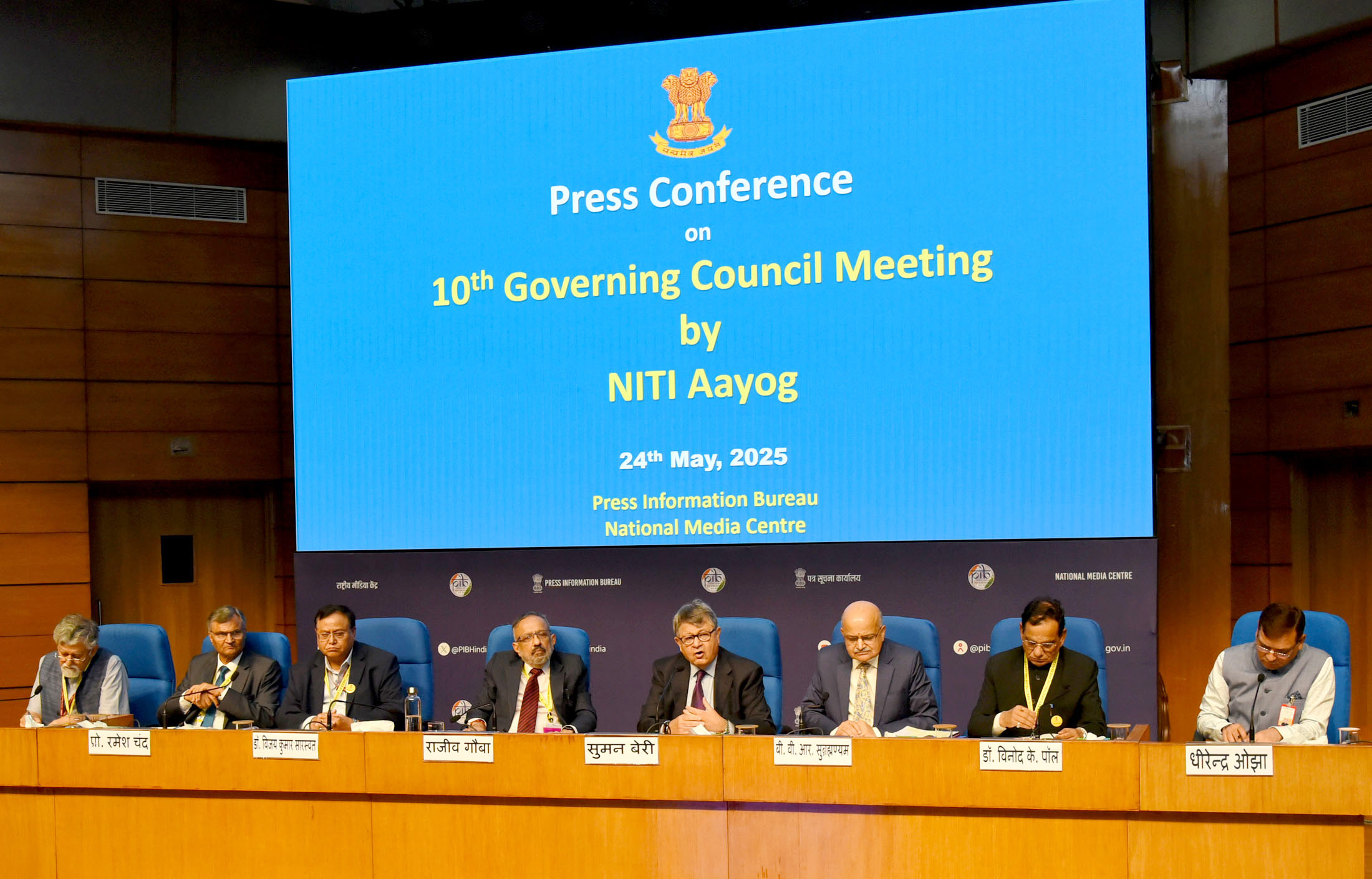
The Vice Chairman, Niti Aayog, Suman K Bery, addressing a press conference on the 10th Governing Council Meeting of NITI Aayog at National Media Centre, in New Delhi on May 24, 2025.
New Delhi: A NITI Aayog meeting chaired by Prime Minister Narendra Modi today placed a sharp focus on harnessing global investment to propel India’s economic transformation.
To capitalise on global investor interest, Modi directed NITI Aayog to develop an Investment-friendly Charter to simplify regulations and attract both domestic and foreign capital. Citing recent trade agreements with the United Arab Emirates, the United Kingdom, and Australia, he urged states to optimise these opportunities to boost local economies.
Beyond investment, the Prime Minister emphasised skilling youth for emerging sectors like AI, semiconductors, and 3D printing, supported by a Rs 60,000 crore skilling scheme. He envisioned India as the Skill Capital of the World, leveraging its demographic dividend through modern training infrastructure and rural skill hubs.
Modi also called for states to develop at least one global-standard tourist destination, building on the G20 Summit’s success in establishing India as a global tourism hub. Such initiatives, he noted, would attract investment while creating jobs. Sustainable urbanisation was another priority, with a Rs 1 lakh crore Urban Challenge Fund announced to drive planned growth in Tier 2 and Tier 3 cities. The Prime Minister advocated for reforms to empower Nari Shakti, urging changes in the public and private sectors to enhance women’s workforce participation.
The 10th Governing Council Meeting, held at Bharat Mandapam, brought together representatives from 24 States and 7 Union Territories under the theme Viksit Rajya for Viksit Bharat @ 2047. With global investors increasingly drawn to India’s potential, Modi urged states to seize this moment, streamline processes, and position themselves as competitive hubs for capital inflow. The meeting, which began with a minute of silence for the victims of the Pahalgam terrorist attack, set an ambitious tone for collaborative growth to achieve a developed India by 2047.
The Prime Minister emphasised that Viksit Bharat is the collective aspiration of 140 crore Indians, transcending political agendas. He called for every state, district, and village to align with this vision, asserting that unified efforts could realise a developed India well before 2047. Highlighting India’s ascent among the world’s top five economies and the escape of 25 crore people from poverty, Modi stressed the need to accelerate this transformation. He encouraged states to leverage their manufacturing strengths, noting the Government of India’s Manufacturing Mission as a key enabler.
Water management featured prominently, with Modi encouraging states to create river grids to address scarcity and floods, praising Bihar’s Kosi-Mochi connection grid as a model. He also lauded the Aspirational Districts Programme for its success through collective efforts. In agriculture, the Viksit Krishi Sankalp Abhiyan was highlighted, with 2,500 scientists set to promote crop diversification and chemical-free farming in villages. On health, Modi stressed expanding telemedicine and E-Sanjeevani services to connect district hospitals with expert doctors, while ensuring preparedness for future challenges like COVID-19.
The Prime Minister also underscored the need for sustained civil defence preparedness, citing Operation Sindoor as a model for long-term action rather than a one-off effort. Chief Ministers and Lt. Governors praised the operation’s precision and the Armed Forces’ valour, alongside India’s strides in Aatmanirbharta in defence. States shared their Vision for 2047, offering insights on agriculture, education, entrepreneurship, digitalisation, and cybersecurity.
Modi directed NITI Aayog to study these suggestions, describing the meeting as a milestone in its decade-long journey. He expressed gratitude to participants, emphasising that cooperative federalism will drive India toward Viksit Bharat (Developed India).
– global bihari bureau