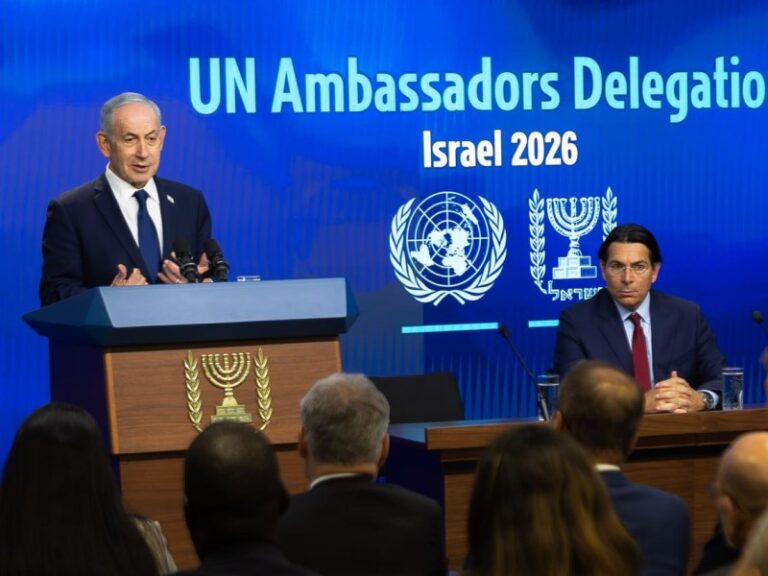
Israeli Prime Minister Benjamin Netanyahu, today, with a delegation of UN ambassadors, together with Israeli Ambassador to the US Danny Danon, at the Prime Minister’s Office in Jerusalem.
From Defence Ties to FTAs: India’s West Asia Reset
Israel Visit Signals Integrated Economic–Security Push
New Delhi: As India simultaneously opens trade negotiations with Israel and the Gulf bloc, Prime Minister Narendra Modi’s State visit to Israel on February 25–26 signals a recalibration of New Delhi’s engagement with West Asia—one in which strategic cooperation in security and technology is being deliberately aligned with a rapidly expanding architecture of economic agreements. This will be the Prime Minister’s second visit to Israel and comes at a moment when regional instability and global supply chain disruptions have sharpened India’s search for more institutionalised and diversified partnerships. The visit, at the invitation of Israeli Prime Minister Benjamin Netanyahu, is being framed by both sides as part of a shared vision for a robust partnership between two democracies confronting converging geopolitical and economic challenges.
During his meetings with Netanyahu, the two leaders will review progress in the India–Israel Strategic Partnership and explore cooperation in science and technology, innovation, defence and security, agriculture, water management, trade and the broader economy, alongside people-to-people exchanges. They are also expected to exchange perspectives on regional and global developments of mutual interest, reflecting shared concerns over instability in West Asia and the pressures reshaping international alignments. The Prime Minister will also call on Israel’s President Isaac Herzog, underlining the political and symbolic character of the visit as one between two democracies seeking to reposition cooperation in a changing international order.
Ahead of the visit, Netanyahu has described Modi’s arrival as historic and has highlighted the personal rapport between the two leaders as a catalyst for expanding ties. He has situated the India–Israel relationship within a wider regional arc that links India with Mediterranean partners such as Greece and Cyprus, alongside Arab and African countries, as part of an emerging network of cooperation aimed at strengthening strategic resilience and countering instability. This framing suggests that Israel increasingly views India not merely as a bilateral partner, but as a central pillar in a broader alignment integrating security, technology and economic collaboration across West Asia and its adjoining regions.
The visit coincides with the first round of negotiations for an India–Israel Free Trade Agreement (FTA), which began in New Delhi on February 23 and continues through February 26. The Terms of Reference for the talks were signed in November 2025, establishing a structured framework for expanding trade and economic cooperation. Bilateral merchandise trade stood at USD 3.62 billion in FY 2024–25, and officials from both sides have described the proposed agreement as a mechanism for providing predictability and certainty to businesses, including micro, small and medium enterprises, while encouraging deeper investment and technology linkages.
Technical experts from India and Israel are engaged in detailed discussions covering trade in goods and services, rules of origin, sanitary and phytosanitary measures, technical barriers to trade, customs procedures and trade facilitation, and intellectual property rights. Commerce Secretary Rajesh Agrawal has characterised the timing of negotiations as especially significant in the context of the Prime Minister’s visit and has pointed to innovation, artificial intelligence, cybersecurity, high-tech manufacturing, agriculture and services as areas of strong complementarity. India’s chief negotiator Ajay Bhadoo, has stressed the importance of crafting a balanced and forward-looking framework suited to an evolving partnership, while Israel’s chief negotiator, Yifat Alon Perel, has emphasised the potential of the agreement to strengthen supply chains, deepen cooperation and open new markets for both economies.
Running parallel to the Israel track, India has formally launched negotiations for a comprehensive Free Trade Agreement with the Gulf Cooperation Council (GCC) through a Joint Statement signed in New Delhi between Union Commerce and Industry Minister Piyush Goyal and GCC Secretary General Jasem Mohamed Albudaiwi. The Joint Statement follows the adoption of the Terms of Reference earlier this month and signals an effort to anchor India’s economic engagement with one of its most significant trading regions in a long-term, rules-based arrangement.
The GCC remains India’s largest trading partner bloc, with bilateral trade reaching USD 178.56 billion in FY 2024–25, accounting for 15.42 per cent of India’s global trade and registering an average annual growth rate of 15.3 per cent over the past five years. India’s principal exports to the region include engineering goods, rice, textiles, machinery and gems and jewellery, while imports are dominated by crude oil, Liquefied Natural Gas (LNG), petrochemicals and precious metals such as gold. Collectively, the GCC countries represent a market of 61.5 million people with a combined Gross Domestic Product (GDP) of about United States Dollar (USD) 2.3 trillion. The region is also a major source of foreign direct investment for India, with cumulative inflows exceeding USD 31.14 billion as of September 2025.
These parallel negotiations with Israel and the Gulf bloc are unfolding within a broader reorientation of India’s trade diplomacy, where free trade agreements are being positioned not merely as commercial instruments but as strategic tools to stabilise supply chains, widen market access and anchor long-term partnerships in an uncertain global environment. The scale and speed of this outreach were underscored the same day by Union Commerce and Industry Minister Piyush Goyal, who linked the West Asia initiatives to a rapidly expanding architecture of agreements shaping India’s external economic engagement.
This twin-track diplomacy with Israel and the GCC is being pursued within a wider acceleration of India’s FTA outreach. Addressing industry leaders at a national exports summit, Goyal said India is building “bridges of trade, trust and transformation” at a time of global uncertainty and now enjoys preferential access to nearly two-thirds of global trade through a series of agreements concluded in recent years. He noted that all nine FTAs signed so far have been with developed economies that complement, rather than compete with, India’s growth trajectory, reflecting what he described as the governing philosophy of “reform, perform and transform”.
Goyal highlighted the speed and scale of current trade diplomacy, pointing out that within a short span India had launched FTA talks with the GCC, advanced negotiations with Israel and prepared for discussions with Chile on a new-generation agreement aimed at securing access to critical minerals. He also indicated that Canada’s Prime Minister is expected to visit India shortly, with both sides hopeful of finalising the Terms of Reference and launching FTA negotiations. He described this expanding network of agreements as part of India’s strategy to de-risk its economy through diversified trade partnerships.
The Minister said early results of this approach were already visible, noting that merchandise trade with Australia and the United Arab Emirates has doubled since the signing of FTAs with those countries. He also linked the trade strategy with the recently launched Export Promotion Mission, which seeks to support MSMEs by improving access to credit, reducing operational costs, helping them meet international compliance standards and enabling entry into demanding markets such as the European Union and other developed economies.
Goyal outlined a four-point roadmap to transform India’s export journey: taking FTAs to the grassroots through wider dissemination and training so that clusters, districts and factory floors understand how to use tariff benefits; making quality non-negotiable, with standards treated as gateways rather than barriers in line with the Prime Minister’s “Zero Defect, Zero Effect” vision; moving steadily up the value chain from raw materials to branded and high-technology products; and building local export ecosystems by encouraging large firms and industry associations to mentor Micro, Small & Medium Enterprises (MSMEs) and develop backward linkages in districts and smaller towns.
Describing India’s export story as one of confidence, resilience and aspiration, Goyal said it belongs to 140 crore Indians and to the millions of MSMEs spread across professions and regions, from traditional artisans to modern entrepreneurs. High quality and productivity, he argued, are indispensable for sustained competitiveness and for establishing India as a leading exporting nation.
Read together, the Prime Minister’s second visit to Israel, the launch of FTA negotiations with both Israel and the GCC, and the broader export strategy articulated by the Commerce Minister point to a recalibration of India’s West Asia and global trade policy. Strategic cooperation in defence, security and technology is being matched with trade architecture designed to stabilise supply chains, diversify markets and institutionalise partnerships. Rather than isolated diplomatic engagements, the simultaneous political and economic initiatives suggest an integrated strategy in which dialogue, commerce and people-to-people ties are being woven into a single forward-looking framework for India’s engagement with West Asia and the wider world.
– global bihari bureau